
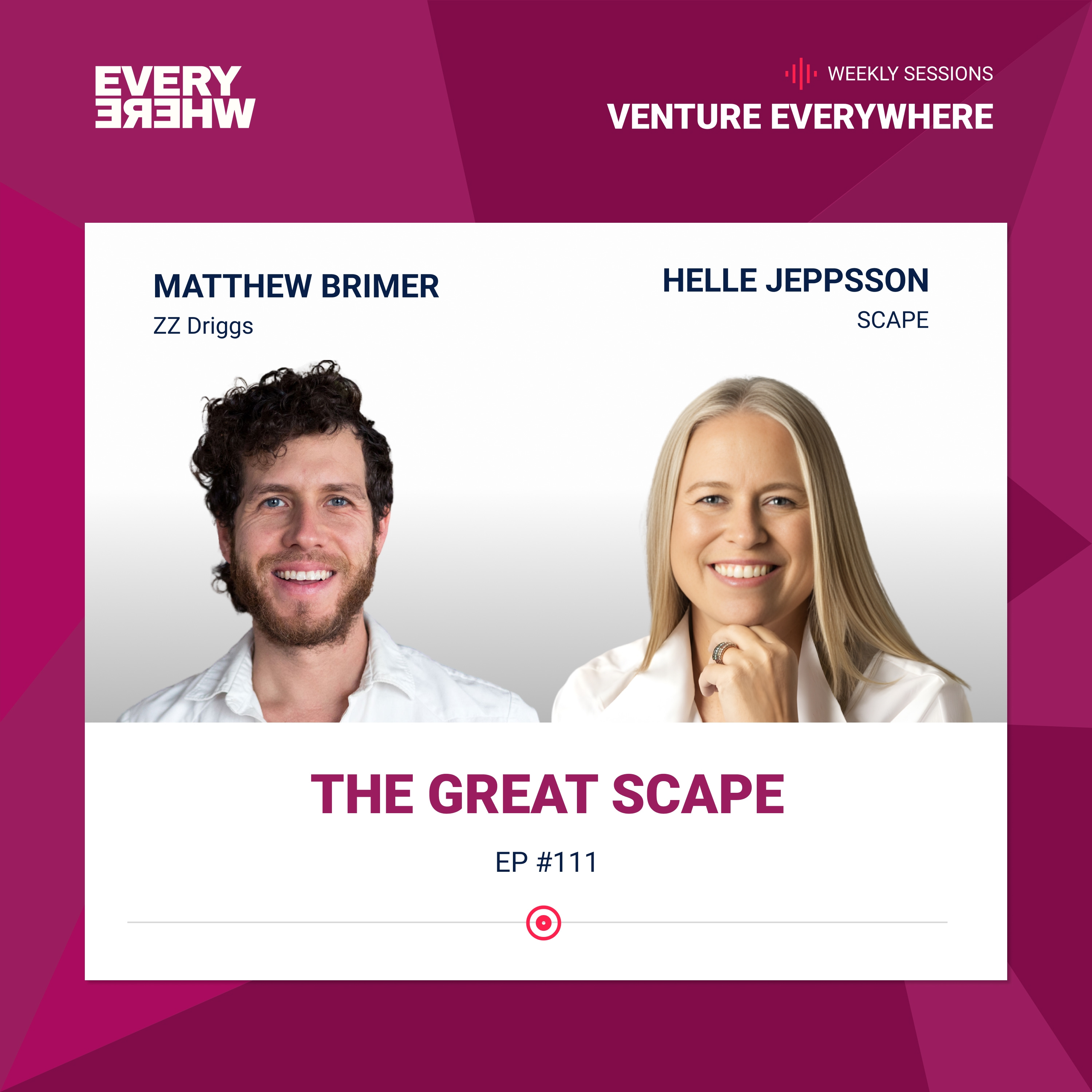
In episode 111 of Venture Everywhere, the host is Matthew Brimer, co-founder of Everywhere Ventures and co-founder of ZZ Driggs, a furniture and design company serving the real estate and hospitality industry. He talks with Helle Jeppsson, co-founder and CEO of SCAPE, a wellness tech platform delivering on-demand spa services across Latin America. Helle shares her path from opening physical spas in the U.S. and Mexico to building an alternative after COVID exposed how hard it is to make brick-and-mortar wellness scale. She discusses how SCAPE pivoted from a B2C consumer brand into a white-label spa product for hotels and businesses, converting a traditional loss-center amenity into a profit center for properties that can’t justify the overhead of a full spa operation.
In this episode, you will hear:
Building on-demand wellness infrastructure across Latin America.
Pivoting from B2C to B2B after spotting organic demand from the hotel industry.
Using consumer brand recognition to break into corporate wellness.
Creating better work conditions and higher earnings for women therapists in Latin America.
If you liked this episode, please give us a rating wherever you found us. To learn more about our work, visit Everywhere.vc and subscribe to our Founders Everywhere Substack. You can also follow us on YouTube, LinkedIn and Twitter for regular updates and news.
TRANSCRIPT
00:00:04 VO: Everywhere Podcast Network.
00:00:14 Jenny Fielding: Hi, and welcome to the Everywhere podcast. We’re a global community of founders and operators who’ve come together to support the next generation of builders. So the premise of the podcast is just that, founders interviewing other founders about the trials and tribulations of building a company. Hope you enjoy the episode.
00:00:32 Matthew: Hello, everyone, and welcome to the Venture Everywhere podcast. We have the latest episode here for you. My name is Matthew Brimer. I am a serial entrepreneur and also co-founder of Everywhere Ventures, who produces this podcast.
00:00:46 Matthew: I’m here with the amazing Helle Jeppsson. I’m excited for this conversation as two founders getting into the weeds and sharing what life and work is like on the front lines.
00:00:55 Matthew: I won’t go too long on my own background, but just a little bit of context. Serial entrepreneur, real estate developer, investor, designer, community builder. I’m probably curious about too many things, but it has navigated my career in interesting ways.
00:01:09 Matthew: Currently the co-founder of a furniture and design company that works with the real estate and hospitality industry called ZZ Driggs. Also co-founded a company called Special Address, which is a boutique luxury hospitality brand with short-term stay properties in upstate New York and the island of Jamaica.
00:01:23 Matthew: Prior to all of that, co-founded a global education company called General Assembly. And also along the way, after coming back from Burning Man about 14 years ago or something like that, was inspired to start something called Daybreaker, which is a completely sober early morning dance party and wellness movement that has spread around the world.
00:01:41 Matthew: But today we are here. Helle is the co-founder and CEO of SCAPE, which is the leader of wellness on-demand experiences in Latin America.
00:01:51 Helle: Hi, thank you, Matthew. I think your background is so interesting. I read your bio. I was like, it must be five of you to have done all of that. But thank you for the interview.
00:02:03 Helle: So I’m Helle Jeppsson. As you mentioned, I co-founded SCAPE, which is a wellness tech platform in Latin America. Before that… I’m Swedish background, but lived in Mexico for 13 years. I started in the wellness industry about 17 years ago, opening physical spas in the U.S.
00:02:22 Helle: So I’ve been in the industry for quite some years and done a lot of different things. Worked in corporate for many years, but now focusing on growing SCAPE.
00:02:31 Matthew: Take yourself back to being in corporate world. What made you decide to leave the whole thing? What was the need or the passion or the driver for you to say, I’m going to start my own thing?
00:02:42 Helle: I’ve had two moments of change in that sense. The first one was I worked in D.C. I worked at the World Bank and took a step leaving the World Bank to pursue starting a spa company. So it was quite a big leap and at an early age also.
00:02:59 Helle: What made it happen was that my dream was actually to work within development. But a lot of times you have these ideals of what you think work is going to look like. I was doing both things at the same time.
00:03:12 Helle: One morning I just woke up and said, “When I wake up in the morning, when I do startup versus when the morning I wake up, when I have to go to the World Bank, I’m so much happier doing startup.” But in the end, life is short. So you have to pursue what makes you happy, really. It all boils down to that.
00:03:31 Helle: And then I did it again. I worked as the CEO of a very large European company in Mexico and had worked very hard to get there. I think also for a woman in Latin America, it’s not as easy to get jobs at that level. And then the idea of SCAPE started and I did it again. I jumped up, but I haven’t regretted it.
00:03:52 Matthew: So multiple corporate escapes to start things.
00:03:56 Helle: I’m interested to hear about you also, how you’ve been changing so many times. How have you done so many different things?
00:04:04 Matthew: Like you, I think fulfillment and the level of happiness and pursuing this thing called purpose, it can never be totally defined, we’re all chasing it and seeking it and wanting to align with a lot. I think that has always been such a big driver for me. My whole career thus far, at least I’ve managed to avoid doing the corporate thing.
00:04:23 Matthew: I went to Yale for undergrad. And so my junior year, I started this social gaming startup with a few Yale friends, and it was called GoCrossCampus. This was 2007. We started right before even the first iPhone came out.
00:04:36 Matthew: And so we were building these massively multiplayer online social casual games where we were enabling students to play out their school rivalries, whether between residential colleges at Yale or between the whole Ivy League buying these online games, the main one being Risk.
00:04:53 Matthew: So imagine the board game Risk, and instead of a map of the world, you’re trying to take over your college campus. All the Ivy League students trying to take over New England.
00:05:02 Matthew: And so then we expanded to a whole bunch of different sports divisions and basically just leveraged college rivalries and other affinity groups eventually to create these fun team-based online game experiences.
00:05:13 Matthew: That was my first startup. That was in college, doing the entrepreneurial thing while also being a Yale student, getting a degree in sociology and all of it. So it was a very interesting extracurricular.
00:05:22 Matthew: And this is a time when entrepreneurship and being a founder was not common for college students. Right now, it’s very common. It’s every student’s dream. But this was a more limited set of us who were doing this thing.
00:05:35 Helle: It’s a different world. Yesterday, I was with my daughters. It was Women’s Day. So it was… Lovable, the Swedish app, that platform that you can build. So yesterday, my two daughters built their first company. Today I think the world has changed in that sense.
00:05:50 Matthew: Totally. There was no Claude Code in 2007 to just one-shot an app into existence. It was a lot more effort. So coming out of Yale, senior year the next year, and all my friends were applying to all different jobs. a lot of people doing the corporate thing or the non-profit thing or grad school.
00:06:09 Matthew: But I was like, “Okay, I have this startup that I co-founded.” We raised some money as well. So great. I’m going to graduate and go to work as a full-time co-founder of my own startup. That sounds great. I can avoid the corporate thing altogether.
00:06:19 Matthew: But then basically we ran out of cash. We couldn’t raise any more money. We could never figure out how to really generate any revenue, which apparently is important for running a business, so they say.
00:06:29 Matthew: So all of this is happening right when I was graduating. And so we shut the company down the summer 2009 when I graduated. And I was like, “Well, okay, that full-time entrepreneur thing, now that opportunity is no longer. It evaporated. So what am I going to do?”
00:06:42 Matthew: But I moved to New York and was bringing income by doing just freelance web design, web development and just threw myself and immerse myself into the startup and tech ecosystem in New York in 2009 through 2010, which was this underdog rag tag, but burgeoning and exciting ecosystem to be in.
00:07:00 Matthew: And then out of that, ended up starting General Assembly. And we can get more into the tales from there. But it was just following my nose in a way, which maybe you can relate to.
00:07:08 Helle: I lived in New York the same year. So we might have crossed each other.
00:07:12 Matthew: Were you ever at General Assembly in those early years?
00:07:15 Helle: I don’t know, maybe. But I lived there for six years.
00:07:21 Matthew: I’m curious, how has it been being from Sweden, living in Mexico and building a company there for Latin America, but being an expat? I’m sure that’s got to be challenging. But does it give you a fresh perspective that natives don’t get or how has that been?
00:07:35 Helle: The thing is that in my case, I’m half Swedish, half Norwegian, but most of my childhood, I grew up in Spain. So I have the language barrier, which I think it’s usually one of the big barriers when you move to a new country.
00:07:48 Helle: At some point I met a Mexican that is today my husband. So I moved to Mexico because of that. I integrated into the country, I would say really quickly. So I’ve almost felt Mexican from the day I came there. So even if I’m obviously a foreigner, but I have never really
felt like I was a foreigner in Mexico. I felt I understood the culture quite quickly.
00:08:14 Helle: And there’s so many opportunities. I think that’s what happens in Latin America. The opportunities are huge because there’s so much need for so many different products that if you take a risk and build in countries where there is more need, usually the upside is much larger.
00:08:31 Helle: And now, today, it’s such a huge startup community. There’s a lot of digital nomads from the US and other countries that have started, even if they don’t build their companies for LATAM, a lot of them sit in Mexico and build for other countries.
00:08:48 Helle: Plus for me, it brings back what I wanted to do, which was to work with something that has an impact. That’s been so important for me since I was little. When you see the company, you might not see that angle of it but SCAPE has a huge impact on women in the region, especially therapists.
00:09:08 Helle: The largest population of therapists in the world is in Latin America and 92% are women. Usually the work conditions for therapists in the region are quite tough. For a lot of women, they work six days a week, 10, 12 hour shifts. That means they don’t have that much time to spend with their kids, for example.
00:09:30 Helle: They usually make six to seven times the money they made before entering SCAPE. And they have flex hours, which means that they can now earn much more, work in a much safer way and have time with their children. So you don’t lose out on that.
00:09:46 Helle: So for me, that’s my biggest purpose with the company. That is amazing because in Latin America and the opportunities to have that impact are there.
00:09:56 Matthew: For you, thinking about the inception of SCAPE, your wedge into this, was it about wellness and wellness being a very important part of your life and what you wanted to bring to other people? Was it more about empowering women and providing economic opportunity, safety, lifestyle improvements?
00:10:14 Helle: Sometimes you end up in things just by random opportunities. I’ve always been that type of person that are always open to new ideas, opportunities. I end up saying yes to too many things. But I started in wellness a bit randomly. It was a project my sister had and she couldn’t do it. So then I ended up opening the company, running a spa company in the US.
00:10:37 Helle: But I owned and operated physical spas in Mexico. And what happened was that after COVID, the physical spa world crashed and the demand for wellness increased a lot. And what happened for me and for the spa industry as a whole, is that it’s hard to make a physical spa profitable because usually you have a lot of dead hour space.
00:11:00 Helle: So if you look around worldwide, there are not that many large spa companies if they’re not franchise companies. I wanted to build something large and saw that the opportunity to scale in the physical space was tough.
00:11:14 Helle: But people really were demanding wellness services. I saw the opportunity and saw a need for it in the market. Let’s build something that will bring wellness easier into people’s homes. So I started a B2C company. So we became the Uber for spas in Latin America.
00:11:31 Helle: And then after that, we saw the opportunity to go into B2B. That’s where we’re focusing today, especially in the hotel industry. That’s where we’re growing the most. It’s becoming a white label product for the spa industry. We are an on-demand spa product for hotels.
00:11:48 Matthew: I see. Cool. So they don’t even need to have their own facilities. It’s an amenity offering that can be bolted onto an existing hotel and then guests can request services and it shows up.
00:11:58 Helle: Exactly. Because for hotels today, before COVID and around COVID, the number one search word when people were booking hotels, the first amenity was gym. And today the first amenity is wellness. That’s what people are looking for. So a lot of hotels need to have a wellness component to be able to book their rooms.
00:12:15 Helle: But a huge percentage of hotels, their spas are unprofitable. What they do is they allocate the loss per room. By using a system like ours, they will be able to offer wellness services, but they don’t have a cost structure onto it.
00:12:29 Helle: Plus in our model, they build a 40-50% percentage margin on top of our price. So they also now not only have a loss center, they have a profit center. That’s been a really good solution to the industry. So we’re very focused on that segment right now.
00:12:46 Matthew: That makes sense… starting with a B2C kind of perspective, honing the product and being close to the end customer. I feel like a lot of companies, including some of my own, will do that. And then once you’re in it, then you realize, actually, this is good. We have a product that is resonating with consumers and that they love.
00:13:04 Matthew: But ultimately, it may not be a big enough market. Acquisition might be expensive, et cetera. Many examples where then founders broaden their horizons in terms of marketing. Actually, we have a product that really works well with consumers, but the opportunity is more in a B2B direction.
00:13:21 Matthew: But I guess in your case, it’s B2B2C in a sense. You’re still serving the end consumer, but partnering with and doing deals with offices, hotels, et cetera, to get there.
00:13:31 Helle: Exactly. The hotel is my client, but obviously it’s an end consumer. But you’ve been in the hospitality industry. You’ve been everywhere.
00:13:41 Matthew: At General Assembly, we were very B2C focused, offering classes, workshops, community, co-working in the early years for individuals and for startups.
00:13:50 Matthew: But our educational programs, especially, were for folks who were looking to transform their careers, level up their careers, gain 21st Century skills, and have opportunities in their life. And that was working, but then we started dabbling in… well, would enterprises and larger companies be interested in what we were doing?
00:14:09 Matthew: It was something that I experimented with and got started in GA’s early days. It was very untested right when we were doing it, but we managed to get introductions to some digital transformation leads, innovation leads at like Amex and GE and some cool companies who were interested in what we were doing and decided to take a flyer on us and cobbled together various components of our consumer programs.
00:14:34 Matthew: We’re like, “Okay, we can make a week-long executive education week. We call these different components of what we’re already doing for consumers and put it all together. We’ll call it enterprise education.” There’s this MVP version 0.1 of our corporate training and everything.
00:14:49 Matthew: But it started to work and the businesses appreciated that we were really resonating with consumers, first and foremost. They loved our brand. They loved that our educational products were really resonating with consumers.
00:14:59 Matthew: I think that made us cooler, sexier, something more attractive to these big companies because it made it more attractive strategically, experientially, et cetera.
00:15:09 Matthew: Then we had to figure out how do we serve the Fortune 1000 when we’ve been serving individuals looking to fund their career. And then eventually, our enterprise offering became the biggest part of General Assembly revenue-wise.
00:15:23 Helle: For us, it’s happened a bit… not similar, but the entry to corporate, because we do corporate wellness. So now we have large enterprise clients. Amex, for example, it’s a client right now. Last week it was like, “Oh, wow.” Now they’re in Mexico, for example, in Amex rewards. There are only seven companies that sell gift certificates like Uber, Amazon, Spotify, and us.
00:15:47 Matthew: Got some good BD right there.
00:15:49 Helle: But it’s been interesting, the selling into corporate, because since we started out as a B2C company and we became very much an influencer brand in the region. So we became a brand, a lot of people will actually say, have you got them? Have you booked a SCAPE? Instead of saying, have you booked a massage? So we became a bit of a brand name.
00:16:08 Matthew: You became a noun.
00:16:10 Helle: It’s been much easier to knock on doors in companies because a lot of the end users know us from the B2C. So that’s made the entry to corporate much easier.
00:16:21 Matthew: I see. Employees already maybe use your services are very familiar and so it’s relevant. It’s a cool strategy. It’s funny. We actually did something similar for Daybreaker.
00:16:31 Matthew: As we were growing and we were looking to work with sponsors and work with brands and integrate them into what we’re doing, provide additional revenue streams, we would find who had attended a Daybreaker experience from a certain company, certain brand that we were targeting. And then we were able to reach out to those people.
00:16:49 Matthew: One day we had a whole bunch of people from brand X who all went to Daybreaker as a team. And so we emailed them, reach out. “Hey, should we talk? Maybe we should get your company involved.” And because the actual employees went to the experience and loved it, like, “Oh, yeah, our company should definitely partner with Daybreaker.”
00:17:04 Matthew: And so in advertising, we didn’t have to hire a whole sales team to do that. It was just the individuals came to the thing, loved it. So it seems like you’ve had some success doing the same thing.
00:17:15 Helle: We’ve used that strategy. And then for companies, it’s been fun. Sometimes I talk to a client the other day and she’s like, “No, we love it. But also we love it because our employees post photos of the experience on their LinkedIn and Instagram, everything. So it gives good corporate image.” And I was like, “Yeah, of course, once you have a brand, you can actually use that. So sometimes I feel they hire us for the Instagram posts.
00:17:41 Helle: But corporate wellness, it has also grown so much. I think that we have had a huge advantage there because we are a real product. A lot of employees don’t want digital products for wellness. They actually want something more tangible.
00:17:55 Helle: And then, since we have national presence in most countries in Latin America where we are, we’ve become a very popular employee gifting for bonus programs and stuff like that. Gifting is not as big in Latin America so digital gifting has been really interesting for us to step into.
00:18:14 Matthew: What has been surprising along the journey that you wouldn’t have expected? Looking back, I always find it always makes more sense looking back than looking forward.
00:18:21 Helle: I think probably for us, the largest surprise that it wasn’t as a strategy. Since I had had physical spas, the hotel strategy was never really a strategy in the first place. It was more my wanting to still have contact with the hospitality industry because I had spas within hotels and things like that.
00:18:41 Helle: So having all of a sudden a product that’s completely technological and you don’t have a physical space, I missed that experience. So that’s been a surprise for us that it was a bit of an “aha” moment for me.
00:18:53 Helle: Our B2B director one day sat me down and said, “Helle, have you actually looked at the numbers? We are closing one to two hotels a day and we have not one salesperson.” This is the channel.
00:19:07 Matthew: It was organically happening, whether you wanted it or not.
00:19:10 Helle: But I was telling everyone that, “Oh, I love this part. It’s not really part of the business, but I love doing the hospitality thing,” until someone told me, “Listen, you really have to look at the numbers. This is not your hobby anymore. This is where the business is going.” So that was a little bit of a surprise. But I think you have surprises every day when you’re an entrepreneur. It’s…
00:19:30 Matthew: Never ending.
00:19:31 Helle: Never ending.
00:19:32 Matthew: What would you say if you had to point what has brought you the most joy in building SCAPE?
00:19:37 Helle: There’s a lot of things. Obviously my team is a big part, but really what brings me joy is the change of lives for therapists. When I get these messages from the therapist that will tell me, “I’ve been able to do this and I’ve been able to put my kid through college. Thanks to SCAPE.”
00:19:53 Helle: And I had one call, Christmas on Zoom two years ago. All your teams, you have to do Zoom with other teams. All the therapists were listening and some were interfering. And all of a sudden, I heard a little voice that said, “Can I say something?” A seven-year-old boy. He’s like, “I just want to thank SCAPE because after my mom started with SCAPE, I now see her every day.”
00:20:16 Matthew: Oh, I get chills. That’s amazing.
00:20:19 Helle: That really brings me joy.
00:20:20 Matthew: I respect that a lot. Looking back at my own entrepreneurial journey, I think I also have to say that knowing and feeling and witnessing and being humbled by the impact of the things I’ve built on how they’ve changed people’s lives…
00:20:35 Matthew: And to hear those stories, even though I haven’t been involved in the day-to-day General Assembly, for example, for several years now, but regularly, people will tell me, when they meet them, “Oh, my cousin was doing this totally random thing and was struggling to figure out their path and their purpose or whatever.”
00:20:50 Matthew: “And now as a senior engineer at this amazing company and moved to this other city. He’s supporting his family and better off than he was before.” And those stories always resonate. Those just make me feel the best.
00:21:05 Matthew: Doing this thing, I’m just one guy, but with the team and our community instructors and everything, it has transformed so many people’s lives for the better in fundamental ways.
00:21:13 Matthew: And so what you’ve been doing, those stories, it’s amazing. You’ve really impacted so many people’s lives and it’s not making people’s lives just more convenient. There’s plenty of things, products and startups, now this thing is slightly more convenient or whatever.
00:21:26 Matthew: But it’s such a deeper sense of meaning, which is something you can relate to as a founder, when you’re now making people’s lives more convenient, especially for the therapists. You’re changing the trajectory of their life and providing fulfillment and opportunity for that. That’s the best way to feel joy, is to bring meaning and joy to other people.
00:21:44 Helle: 100%.
00:21:45 Matthew: Before we go with the speed round, there’s a lot of advice out there. But if you had to share some advice that, say, could not easily be found on the internet, some non-traditional, atypical advice that you feel you want to get across here, what comes to mind?
00:21:59 Helle: You can give a lot of advice, but I think – and it’s not something atypical – I always say is resilience and consistency is really the trick to everything.
00:22:08 Helle: It sounds so boring, but really, you can always tell at least 95% of founders that make something happen. There’s always that other 5% that is a different bucket, but it’s consistency and putting every day, doing a little bit. And consistency is the key for anything to be successful. So I always say that.
00:22:32 Matthew: Yeah, the resilience is critical. You gotta live on to fight another day every day. Would you say the driver, the motivating force behind the resilience and consistency, is it pursuit of creating something big, making a lot of money, being very successful, or is it the purpose and the impact that your company is making on people?
00:22:51 Helle: I think if you don’t have a purpose, a real purpose, things are never gonna work because, at least for me, making a lot of money, it’s a hopeful side effect. But really to put in so much work and so much passion and effort, you really have to have a little bit of a larger purpose in what you’re doing.
00:23:10 Helle: Each person might have a different purpose because it’s not all highs. There is a lot of lows also in entrepreneurship so you really have to have that drive and purpose, otherwise it’s gonna be tough. That’s a must.
00:23:22 Matthew: Yeah, I agree. Or else you won’t have the resilience. You won’t make it through the trenches if you’re just in it for a big payout. That’s not motivating enough. It has to be deeper. It has to be far deeper to carry you through.
00:23:33 Matthew: Now we’re gonna move into the speed round. So what’s a book, newsletter, or podcast that you love and you’re not allowed to say, the Venture Everywhere podcast?
00:23:43 Helle: Oh, that was exactly what I was gonna say. A book that I always recommend because it actually talks about this, how you need to be consistent, is Good to Great by Jim Collins. I think that’s a very good book for anyone that wants to start a real idea of what is needed.
00:24:00 Helle: And then a podcast, I always try to recommend a Latin one so that they listen to Latin podcasts in Spanish. There is a guy in Mexico called Oso Trava that he has a podcast called Cracks and he interviews founders, but he also interviews very interesting people across. And I think that’s a very interesting way to listen to Latin American different personalities. So I would recommend that.
00:24:25 Matthew: This question is funny because you’ve already lived many places around the world. You’re already doing this, but if you could live anywhere in the world for one year, let’s say that you haven’t lived yet, where would it be?
00:24:35 Helle: So I’ve actually been here, but I would love to stay longer. I would love to live a year in New Zealand because there’s so good skiing. I love skiing. So I would love to live there for a year.
00:24:49 Matthew: Amazing. What’s your favorite productivity hack?
00:24:51 Helle: I would say massage. It sounds strange, but today there’s very few times where you’re conscious, but disconnected. It sounds strange, but some of my best thinking processes have been during a massage.
00:25:06 Matthew: I believe it.
00:25:07 Helle: It’s a very good way of getting clarity and I think that’s a good productivity hack, even if it don’t sound common.
00:25:16 Matthew: I think it’s wise. Also when you’re getting a massage, you can’t get distracted and go do something else. You can’t stop doing it. It’s happening to you.
00:25:22 Helle: Yeah, you actually are with yourself and your head for an hour, but you’re awake. I think for a lot of people, it’s similar to a stage of meditation, but you’re actually thinking.
00:25:34 Helle: So there’s a time between where you’re at high stress, you go down to down stress. And in those 10, 15 minutes between one stage to the other, the clarity of thinking is fantastic. If you use that for productivity, it’s great. I’ve had a lot of my better ideas for developing in massage.
00:25:55 Matthew: Wow, cool. Neck, limb and all space between brainwaves.
00:25:59 Helle: So try it.
00:26:00 Matthew: I feel like number four, you have the same answer, but if you had to give a different one, a habit or practice that you swear by.
00:26:06 Helle: Another thing that also helps me think really clearly is swimming, but not swimming, like doing a lot of different exercises. Doing lap swimming for a full hour. It also gives you a lot of clarity.
00:26:20 Helle: I usually have a book in my bag. As soon as I get out of swimming, I write down all the ideas I had while swimming because you get really clear headed while you swim. So I think that’s another one I would suggest.
00:26:34 Matthew: Like that. And good for de-stressing too. Before we wrap up, where can listeners find you on the interwebs?
00:26:40 Helle: Obviously on LinkedIn under Helle Jeppsson or they can find us on Instagram as SCAPE Wellness or me on Instagram as Helle Jeppsson, but it’s better to find SCAPE. Where can they find you?
00:26:53 Matthew: LinkedIn. My handle is mobrimer. And then on Instagram it’s just brimer. B-R-I-M-E-R.
00:27:01 Matthew: This is a pleasure. Thanks for your thoughts and stories and shares. I think we could have gone on for much longer. So maybe we’ll do a part two at some point. But so cool to hear what you’re building and the impact it’s having in hospitality, on actual consumers and guests and for their own wellness and well-being.
00:27:17 Matthew: But I think, even maybe most powerfully, in how it’s elevating and empowering and supporting women and their families and allowing them to live the lives and build the professions that they want and make more income doing so and that they could see their families more. Rock on to that. I’m impressed. Keep doing that.
00:27:33 Helle: I love it. I don’t want to do anything else right now.
00:27:36 Matthew: Yeah, super inspiring. Well, thank you, Helle. Appreciate it. Thanks for taking the time.
00:27:41 Helle: Thank you so much.
00:27:43 Scott Hartley: Thanks for joining us and hope you enjoyed today’s episode. For those of you listening, you might also be interested to learn more about Everywhere. We’re a first-check pre-seed fund that does exactly that, invests everywhere. We’re a community of 500 founders and operators and we’ve invested in over 250 companies around the globe. Find us at our website everywhere.vc, on LinkedIn, and through our regular founder spotlights on Substack. Be sure to subscribe and we’ll catch you on the next episode.
Read more from Helle Jeppsson in Founders Everywhere.