Welcome to Founders Everywhere, where we highlight the incredible people behind the companies we’ve backed at Everywhere Ventures, a global pre-seed fund supported by a community of 500 founders and operators.
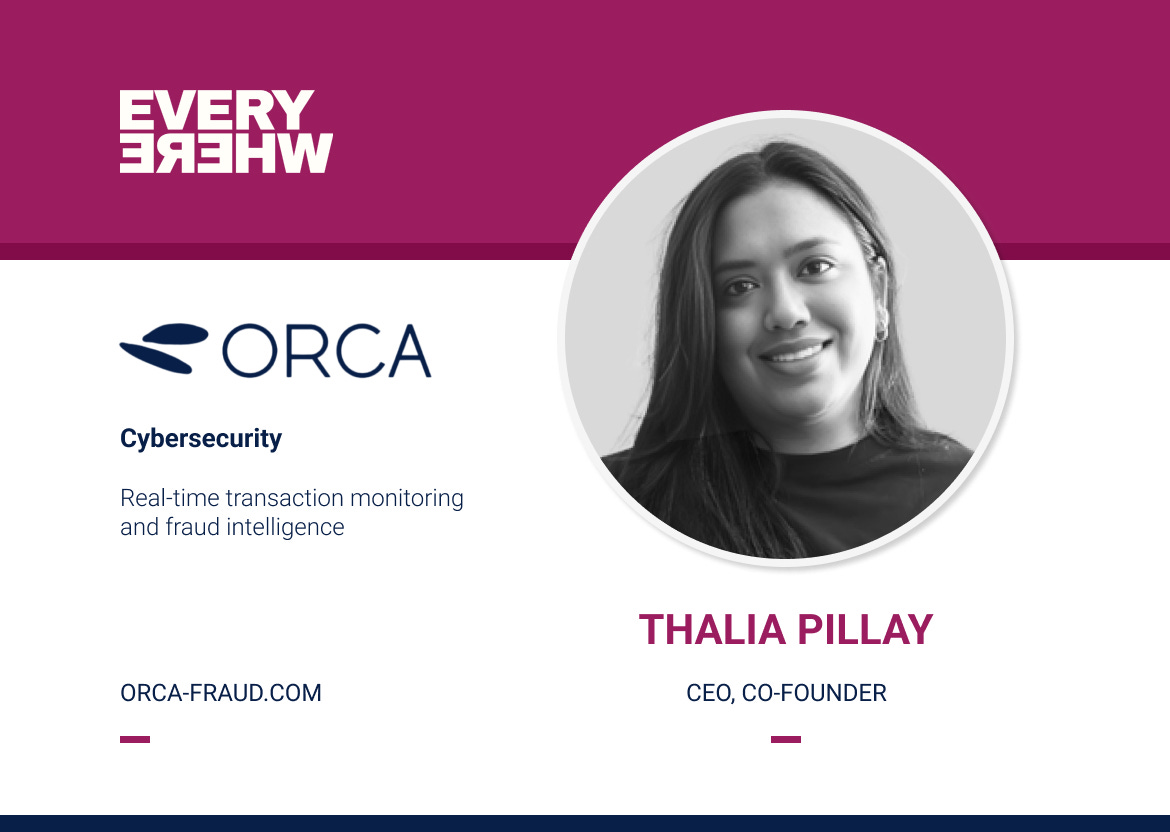
Fraud in emerging markets has grown increasingly sophisticated and costly, but one Cape Town‑based startup is turning the tide. Orca Fraud builds real‑time, AI‑driven fraud intelligence that integrates directly into live payment systems, helping banks, fintechs, telcos, and other financial platforms spot and stop malicious activity before losses occur. Orca has quickly expanded its reach across more than 70 countries and processes over $5 billion in transactions monthly. They just raised a $2.35 million seed round to scale its platform and tackle the unique challenges of fraud in emerging economies.
Co-founders Thalia Pillay, CEO, and Carla Wilby, CTO, have known each other for over a decade, first meeting while studying engineering at the University of Cape Town. Both are highly technical: Thalia holds a degree in Mechatronics, Robotics, and Automation Engineering, and Carla in Electrical and Computer Engineering. After pursuing separate paths in banking and edtech, they reunited at a payments startup and saw firsthand that fraud in emerging markets looks very different. Most tools weren’t built for rails like mobile money or agent banking. After evaluating existing products, they decided to build the fraud infrastructure they wished we’d had. Through Orca‑stration, they’re fighting fraud and protecting businesses and people across Africa.
What’s Orca’s north star?
Our north star is fraud actually blocked, not just flagged. For each customer, we measure how much real fraud we’re stopping and how much still slips through. As engineers we care about metrics like latency, transaction coverage, and model performance. But at the end of the day the question is simple: how much fraud are we blocking, and are we getting smarter over time?
What makes Orca a must-have vs a nice-to-have?
Our machine learning models are trained on local payment data, and our whole stack is designed around emerging‑market payment behaviors, which most global tools simply don’t capture. We sit directly in real‑time payment flows and can block suspicious transactions as they happen, which makes us critical infrastructure rather than an after‑the‑fact reporting tool. Without something like Orca, startups, fintechs, banks, and telcos can end up eating huge fraud losses. There are public examples of companies that have effectively been taken out by fraud. We’ve seen markets where close to 100% of transactions turned into chargebacks, meaning the institution was on the hook for every single one. Our job is to make growth sustainable by keeping fraud losses predictable and manageable instead of existential.
Tell us about some recent milestones that Orca crushed.
We’re incredibly proud of our fundraising journey. Our pre‑seed was one of the largest ever raised by an all‑women founding team in Africa, and our recent $2.35M seed round is also among the largest by an all‑women team on the continent. We closed the seed round earlier than planned due to strong enterprise demand from banks, telcos, and payment providers. That funding is helping us scale real-time fraud infrastructure, deepen enterprise adoption, expand our consortium network across emerging markets, and apply ML to high-ROI use cases like anomaly detection, rule tuning, and risk scoring.
How does Orca inspire “customer love”?
Customers love that we’re a very technical team, so integrations are fast. We’ve had clients go live in a day or two instead of the 6–12 months they’re used to hearing. They also appreciate that we design for “fraud fighters”: fraud and risk teams get powerful, usable tools, and we’ve been able to walk with them from “we just need a skateboard” to “we’re ready for a Ferrari” as their fraud posture matures.
How would you describe Orca’s culture and approach to work-life balance?
Both Carla and I have been through multiple startups where burnout was almost a badge of honor, and we were often the engineers up at midnight fixing bugs. From day one at Orca we agreed we weren’t going to glorify hustle culture or 996‑style work. We’re working hard right now because demand is high, but we see that as a privilege, not a permanent state, and we’re hiring intentionally to offload work instead of normalizing 24/7 chaos. We also want Orca to be an employer of choice at every stage of life, not just for people with unlimited flexibility. As female founders, and with a team that includes working parents, we’re especially mindful of building a culture that supports ambition and well-being.
Fun Fact:
I play six instruments, including flute, violin, piano, guitar, ukulele, and clarinet, and we’re slowly assembling an “orca-stra” now that there are enough musicians on the team.
Listen to Helle Jeppsson with Matthew Brimer, on the Venture Everywhere podcast: The Great SCAPE. Now on Apple & Spotify. Check out to all our past episodes here!

Also, check out our General Partner Anna Barber’s Substack for more insights!