
Every year around the Fourth, we find ourselves thinking about what “building America” actually means. Not the bumper sticker version, but the version that looks like a utility finally understanding its climate risk or a first responder seeing what’s happening before arriving on the scene.
For much of the country’s history, American dynamism was visible in the systems the country chose to build before the outcome was obvious. Canals, railroads, laboratories, factories, highways, semiconductors, satellites, and the internet were not just symbols of progress. They were proof that progress required more than invention. It required deployment.
That instinct has always been tied to the technology industry, even when the industry has chosen to tell a cleaner version of its own origin story. Silicon Valley did not begin as a chip or software story. Its early foundations were shaped by universities, government research, and national defense. Wartime radar research helped accelerate the electronics industry and trained a generation of engineers who later carried that technical base into commercial computing, semiconductors, and communications. Frederick Terman, the Stanford dean and provost often credited as one of the fathers of Silicon Valley, helped build the bridge between academic research and high-technology companies. Stanford Research Park was part of that same vision.
The early Valley was also deeply connected to federal R&D. By 1959, more than 85% of U.S. electronics research and development was funded by the federal government, much of it through defense. In other words, modern technology was never fully separate from national priorities. It was built through a mix of ambitious founders, public need, and institutional support.
Over time, though, parts of the venture ecosystem became uncomfortable with that language. “Defense” felt too harsh. Government markets felt too slow. Regulated sectors felt too bureaucratic. Many founders kept building in these areas anyway, but the work often lacked a shared narrative.
That is what the American Dynamism rebrand helped change. It did not invent a new type of founder. It gave a name to a familiar instinct: the desire to build in places where better technology can make institutions stronger and systems more capable. It also helped flip the way people think about bureaucracy. The friction was no longer just a reason to avoid certain markets. It became part of the opportunity.
The point is not that technology should remove every layer of process. Many of these systems are complex for good reason. But when process becomes the bottleneck, better software can help institutions act faster, coordinate better, and make decisions with more confidence.
At Everywhere Ventures, this is the version of American Dynamism that feels most relevant. Many of the founders we back would not necessarily use the phrase themselves. They are not building from a slogan. They are building because they see systems that need to work better.
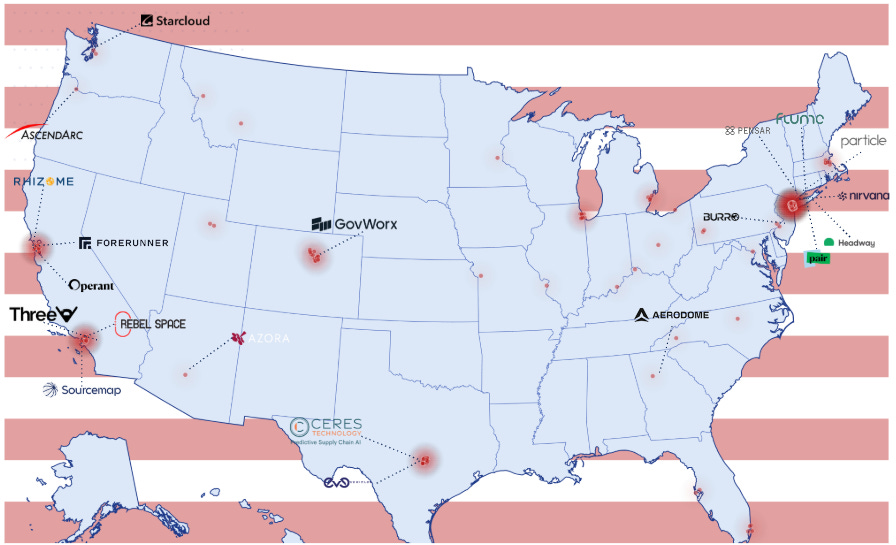
You can see it in climate resilience, where the problem is no longer theoretical. Wildfires, floods, insurance gaps, and grid strain are forcing institutions to make better decisions under pressure. Rhizome is helping utilities understand climate risk before it becomes a catastrophe. Forerunner is helping governments and communities plan around flood exposure with more precision. These companies are not simply selling software into slow-moving markets; they are helping complex institutions move with more clarity when delay is costly.
In public safety, emergency response is one of the clearest examples of a system where better technology can have an immediate human impact, but where modernization has historically been difficult. GovWorx is helping first responders make sense of the data already flowing through 911 calls, radio audio, CAD systems, and body camera footage. Eve Vehicles is building Drone First Responder infrastructure so emergency teams can see what is happening before they arrive. Aerodome, acquired by Flock Safety, showed how quickly this kind of technology can move from experimental to operational when founders are willing to work inside real agencies with real constraints. This is what American Dynamism looks like in practice: not a rejection of institutions, but a push to make them more capable.
As satellites, software, supply chains, and public infrastructure become more connected, trust becomes a basic requirement. Rebel Space is securing space systems as satellites become more important to communications and monitoring. Azora Space is building optical ground station infrastructure to move data from space to Earth faster and more accessibly. Starcloud is pushing compute infrastructure beyond Earth, reflecting a future where space is not only observed from but also operated in. Operant AI and Pensar AI are protecting the software layer, where vulnerabilities can move quickly from codebase to real-world risk. These companies sit in different markets, but they are responding to the same reality: the systems we rely on are becoming more digital, more distributed, and the stakes of failure are getting higher.
The same is true in the physical economy. For the last twenty years, much of software was built around digital workflows. The next wave is moving deeper into the physical world. Burro is building autonomous robots for agriculture and other labor-intensive environments. Ceres Technology helps companies anticipate supply chain risks before they cascade. Sourcemap gives enterprises better visibility into where products come from. ThreeV brings inspection automation to industries where downtime and maintenance matter. It does so not by skipping the hard operational details, but by making them visible and easier to act on.
Connectivity belongs in the same conversation. A dynamic country depends on the networks that let people work, learn, receive care, and participate in the economy. Ascend Arc is approaching that problem from orbit, building cost-effective geostationary satellites to expand connectivity. Flume Internet is working from the ground, delivering high-speed fiber internet to homes and businesses. Different layers, same underlying need: reliable access to the infrastructure modern life depends on.
Healthcare is another essential system where better technology can expand capacity. Headway is making it easier for people to find mental health providers who accept insurance while reducing administrative burden for clinicians. Particle Health is improving access to patient data so care can be better coordinated. Nirvana Health is automating insurance verification, claims, and reimbursement workflows, removing friction that providers and patients feel every day. Healthcare access belongs squarely in this conversation. If the thesis is about strengthening the systems that make a country work, care delivery and administrative capacity are central to it.
Taken together, these companies point to a broader definition of American Dynamism. It is not only defense, deep tech, or the most visibly ambitious categories. It is technology as a tool for capacity-building. That is the power of the phrase: it created a shared frame for work that used to feel scattered and made more founders and investors willing to spend time in sectors that once felt too slow, too complex, or too tied to government.
This is also why the conversation is not limited to America. Across Europe, a similar question is emerging around sovereignty and technological independence. At VivaTech in Paris, Jenny Fielding joined government officials, defense leaders, and deep tech investors to discuss how defense tech is reshaping Europe’s innovation landscape. The conversation kept returning to a larger point: sovereignty is not only a policy goal. It is a mindset. Europe has the talent and the technology. What it has not always had is the connective narrative. The World Cup can bring people together around identity, ambition, and shared belief. Deep tech has rarely done that at the same scale. But the ingredients are there, and the need is becoming harder to ignore.
That may be the broader lesson of American Dynamism. Rebrands matter when they help people see familiar work differently. Language matters when it gives builders, customers, and capital a reason to gather around a common project. A movement does not remove the hard parts of building. It does not erase procurement cycles, technical risk, or regulatory complexity. But it can make more people willing to engage with them. And in the best cases, it can also reduce the bureaucracy that slows essential systems down. It succeeds, not by ignoring complexity, but by giving founders and institutions a shared reason to move faster.
Because the next chapter of American Dynamism will not be defined only by the loudest or most visible technologies. It will be built inside the systems people depend on every day: the response layer, the care layer, the trust layer, the connectivity layer, and the physical infrastructure underneath it all.
Interested in investing alongside Everywhere Ventures? Learn more about joining our investor community here.
Listen to Mayssa Chehata with Scott Hartley, on the Venture Everywhere podcast: (Don’t) BEHAVE Yourself. Now on Apple & Spotify. Check out all our past episodes here!
