
Anthropic opened a research preview of the Model Hardware Standard, or MHS, a shared specification for AI agents to safely operate physical devices. The standard is designed for labs, manufacturing facilities, robotics systems, electronics workflows, and other environments where AI needs to interact with real equipment: microscopes, liquid handlers, robotic arms, centrifuges, plate readers, quantum hardware, and more.
That is a big deal because many scientific and manufacturing workflows still depend on brittle, bespoke integrations. A lab may have multiple automated machines, but each device often speaks its own language. Connecting them into a single workflow can take specialists weeks or months. Anthropic’s goal with MHS is to reduce that integration work to hours or minutes while giving AI agents safer, standardized ways to discover devices, understand what they can do, operate within safety limits, and coordinate work across instruments.
Tetsuwan, one of our portfolio companies, is directly aligned with that future.
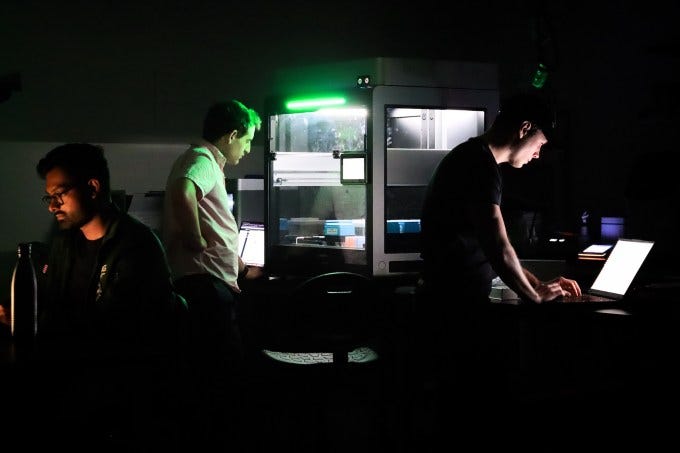
Tetsuwan is building an automated biology lab available to researchers and agents through an API. Its platform, ResearchOS, lets users generate, run, and manage automated workflows from natural-language protocols. Claude can help translate those protocols into scripts, which are then processed by Tetsuwan’s custom compiler into automation code for lab equipment.
In Anthropic’s research preview, Tetsuwan integrated MHS with ResearchOS to run qPCR workflows for a citizen science project studying pollution in California’s San Pedro Creek. The workflow involved coordinating across lab devices, detecting issues during liquid handling, and recovering from errors in real time.
One example captures why this matters. qPCR workflows often involve viscous reagents that can bubble or foam during pipetting, which can compromise an experiment. In the Tetsuwan pilot, a camera detected bubbles in a transfer. Claude, operating through MHS, helped identify a recovery strategy: move the tube to a centrifuge and briefly spin it to draw the liquid down. Through MHS, Claude could then issue the appropriate commands to the centrifuge.
That kind of orchestration is the real unlock. It is not just “AI plus robot.” It is a system where protocols can become more hardware-independent, devices can be discovered and coordinated dynamically, and experiments can adapt when conditions change. Anthropic’s post also notes that Tetsuwan used Claude and MHS in a closed-loop optimization experiment to improve compiler heuristics, testing 9,143 individual dispenses, 300 unique transfer types, and 1,508 measured conditions across four liquid types.
This is why we invested in Tetsuwan. Biology is dynamic. Experiments vary from run to run. The long tail of scientific work cannot be automated with rigid, one-off configurations alone. It needs an operating system that can turn scientific intent into reliable execution across real-world instruments.
ResearchOS and MHS point toward that future: labs where researchers can express what they want to test, agents can help translate that intent into workflows, and automated equipment can execute, monitor, recover, and improve over time.
Congratulations to Cristian Ponce, Théo Schäfer, and the Tetsuwan team on being part of Anthropic’s Model Hardware Standard research preview. This is an exciting step toward making experimentation more accessible, reproducible, and programmable.
Read Anthropic’s announcement.
Interested in investing alongside Everywhere Ventures? Learn more about joining our investor community here.