
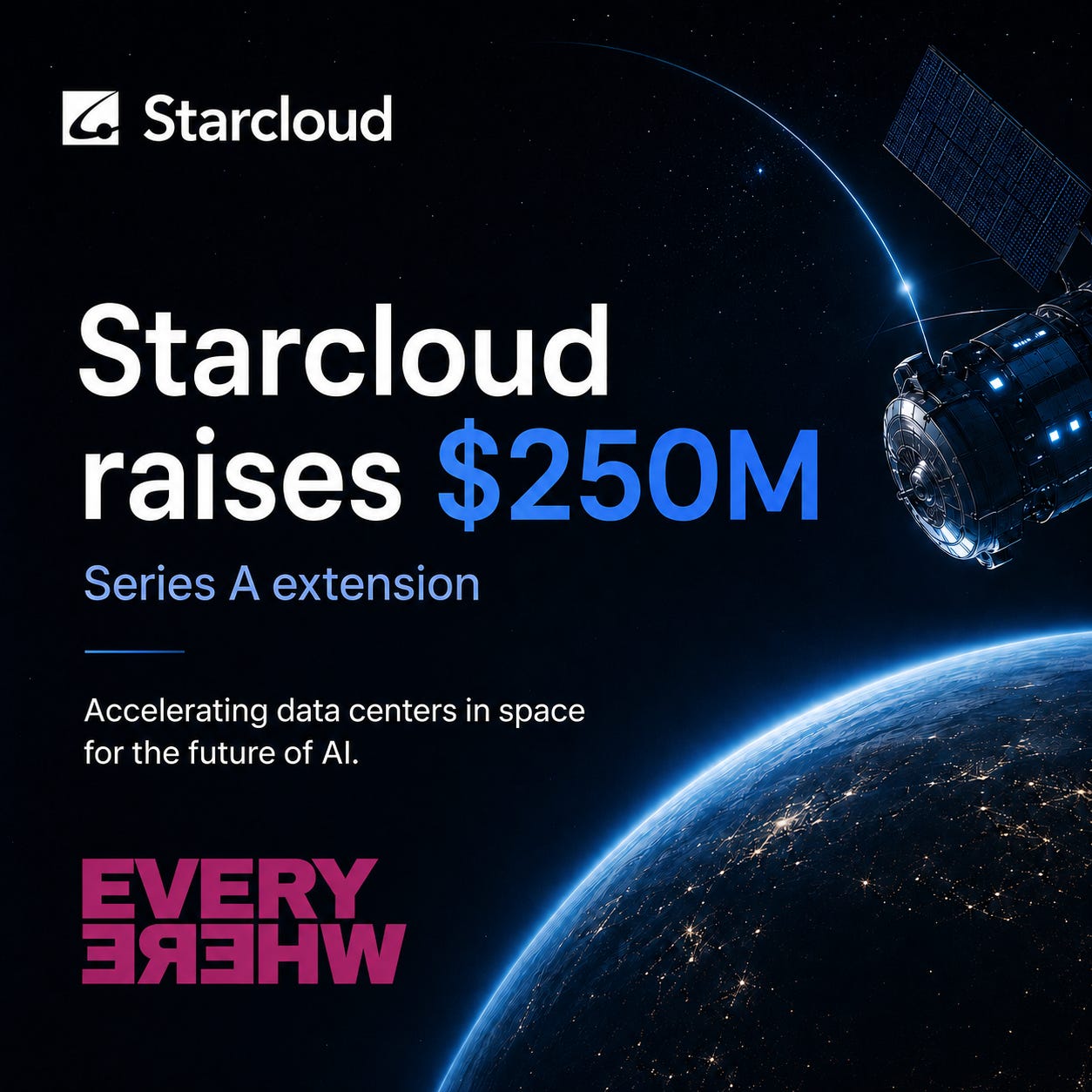
Huge day for Starcloud. The company has added a $250M extension to its March $170M Series A, valuing Starcloud at $2.3B. The financing includes participation from Nvidia, Cisco, Benchmark, EQT, Soma, NFX, 776, Cedar Capital, Goanna Capital, Standard Capital, and others, and will help the team expand manufacturing and advance Starcloud-3, its largest orbital data center spacecraft.
We invested in Starcloud because the team is working on one of the most important infrastructure questions of the AI era: where will the next generation of compute live?
AI is often discussed as a model, software, or chip story. But the more it scales, the more it becomes a physical infrastructure story. Data centers need power. They need cooling. They need land, permitting, interconnection, supply chains, and massive capital deployment. The constraints are not theoretical; they are already shaping where and how AI systems can be built.
Starcloud is taking a very different approach: orbital data centers.
The company is developing compute infrastructure in space, where satellites can use continuous solar power and the thermal environment of orbit to support AI workloads beyond the limits of terrestrial facilities. That idea sounds futuristic until you look at the direction of AI demand. If compute keeps becoming one of the defining scarce resources of the next decade, then expanding the geography of compute is not a novelty. It is infrastructure.
The team is already proving pieces of the system. TechCrunch notes that Starcloud is the only company it knows of currently operating an Nvidia H100 terrestrial data center GPU in orbit, and the first to train a model using it. That experience is informing Nvidia’s work on a purpose-built space GPU, the Vera Rubin Space-1 chip.
The company is also thinking beyond one spacecraft. TechCrunch reports that Starcloud has requested permission from the FCC to operate 88,000 spacecraft and is working to secure future launch capacity as access to space becomes more constrained. Near term, the company is focused on launching two Starcloud-2 satellites in 2027, each designed for 8 kW compute and intended to perform orbital inference tasks for customers including U.S. government agencies. Longer term, Starcloud is building toward a much larger orbital inference layer.
This is exactly the kind of deep tech company we are excited to back: technically ambitious, infrastructure-defining, and built around a constraint that is only becoming more important. Orbital data centers sit at the intersection of space, AI, energy, chips, launch, and manufacturing. It is a hard problem, but it is also a category-defining one.
Congratulations to Philip Johnston, Ezra Feilden, Adi Oltean, and the entire Starcloud team on a major financing milestone and an even bigger vision for the future of compute.
Read the full TechCrunch article.
Interested in investing alongside Everywhere Ventures? Learn more about joining our investor community here.