
Welcome to Founders Everywhere, where we highlight the incredible people behind the companies we’ve backed at Everywhere Ventures, a global pre-seed fund supported by a community of 500 founders and operators.
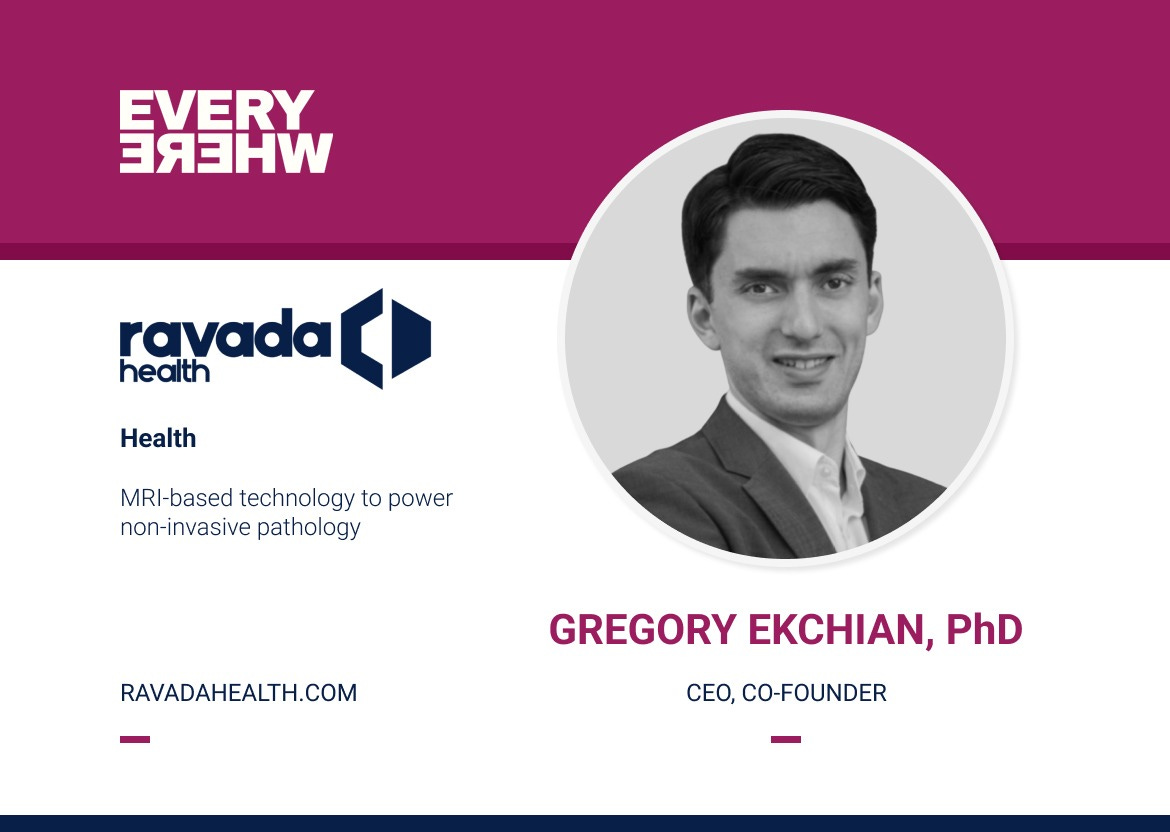
Diagnosis of many diseases has traditionally involved a combination of non-invasive imaging and invasive sampling in the form of a biopsy. Magnetic Resonance Imaging (MRI) has long been a preferred method to screen patients for disease or injury and provide critical insights for further testing or treatment. Historically, MRI has been interpreted visually by the radiologist and the accuracy is often a function of the specific radiologist and their experience.
One of those available tests is a biopsy, which is an invasive procedure that removes small pieces of tissue from an organ so they can be examined to provide greater certainty of what’s happening inside the body. It has long been the only way to get that type of biological information. But a biopsy samples only a small part of a much larger organ, so it may not capture the full picture of someone’s disease. Subjective image assessment and incomplete tissue sampling can lead to unnecessary procedures, missed diagnoses, or treatment decisions based on a misunderstanding of the underlying disease.
Ravada Health is powering non-invasive pathology, using MRI to objectively and quantitatively assess tissue biology and pathology to directly confront the limitations of subjective radiology assessments and biopsy sampling. Its technology first harmonizes and quantifies MRI data so measurements are consistent across scanners and hospitals and then uses this data with their proprietary pathology models designed to assess the likelihood, presence, and aggressiveness of disease. Their goal is to turn MRI into an objective biological assessment rather than relying on visual interpretation alone. They are starting with prostate cancer and are focused on building a platform to help clinicians determine who needs a biopsy, where to target the needles, and to characterize cancer aggressiveness to inform treatment.
Ravada Health was founded by CEO Dr. Gregory Ekchian and his former MIT PhD advisor, Professor Michael Cima. The two first met while Greg was pursuing his master’s degree at MIT and have known each other for more than 16 years. Greg holds a bachelor’s degree in Biomedical Engineering, as well as a master’s and PhD in Materials Science and Engineering from MIT, where he also completed a postdoctoral fellowship at MIT’s Koch Institute for Integrative Cancer Research. Michael brings decades of experience in research and innovation at MIT and has been a serial entrepreneur who founded companies focused on novel diagnostic and drug delivery approaches. What began as an academic mentorship developed into a long-standing collaboration, eventually bringing the two together to combine their expertise to build Ravada Health, with the goal of improving the quality of care and outcomes for patients.
What is Ravada’s North Star?
We believe that high-quality care is built on comprehensive and objective biological assessment of disease. This ensures all patients can begin their journey from the same starting point and provider and treatment options can be selected for what is best for the individual patient regardless of the setting in which they initially seek care.
What sets Ravada apart?
Advancements in radiology have mostly focused on building tools to assist the radiologist with the existing subjective interpretation. At Ravada, we believe MRI should be an objective, reader-independent assessment of tissue pathology which could provide information that previously required invasive and undesirable procedures. Our approach is also contrast-free which eliminates a major bottleneck in MRI and offers the potential to increase throughput and access to MRI for patients.
Objective pathological assessment via non-invasive imaging would be a big unlock for patients, providers, and payers. Ensuring that undesirable and expensive invasive diagnostic procedures are used only when necessary and in some cases potentially eliminating them altogether would mark a major advancement in patient care.
How does Ravada engage with stakeholders?
We’re building relationships with radiologists and urologists across academic medical centers, community hospitals, and private practices as well as patient advocacy organizations. Understanding the perspective of all the stakeholders from the start ensures we build a product that meets the needs of doctors and patients.
What’s a recent milestone for Ravada?
Ravada recently completed a multi-site pilot study evaluating our platform in prostate cancer. The results of this very encouraging study will be published next year highlighting the potential for the technology to improve diagnosis, treatment, and access for patients with prostate cancer.
What motivates you as a founder?
What motivates me is the opportunity for scalable impact: solving a problem not just for one person, but for many. In healthcare, that means helping people find clarity during some of the most difficult and confusing moments of their lives and empowering the individual patient to have a clear understanding of their health so that they can be their own best advocate.
Fun fact:
I got my entrepreneurial start as a kid in my grandfather’s rug store.
We’re excited to introduce Jelly, the first company incubated inside Everywhere. Built initially to solve a challenge within our own investment team, Jelly is a startup discovery and research platform that brings together millions of data points on private companies, investors, funding activity, accelerator batches, and more. By making fragmented startup intelligence easier to find and understand, Jelly helps investors spend less time piecing together information and more time connecting with founders.
Read the story behind Jelly, why we built it, and how we’re making it available to the broader venture community.
