
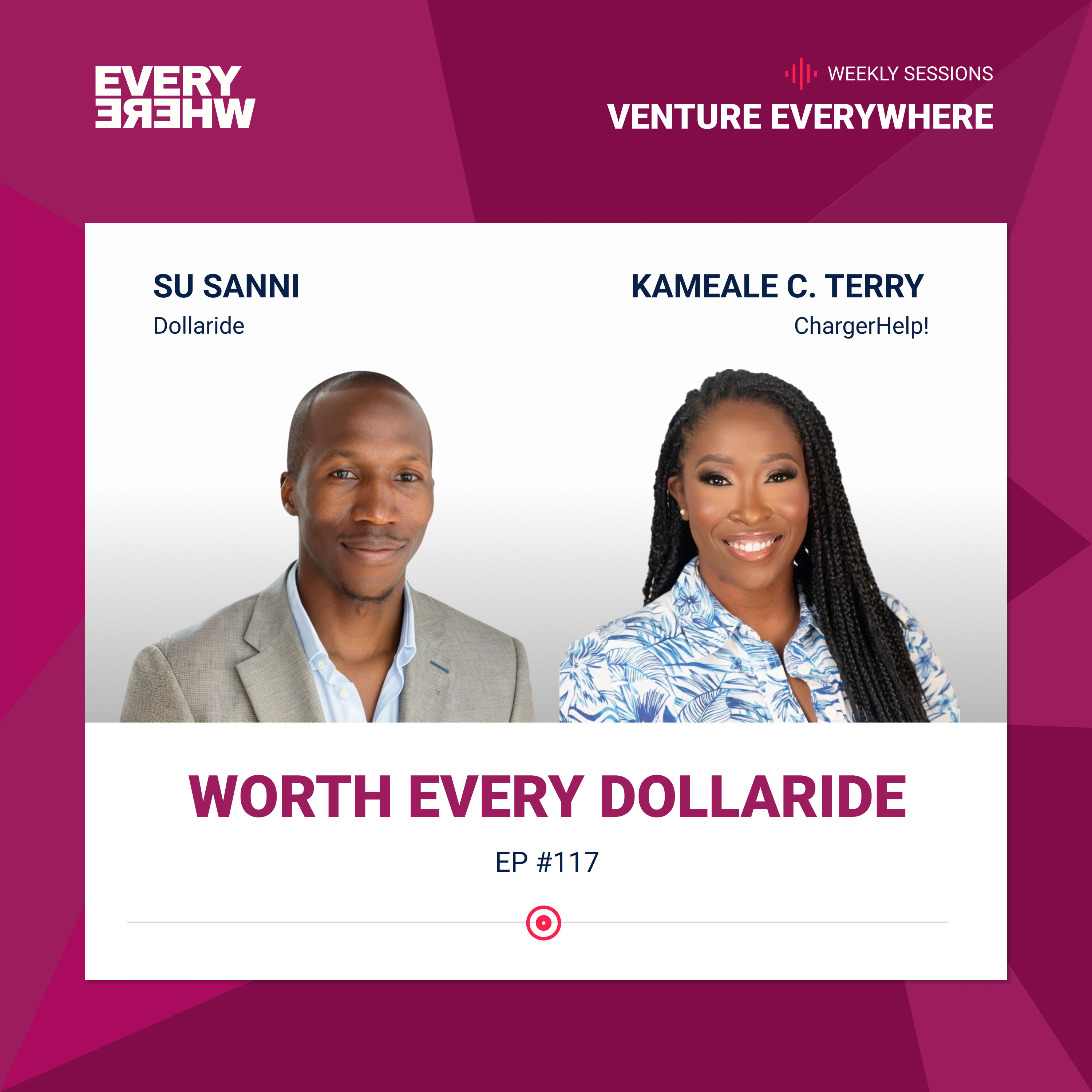
The host of episode 117 of Venture Everywhere is Kameale C. Terry, co-founder and CEO of ChargerHelp, an EV charging maintenance and workforce development company keeping charging stations operational across the country. She talks with Su Sanni, co-founder and CEO of Dollaride, a clean transportation company electrifying small urban fleets in New York City. Su shares how growing up in East New York with limited transit access shaped his conviction that underserved communities deserve better transportation options. He discusses how Dollaride evolved from a digital app for dollar van riders into a B2B electrification platform, positioning small fleet owners as key players in New York’s clean transportation transition.
In this episode, you will hear:
Digitizing dollar van payments and routing through a consumer app.
Pivoting from B2C rideshare to a B2B fleet electrification platform.
Winning a $10 million NYSERDA grant to electrify New York’s dollar van industry.
Offering EVs, charging, and parking as a turnkey solution for small fleet operators.
Balancing government contracts with a commercial ground game to sustain cash flow.
If you liked this episode, please give us a rating wherever you found us. To learn more about our work, visit Everywhere.vc and subscribe to our Founders Everywhere Substack. You can also follow us on YouTube, LinkedIn and Twitter for regular updates and news.
Transcript:
00:00:04 VO: Everywhere Podcast Network.
00:00:14 Jenny Fielding: Hi, and welcome to the Everywhere podcast. We’re a global community of founders and operators who’ve come together to support the next generation of builders. So the premise of the podcast is just that, founders interviewing other founders about the trials and tribulations of building a company. Hope you enjoy the episode.
00:00:32 Kameale: Hello and welcome to the Venture Everywhere podcast. I’m Kameale, the co-founder and CEO of ChargerHelp!. I am so excited because I’m here with Su Sanni, who is the co-founder and CEO of Dollaride.
00:00:47 Kameale: And this is a bit of a treat because one, I’ve been on this podcast before. But two, I have gotten the pleasure to meet Su in a lot of places while building my company, ChargerHelp!. Let’s hear more from him. Su, introduce yourself to the people.
00:01:02 Su: Thank you so much, Kameale, for that great intro. Hey, everyone. My name is Su Sanni. I’m the founder and CEO of Dollaride. I’m calling in today from Brooklyn, New York, where I was born and raised and where Dollaride is also headquartered.
00:01:18 Su: For those of you who don’t know, Dollaride is a clean transportation company that focuses on bridging transit gaps in New York City by electrifying fleets. Happy to be here and happy to talk more about what we’re doing and our journey through the clean tech startup ecosystem.
00:01:37 Kameale: I think this is my first time interviewing a founder. And the one thing that I am always interested in, because it’s a very interesting story for me, is what sparked your idea? How did you even know to start Dollaride? Let’s start there.
00:01:51 Su: Dollaride is actually the family business for me. I say that because what inspired me was my two uncles who were immigrants from Nigeria, moving here to New York in about the 70s or early 80s. The first jobs that they were able to get were jobs as, quote unquote, “dollar van drivers.”
00:02:12 Su: For those of you who don’t know, in New York City, we have this underground network of drivers who own their own shuttle vans and buses. They’re known around town as the dollar vans. That’s because back in the 80s, it literally cost only a dollar to get on these vans. They would take you wherever you needed to go within a certain neighborhood.
00:02:34 Su: My uncles were among the early pioneers of this industry. Their story in moving to New York, starting this little business of theirs, and then it growing into a little bit of a phenomenon was what inspired me to start Dollaride.
00:02:50 Su: The name is piggybacking off of them. The problems that we’re solving have a lot to do with transportation access in communities that the dollar vans serve today.
00:03:00 Kameale: That’s so incredible. I’m from LA and anytime I learn more about the dollar rides and even your company, I was like, “Oh, my gosh. That would have been something so cool growing up in LA,” because we didn’t necessarily want to catch the bus per se. But I could imagine us getting into this really cool, sleek electric van and getting around.
00:03:20 Kameale: Could you talk a little bit about how it was for you growing up in Brooklyn and how did that shape your perspective on mobility, access and underserved communities?
00:03:29 Su: Yeah, sure. And this is an integral part of my story and like lens on building businesses and transportation, especially in New York. I grew up in East New York, Brooklyn, which is right next door to Brownsville.
00:03:42 Su: I always tell people Brownsville is the home of Mike Tyson. These are some of the most challenging neighborhoods in Brooklyn. Especially growing up in the 90s, not only was it dangerous oftentimes, but we had very limited access to public transit.
00:03:58 Su: It was common in my neighborhood for kids as young as six, seven, eight years old like I was to walk about a mile from our apartment buildings to the nearest subway where we could finally hop into public transit and then get to school.
00:04:13 Su: My earliest memories of taking public transit always started with a lonely, cold and sometimes dark walk to the subway. That always left an impression on me about why is my commute so difficult or different from other people who live in New York?
00:04:31 Su: That pretty much shaped my view on transportation, and it just made me have a soft spot for folks who live in areas that are far away from public transit or even people who might not be able to take public transit because they might have a physical disability. These transit access issues were really prevalent in my neighborhood.
00:04:49 Su: By the time I became an adult and felt like I was empowered or had the agency to do something about it, I was really driven by that experience that I had as a eight-year-old trying to get to school every day, having to start with a 25, 30-minute walk to the subway.
00:05:06 Kameale: That’s so impactful and just dope to see just how our lived experiences can really shape what we build. When did you start Dollaride again and who was your first customer and what did the business first look like when you started?
00:05:21 Su: I first started Dollaride… you can say officially in 2019. At that time, it was just me and my co-founder. His name is Chris Coles. He’s our CTO. We essentially just built a website and a prototype app. The idea at the time was to create the Uber for New York City dollar vans.
00:05:43 Su: This was an app-based service where the driver from his phone can see any nearby passengers that wanted to hail a dollar van or his particular vehicle. At the time, this was novel, very unique because the way people take dollar vans in New York City, even today, is they’ll get out onto the street and hail it just like you’re hailing a yellow cab.
00:06:07 Su: You have to physically know where the vans are driving each day in order to see them. And then you physically wave your hand so that the driver can pull over, open up his door and let you into his van or his minibus.
00:06:21 Su: Our idea initially was to make this experience digital and more transparent to both the driver and the passenger and also enable them to transact digitally. We introduced credit card payments and paying digitally into this dollar van service, which was primarily cash-based at the time.
00:06:42 Su: That’s how we started in 2019 and what the business and the service looked like then. But after COVID in 2020 and a bunch of iterations, the company has definitely evolved from that initial vision.
00:06:55 Kameale: That makes total sense. Before we get to just where you all are at today, as someone who started the company in January of 2020, it’s always interesting to hear what was your biggest challenge back in 2019? What was keeping you up at night in 2019? Because I think that probably what was keeping you up then is different than what’s keeping you up now. Tell me about that a little bit.
00:07:19 Su: In 2019, the biggest challenge that we were faced with then… it was a couple of things. I remember we were really struggling with this idea of somehow allowing passengers to still pay in cash. Believe it or not, even in 2019 in New York City, amongst people who are going to work every day, there are still a significant number of people who wanted to pay for their rides in cash.
00:07:47 Su: We just found that roughly 35% of passengers preferred to pay in cash even though they had credit cards, they have bank accounts and they were using services like Uber and Lyft. They just still had the habit of using dollar vans and paying the driver with two or three dollars in cash.
00:08:05 Su: We often had that request and we were oftentimes arguing internally about whether we should change our technology or make some new features that would account for drivers receiving cash but still providing their service digitally to the passengers who wanted to pay with credit card.
00:08:23 Su: Another challenge that we were faced with then had to do with routing. In 2019, we had a bit of a technical issue. This just was a reflection of our team’s ability to get access to real time routing data that would enable us to show a driver the most efficient route to the passengers that were in their geography.
00:09:47 Su: Traditionally, dollar vans operate on fixed routes like a bus service would. But when you can actually see everyone’s geolocation through their phones, it behooved us to give drivers the ability to pick up passengers that weren’t directly on the fixed route, but that might be only one or two blocks away.
00:09:09 Su: But we realized that when you were doing that, you do have to also take into account if there’s traffic or if there’s obstructions that you can’t really see through the Google Maps API, but would ultimately affect the driver’s ability to get to that passenger on time or within a reasonable amount of time.
00:09:27 Su: I remember we spent a lot of time just trying to optimize our routing algorithm so that it could take into account real time traffic signals or predict if there would be some traffic congestion based on weather patterns.
00:09:42 Su: Needless to say, we do not take for granted the magic that the Uber and Lyft apps have. There’s a reason why those apps work so well today. They basically have invested a lot of engineering time and many millions of dollars into making their service flawless. For us in 2019, that was not easy to do. We spent a lot of engineering cycles trying to figure that out for our startup.
00:10:08 Kameale: Thank you for sharing that. I know that this podcast is one that has a lot of founders and VCs, so it’s always super interesting to think about what kept you up at night when you first started. You guys are almost a decade in.
00:10:22 Kameale: Let’s come to the future. Talk a little bit about how Dollaride has transformed, how you guys operate now and the intersection of mobility and climate. How is the business evolving into an EV fleet solution?
00:10:35 Su: Today, Dollaride operates more so like a B2B platform as opposed to a digital rideshare service. In 2021, maybe even early 2022, we started realizing that as good as our digital product could be, it would be really difficult for us to make an impact on our customers, particularly the drivers and the fleet owners, with only a digital app.
00:11:05 Su: I’ll share an example of my uncles. My uncles became my first customers. They onboarded their drivers into our app and we started using their drivers, their vehicles as the supply in our marketplace to pick up passengers.
00:11:22 Su: But at the end of the day, my uncles and other business owners like them, whenever they would complain about the issues that kept them up at night, it wasn’t our app, it was things like the cost of a vehicle or the cost of gas or getting more customers.
00:11:40 Su: We realized that although our app was getting better and we were getting more and more users, it wasn’t really making a difference in our customers’ true day-to-day operations.
00:11:50 Su: That was when I had a light bulb moment and realized that we could probably be making a bigger impact by taking on more responsibility in the operations of our customers. That means dealing with more of the physical world that they’re in as opposed to only operating a digital app service.
00:12:10 Su: At that time, we pivoted and began providing a B2B service where Dollaride would help our fleet customers. These are the business owners who employ the drivers or who own the vehicles.
00:12:26 Su: We started working directly with the fleets and provided them services like identifying contract-based opportunities to grow their businesses, learning a little bit more about the cost of insurance and how they can optimize insurance so that they can lower their operating costs. Again, it was my uncles and then some of their competitors who became my earliest customers.
00:12:50 Su: But in early 2023, we reached an inflection point and had a huge opportunity to go much deeper in building out a platform that truly helps the business owner. Dollaride eventually won a large contract with New York State. In particular, it is an agency called NYSERDA. Which is the New York State Energy Research Development Authority.
00:13:16 Su: NYSERDA provided Dollaride with a $10 million grant and contract to electrify dollar vans. The general idea here was that Dollaride already knows the dollar van ecosystem very well. We had over 400 drivers already using our app at the time. But all of these drivers and their vehicles emit a ton of carbon or greenhouse gas emissions as they’re providing transportation around Brooklyn, Queens and the Bronx.
00:13:49 Su: As the state wants to decarbonize transportation, they chose Dollaride as an engine for decarbonizing small urban fleets. They wanted to use us as a service provider to the dollar van industry for electrifying dollar vans.
00:14:07 Su: This was an opportunity, but also an inflection point where we had to decide, do we want to get into clean energy as part of our business model in our service offering? It was an opportunity that we embraced with open arms.
00:14:20 Su: This is what Dollaride does today. We are a turnkey solution for small businesses that provide transportation. We provide them with access to an electric vehicle, a charging station and even dedicated parking so that they can electrify their fleet, whether they’re starting with one vehicle or electrifying a fleet of 50.
00:14:45 Kameale: That’s incredible. And it’s so beautiful to see this full circle moment of where you started out before, but also understanding the customer, understanding the market and then bringing something to market that people needed and then being recognized by an entire state that they saw that you all were the best folks to drive this solution. That’s incredible. Hats off to you, Su.
00:15:06 Su: Thank you, Kameale.
00:15:07 Kameale: You’re welcome.
00:15:08 Su: I want to say one thing, too. I’m condensing the story because I just want to give people the highlights. But what led to getting the contract with the state was proposing this actual solution based on the feedback that we were getting from our customers.
00:15:24 Su: We ended up getting over 40 letters of intent from small business owners who are all complaining that the cost of gas and insurance and replacing their vehicles is a big inhibitor on their growth. That gave us the framing and the narrative to propose to the state of New York that there needs to be a solution to this.
00:15:49 Su: Because if we want to electrify and decarbonize our cities and our state, we need to actually think about small businesses who are typically cash strapped and have very limited resources, but make up the majority of the vehicles on the road, especially commercial vehicles. That’s how we really bridged the gap from our experience with customers to a concept and a pro solution that even governments could get behind.
00:16:17 Kameale: I’m so glad you brought that up. You have to truly, one, utilize what you know about your customer in order to create the opportunity. It sounds like, Su, you did that so well and even did it in such an organized way to get those letters. Some people may think, oh, that may take a lot of work, but honestly, it’s totally worth it. So that’s super impressive.
00:16:36 Su: Thank you. Thank you.
00:16:38 Kameale: You’re welcome. Just revisiting the question we had before, what was your biggest challenge back in 2019, super interested to hear what is one of your biggest challenges today? What is keeping you up at night today?
00:16:52 Su: This is an easy answer. It might be a bit of a nod to you, Kameale, and what you’re doing with ChargerHelp!. What keeps me up at night today and the biggest challenge we have is simplified by two words: charging infrastructure. In short, there’s just not enough chargers in New York City to support the electric vehicle fleet transition.
00:17:16 Su: We have policies, even in New York City, that require rideshare drivers and other for-hire vehicles to convert to electric by 2030. But there’s not enough public chargers. There’s not enough chargers that work consistently and reliably.
00:17:34 Su: It’s very common that a driver, whether they have a Tesla or an electric van, will pull up to a charging station and the station doesn’t work or they have to wait in line for over an hour before they can actually start charging, which takes them another half an hour to an hour anyway.
00:17:52 Su: This is a huge problem if you’re a small business owner and you make money off of driving that vehicle. Time is money and the money lost in sitting, waiting for a charger for an hour versus the amount of time that it takes to fuel up if you go to a gas station becomes a really challenging value proposition for my company to get over, as well as something that everyone who’s considering an EV has to really deal with.
00:18:19 Su: At the end of the day, we spend a lot of time right now at Dollaride trying to figure out how to build or procure better charging solutions. It’s something that is inevitably an issue that we deal with every customer and something that keeps me up at night literally every single day.
00:18:37 Su: This is not supposed to be a plug for ChargerHelp!, but I just have to say this. I kid you not, literally today we’re dealing with an issue at one of our charging hubs. We don’t own this particular hub. All the chargers are not owned and operated by us, so we’re relying on third parties.
00:18:54 Su: From time to time, the chargers don’t work or they’re having malfunctions. It’s the worst when we learn about this the morning of when the customer is supposed to take their vehicle out and do their routes in order to earn money.
00:19:08 Su: I’ve already talked to my director of fleet ops about ChargerHelp!. We should definitely talk because we need more of your services and your technicians out here in New York City, for sure.
00:19:17 Kameale: I appreciate that, Su. The other call out here is as you build, sometimes your partners and your customers may be other startups and figuring out how to do that well. That’s a really big deal.
00:19:30 Kameale: I’m going to interject this sales cycle question. So you guys won this really big contract. I’m sure that’s not the only deal that you all have. But then also, I’m sure with transportation, at least from outside looking in and as somebody that’s been in transportation, especially working with government, it just sounds like a very long sales cycle.
00:19:47 Kameale: Talk a little bit about how has the sales cycle been, how have you guys been working towards improving your sales cycle and then, just any tidbits that you could give to founders out there that are trying to build in the transportation, working with government space?
00:20:01 Su: Flat out, working with government is definitely a long sales cycle, especially as you get into larger six figure and seven figure deals, if not more. We’ve experienced that and we’ve dealt with those challenges in a couple of different ways.
00:20:17 Su: Firstly, with the NYSERDA contract where we won $10 million, that in and of itself was at least 18 months of, quote unquote, “sales.” It started out with an RFP, but then there were many milestones and interviews and different steps along the way until we actually received that award and email that we finally got the deal done.
00:20:41 Su: That at least can give the audience some view of how long deals like this can actually take. We also had a similar experience with another contract that also took about 12 to 15 months. With this particular one, once that contract landed, it took another year before we got paid.
00:20:59 Kameale: That should be a whole segment. Just because you win the contract, don’t mean you’re going to get the money in your bank.
00:21:04 Su: This becomes a lesson for us founders about managing cash flow and figuring out how to capitalize your business properly, because you might have a huge contract from a government customer, but they pay late. They don’t necessarily pay reliably or in a predictable way.
00:21:23 Su: You still need to keep the lights on. You still need to pay payroll while you wait for the checks to come in. This is something that we had to learn the hard way, but hopefully folks can learn from our mistakes.
00:21:34 Su: But what I would encourage other founders to do if they are in a highly regulated industry, where government becomes your customer and these contracts are attractive to you… what we do at Dollaride is we do two things at once.
00:21:49 Su: We pursue government as clients. We’re always responding to RFPs and finding ways to pitch our services as a small purchase agreement, which is typically under a certain cost or threshold that might be outside of the RFP process. But we use that as a way of getting our foot in the door and then building up that relationship to a much larger contract agreement over time.
00:22:14 Su: We do that, which is like our sales approach with government. But then at the same time, we’re constantly still building the commercial side of our business, which is selling B2B. In combination, the B2B sales have a much smaller or shorter sales cycle. There’s a lot more customers out there that we can sell to.
00:22:35 Su: I use a football analogy. While you’re throwing for the big Hail Marys, which are the government contracts, you still have a ground game and you’re running these short plays with your B2B customers.
00:22:47 Su: That approach is balanced and can help you weather these long spurts of time where government pays late or they don’t pay on time. You still have a commercial business that is sustainable.
00:22:58 Kameale: That’s really smart. Everybody’s just trying to get their first contract. Once you get your first contract, you do have to start really looking at, okay, what was this process? What do I need to change? How do I go faster?
00:23:08 Kameale: I’m going to ask this last question and then we’ll go into the speed round. If you could wave a magic wand and fix one urban mobility problem tomorrow, what would it be?
00:23:21 Su: Sometimes I think about incentives as a more systematic way to influence customer behavior or markets. So if I could wave a magic wand to fix an urban mobility problem, I would want to somehow create another revenue stream that is durable for urban transportation and local transportation.
00:23:50 Su: What I mean by this is all around our country, public transportation is actually subsidized by government as much as up to 80%. The fares that we’re paying as consumers when we ride the bus or the subway or the light rail, that barely covers the true cost of transportation. It’s our taxes and loans that are covering the rest of it.
00:24:12 Su: But this makes it really challenging if you’re running a for-profit private business or a small business in this sector because the passengers can’t sustain you. You have to somehow have a revenue stream, and this is typically with contracts with government or larger institutions, to help you build a business.
00:24:31 Su: If I could wave a magic wand to solve a problem in urban mobility, it would be to create another revenue stream that helps public transit become more affordable, but also less reliant on government to actually fund its operations and its expansion. If we did that, it’d be easier to build more subways and to expand bus lanes and bus service so that we have fewer transit deserts and more mobility options overall.
00:25:03 Kameale: I love that, and that makes so much sense. Thank you for that. This has been so much fun. I’m going to close this out with a speed round. Are you ready?
00:25:12 Su: I think so. Well, let’s do it.
00:25:14 Kameale: What’s a book you’re reading or a podcast you’re enjoying right now?
00:25:18 Su: I love, love, love The Founders podcast. It’s by David Senra. He interviews founders, but he also reads biographies and autobiographies of famous founders and he talks through his CliffNotes.
00:25:33 Su: It’s a super engaging podcast. It’s helped me learn a lot about building businesses based on the stories and the tactics and techniques of founders before me. So I would highly recommend that one. And that’s one that I listen to nearly every day.
00:25:49 Kameale: Oh, I’m definitely going to have to look that up. I’ve never heard of that. Thank you. All right. Next question is, if you could live anywhere in the world for a whole year, where would it be?
00:26:00 Su: I would go with Tokyo, Japan.
00:26:03 Kameale: Oh, have you been?
00:26:04 Su: I have been. My wife is Japanese, so our family goes to Japan. We try to go there at least every year or two to see her family so that our kids can also be as close to Japanese culture as possible.
00:26:18 Su: Every time I go there, I am floored by how organized and clean and easy it is to live in Japan, especially in places like Yokohama. That’s a place that would be very easy for me to live for a whole year. Hopefully, I’ll get that opportunity at some point.
00:26:36 Kameale: That’s amazing. All right. Last two, favorite productivity hack.
00:26:42 Su: I ran a business almost 10 years ago called WeDidIt, which was a fundraising platform for nonprofits. I’ve had a decent amount of success winning RFPs and government contracts and these opportunities where you have to first know about it and then you have to apply before you actually have a chance.
00:27:05 Su: It occurred to me that the reason why I find these things so often is because I have built a little bit of a system. The productivity hack here is I literally spend an inordinate amount of time subscribing to every government agency and philanthropic foundations newsletter where they will announce when they have an RFP or some grants based opportunity.
00:27:30 Su: And then in my inbox, I filter the newsletters so that they only show me the most relevant opportunities to my business. Over time, when you are subscribed to 30, 50 or hundreds of newsletters, your inbox becomes this consistent magnet of relevant opportunities that you can apply to within your city, state, or region that might be coming from a government agency or a philanthropic foundation.
00:28:01 Su: This is something I’ve done over the years, but you could literally hack together something like this in a week and it tends to pay for itself very quickly.
00:28:12 Kameale: That’s amazing. Last question is, where can listeners find you?
00:28:17 Su: Listeners can find me on LinkedIn. That’s super easy. Just type in Su Sanni, S-U, first name, S-A-N-N-I. And on X @thesusanni.
00:28:30 Kameale: Amazing.
00:28:31 Su: Likewise Kameale. In fact, I should ask you, where can listeners find you if they want to learn more about you and your story, or follow along the journey of Charger Help!?
00:28:42 Kameale: Oh yeah, on LinkedIn as well.
00:28:43 Su Sanni: Excellent.
00:28:44 Kameale: This has been so much fun. Thank you so much for sharing with us and I hope that listeners enjoyed.
00:28:50 Su: Likewise. Thanks for your time today, Kameale. This was fun.
00:28:54 Scott Hartley: Thanks for joining us and hope you enjoyed today’s episode. For those of you listening, you might also be interested to learn more about Everywhere. We’re a first-check pre-seed fund that does exactly that, invests everywhere. We’re a community of 500 founders and operators, and we’ve invested in over 250 companies around the globe. Find us at our website, everywhere.vc, on LinkedIn, and through our regular founder spotlights on Substack. Be sure to subscribe and we’ll catch you on the next episode.
Read more from Su Sanni and Kameale C. Terry in Founders Everywhere.