
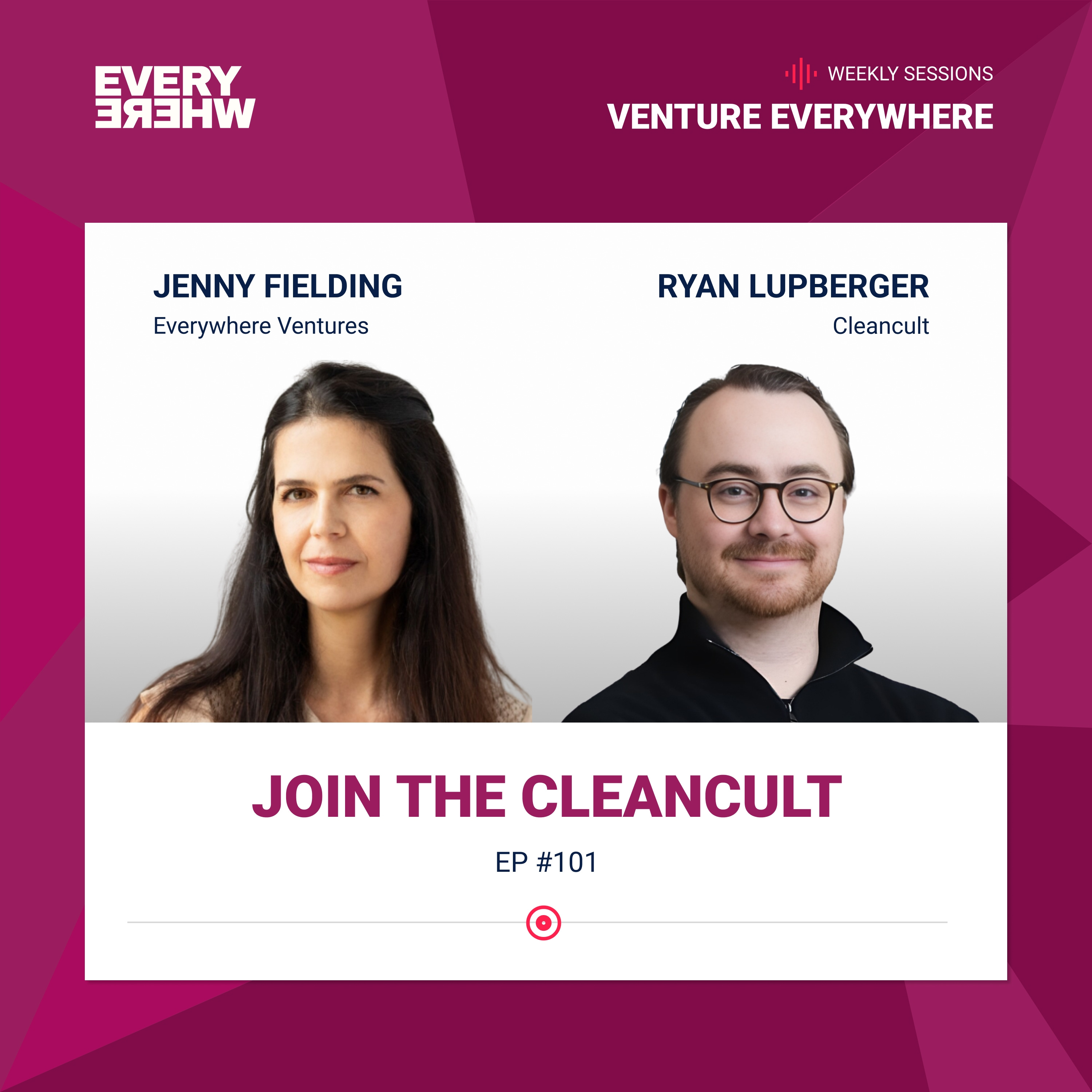
In episode 101 of Venture Everywhere, Jenny Fielding, co-founder and managing partner at Everywhere Ventures, talks with Ryan Lupberger, founder and CEO of Cleancult, a sustainable cleaning products company revolutionizing the household cleaning category with innovative paper-based packaging that eliminates plastic waste. Ryan shares his unconventional journey from working on organic farms to discovering the largely unregulated world of cleaning product ingredients. He discusses the realities of building a sustainable CPG brand that can compete with industry giants without compromising on price or performance.
In this episode, you will hear:
Building custom manufacturing infrastructure for liquid soap in paper cartons from scratch.
Scaling from D2C to nationwide distribution across major retailers.
Achieving price parity with legacy brands through volume, partnerships, and operational discipline.
Expanding the product portfolio with innovative plastic-free formats across cleaning categories.
If you liked this episode, please give us a rating wherever you found us. To learn more about our work, visit Everywhere.vc and subscribe to our Founders Everywhere Substack. You can also follow us on YouTube, LinkedIn and Twitter for regular updates and news.
00:00:04 VO: Everywhere Podcast Network.
00:00:14 Jenny Fielding: Hi, and welcome to the Everywhere Podcast. We’re a global community of founders and operators who’ve come together to support the next generation of builders. So the premise of the podcast is just that, founders interviewing other founders about the trials and tribulations of building a company. Hope you enjoy the episode.
00:00:32 Jenny: Welcome, everyone. Today, we are very excited to have Ryan Lupberger, the founder of Cleancult. I have had the pleasure of knowing you now, Ryan, since 2018. You were actually one of the first investments that we made out of our fund, which is very meaningful for us.
00:00:51 Jenny: You’ve just had such an epic ride, lots of twists and turns along the way. But would love to kick off hearing more about why sustainable cleaning and maybe a little bit about your entrepreneurial background, because you’ve really been an entrepreneur.
00:01:05 Ryan: 8 years. It’s crazy to say that at this point. Originally I never knew I would fall in love with this. I took quite a bit of time off before university and traveled around. I worked on sheep farms and I woofed for quite a while, which is willing workers on organic farms.
00:01:21 Jenny: I did not know that you were a farming nomad. Interesting.
00:01:25 Ryan: I was a bit of a hippie for a few years. Then I worked for a company called the Unreasonable Institute when I was younger. And it’s basically Y Combinator, but for businesses that want to change the world. So it’s all impact focus and just fell in love with what business could do for big problems.
00:01:44 Ryan: So there was a big mango seed recycler that could deliver 30% cheaper chicken feed in Africa. Really successful. They basically merged profit and impact. So, went out to Babson. This was 2012, I think 2010 at that point. When I was there, I looked at the back of my bottle of laundry detergent and didn’t see any ingredients listed.
00:02:02 Ryan: And still a Boulder kid at that time. It’s like, why aren’t there any ingredients on the back of my cleaning products? I was super crunchy back then, less so now. And basically said, why? It put me into this whole journey of ingredients, ingredient regulation, carcinogens, toxicity.
00:02:18 Ryan: The industry is crazy. Right now the US cleaning industry is effectively unregulated or under-regulated. It’s not in the FDA, it’s not in the EPA, it’s not under anything because technically we’re not consuming it.
00:02:32 Ryan: That led to this whole journey. We looked at all the natural products, Meyer’s, Method, Seventh Generation, Babyganics, and they’re all covered with massive plastic packaging. For me, it was like, why hasn’t anyone figured out how to do better ingredients without the plastic packaging at scale? That’s how the idea was born early on.
00:02:48 Jenny: That’s awesome. So you’re out there and you’re like, “Better ingredients are in a lot of these things, but the packaging sucks.” You didn’t have a background in packaging or chemical. How do you even approach this?
00:03:02 Jenny: I know a lot of entrepreneurs are just people. Everyone has these ideas of how to make things better. But when it comes to physical products, it’s really different than like, okay, well, I could vibe code some software.. So how did you get started?
00:03:14 Ryan: It was, to your point, a long winding road. This is not an overnight business for us. Most people think we launched in 2019. It was a few years before that we... that we really started trying to get this off the ground.
00:03:26 Ryan: But we saw massive white space that retailers were forcing sustainable packaging. Government policy, at that time, were forcing sustainable packaging, plastic mitigation, biodegradability, but no brand was delivering on it. So we understood we really liked the category. I had a personal problem with it. I saw our niche, but then it was like, what do we do?
00:03:45 Ryan: So we tried everything. We tried concentrates, dilutables, powders, tablets, vials, glass, and nothing stuck. It was this two year winding journey. It was dilutables, changed too much behavior and people weren’t really willing to adapt it at scale. Powders were too much behavior change for the retailers and no one quite got it.
00:04:07 Ryan: Tablets were really good and we have some great, great competitors out there like Blueland who are doing great with tablets, but only if they’re not shifting behavior. So like dish tabs or laundry tablets. But no one had solved the liquid opportunity. That’s what we wanted to go after.
00:04:21 Ryan: So I had this aha moment one day. I saw Boxed Water, the brand that makes water in paper packaging and said, “Why isn’t anyone done that for cleaning products?” Overnight we went to a mock-up packaging company saying, “Hey, can you make this for us?”
00:04:34 Ryan: I brought it to an investor pitch with Dave Heath, the CEO of Bombas Socks. He was like, “This is it. This is brilliant. Let’s go after it.”
00:004:44 Ryan: So the challenging part was actually bringing that to market. It was harder than we expected, but it was like everything changed. Cause the minute we brought this mock-up in, people said, “Aha, this is it. Why hasn’t anyone done this before?” And that’s really what unlocked the idea for us.
00:04:59 Jenny: That’s interesting. Was it through Bombas’ founder that you met Katie Shea?
00:05:02 Ryan: Yes, exactly.
00:05:03 Jenny: That’s so great. I just saw Katie this week, actually. We run a women’s angel group together. So I totally forgot that she also had invested in you and Katie runs a fund called Divergent and she’s awesome.
00:05:15 Ryan: The small world. Obviously, a lot of shared investors.
00:05:18 Jenny: So from that moment, you know the direction that you’re going. Then what happens?
00:05:23 Ryan: Got the niche, got the category, have the backing, have the idea. It turned out to be brutal.
00:05:28 Jenny: Never heard that before from an entrepreneur.
00:05:31 Ryan: We really thought this was going to be a three or four month launch process. It was wildly challenging because you basically have three key problems in the industry. There’s no contract manufacturing that exists for this category or this product because you can’t run a non-food product on a food machine.
00:05:48 Ryan: All the big cart manufacturers in the world don’t run non-food products. They run juice, milk, water, you name it. So no one could touch this because if you use a non-food on a food machine, that machine can never again be used in food. Even if you clean it, there’s a bunch of regulations.
00:06:03 Ryan: Now we have to buy machinery and we’d never bought scaled machinery before. So I went on a US road tour. We set every equipment manufacturer. I was in the middle of Illinois, Arkansas, Ohio, meeting with a lot of these folks.
00:06:19 Ryan: Finally found one that worked. Long story short, bought the lines. Barely worked. So we have this now big line installed in a soap manufacturer that would take a bet on us because we’re also trying to sell them.
00:06:33 Ryan: We have no backgrounds. We have this crazy idea. Are you willing to have us install this 40 yard machine on the floor of your soap manufacturer and work through this technology with us? Super tricky.
00:06:46 Ryan: And then it was six months of just challenges. You guys did a really good article on our early days: three inches of soap in the floor, leaking everywhere, foaming everywhere. It looked like Willy Wonka with foam. Cause you just have all these really challenging technical problems.
00:07:02 Ryan: Because when you run soap through a line, you have to use what’s called a piston fill to get scaled production quickly. That piston fill foams the soap. So we had to figure out gravity filling and then the soap gets in the seal. When that happens, you have to get a much different temperature setting. And then you have to experiment with all of these different bottom seals. So it took realistically three years to get perfect cartons.
00:07:26 Jenny: So instead of three months, as you anticipated, it took three years.
00:07:31 Ryan: Took three years. The challenge, looking back, it was right during COVID. So we had a lot of demand without a perfect product. You had really challenging gross margins, a lot of custom returns, product issues, but people loved it. So revenue was scaling really quickly, but costs and losses were scaling really quickly.
00:07:51 Ryan: That was a super tricky timeline because we were building the plane as we were flying it, because the curtains weren’t perfect still. That’s why you’re out the door producing, producing, producing, but writing off and shrinkage. So it was just a very tricky balance during the 2019 to 2021 timeframe.
00:08:07 Jenny: I do remember getting a call from you when you got into your first retail. Tell us a little bit about your go-to-market strategy, direct to consumer, and then retail and then maybe pulling that back a little bit.
00:08:19 Jenny: I think that’s really interesting to listeners because, again, so many of us see things wrong in the world and if it’s something that we can solve for in software, we can get at it. But when we see these complex physical problems, I think we always think, “Well, why is it like that? Why hasn’t this been solved?” And you’ve really explained why. Three years just to get your manufacturing stack in order.
00:08:41 Ryan: It’s super tough, but I do prefer the moat. In consumer products, you can either go contract manufacturing, rip something out fairly quickly, or you could develop something really unique. And yes, of course it was hard, but no one’s done this at our price yet.
00:08:55 Ryan: Now we’re in year eight. That defensibility has born to be true, which has been really exciting. Finally, three years, we have the production, we’ve been shipping D2C. And I think it was a crazy journey because D2C was really good back then, and then it got really bad.
00:09:13 Ryan: So we thought, we founded this business thinking we could be the next billion dollar Harry’s for household cleaning products. We have a unique niche. We have a really scalable D2C model. And then the economics just broke because we’re shipping a heavy liquid carton that retails for $8, hopefully bundling and we had our subscription model.
00:09:34 Jenny: It wasn’t an off the shelf razor, which was basically already made and just put a fancy logo on it. It was heavy and bespoke.
00:09:42 Ryan: 100%. We obviously went out to the market 100% D2C. And again, 2021, we started realizing this model is broken. We always knew retail was going to be a big part of the business, but we thought we could have a true omnichannel business. Just didn’t work.
00:09:59 Ryan: The iOS update shifted our tax going up too far. Our shipping inflation during COVID went too much. Our margins were so slim on D2C that by the time all those costs and impact happened, just broke the business.
00:10:12 Ryan: So then we said, okay, we knew we needed to go retail. We had a couple retail tests going on at MYER and some smaller accounts, but we said, let’s double down. We needed to convert this business to a hundred percent wholesale. How do we do it? So then it’s been a four year business expansion to wholesale from 2022 through today.
00:10:34 Ryan: It’s been a longer model and now we’re basically distributed everywhere. We started in MYER, then we went to Walmart, then we got a test in Kroger. Now we are in Wegmans, Harris Teeter, Whole Foods, Costco, Target. I’m still figuring it out.
00:10:49 Jenny: I think what’s interesting about your journey is you probably look back at it and say, there’s so many things I would have done differently. But so many of the challenges that came your way… I mean, I don’t want to say black swans, but they weren’t necessarily things that you could anticipate.
00:11:03 Jenny: So the D2C channel changing was not something you would have done, but in the moment, everyone was doing that. It’s not like there was a learning there because these were new channels. And these things that happen when an algorithm changes or a channel gets shut off, you can’t anticipate that. It doesn’t matter how good an entrepreneur is.
00:11:23 Jenny: So how do you think about the business now and future proofing it and making it more resilient for the future?
00:11:31 Ryan: One of the reasons obviously we have very supportive investors. Everywhere’s great. We’ve had such a deep bench on this journey, which I’m very grateful that people believed in us through each of these crazy black swan events. That’s something we’re just very grateful for. We love our investors and just overall it’s been a really good journey.
00:11:47 Ryan: But I think the Black Swan has been interesting because they’ll keep coming up. Policy and regulation we thought was going to be a much bigger role here because you had big things coming out like SB 54 in California and the US Plastic Pack. And these big commitments coming out from Clorox, Henkel, Unilever, Target, Costco saying they need to go to 100% recyclable, refillable, biodegradable by 2025. That didn’t happen.
00:12:10 Ryan: So the way we’ve decided to future proof is before we thought we could be a premium price product because consumers and retailers would demand less plastic. Now we are the exact same price as the leading brands because everyone wants less plastic but given the economic status, given the retailer status, given the policy environment, no one is willing to pay more.
00:12:35 Ryan: So we future-proofed by can we be the mass player being just like the leading brands, but, again, without the plastic packaging. But that’s super tricky for margins. We future-proofed by betting on volume and retail expansion. But the challenge there is margin.
00:12:54 Jenny: So how do you get to price parity? What were the types of things you had to squeeze on?
00:12:59 Ryan: A lot of it’s throughput, a lot of it’s volume, a lot of it’s right supplier relationships. We’ve not been with our manufacturing partners for almost seven years and they’ve seen the growth. A lot of it’s mix. This year we’ve had a real challenge.
00:13:12 Ryan: So we have our refill hard cartons, first and only in the market. Then we launched our filled and refillable aluminum bottles to pair with those. So we tried glass, we tried a bunch of form factors, but we realized that people needed an entryway into the refills, especially in hand soap and dish soap.
00:13:26 Ryan: We got killed on tariffs this year because they are aluminum bottles and aluminum tariffs at 50%, even though we’re made 100% here in the United States. So that’s really tricky.
00:13:38 Ryan: For us, the way we’ve been able to do this is mix mostly, mix and throughput. And then it’s just being super disciplined and efficient. We’re a small team, every dollar matters. We’re so close to profitability now and will be next year and has been eight years but our margin structure makes it really tough compared to some other businesses.
00:13:58 Jenny: Talk a little bit about your customer base. The product’s called Cleancult. There are people that absolutely love this product. And so what do you do to engage that community?
00:14:10 Ryan: I think that we have a unique benefit. It’s such a different form factor on shelf that a lot of our marketing is just being so wild because no one’s ever seen a carton on a shelf. No one’s ever seen a lot of the aluminum bottles. No one’s ever seen our sheep products in categories like this.
00:14:26 Ryan: For us, a lot of it is that. Obviously it’s named, we lean into humor. We have a big TikTok campaign going on right now called Join the Cult. So it’s a lot of content creators saying, just joined a cult. Not that kind of cult. So we hopefully keep it humorous.
00:14:39 Ryan: But I still think the cleaning category is tough because it’s not in front. You’re not looking at it outside. There’s not that shareable nature of the product. It’s hidden in people’s homes. For us, it’s a little bit different of having a really almost intimate relationship in people’s homes versus something out and about that everyone looks at.
00:14:59 Ryan: We know you have a hand slip out for your guests, but then you probably have a stain killer underneath that laundry, no matter how natural you are. So it’s been, I would say, a long-term engagement. talked to our customers quite a bit. We lean into humor.
00:15:13 Jenny: The brand is really fun. I like the cartons. So I have the cartons and it reminds me of going to my grandma’s house. I think they’re really fun. I just like liquid and I think many of us have been conditioned that way, but also from a practical point of view, tablets and stuff, I use way less soap than most people.
00:15:30 Jenny: My clothes doesn’t get super dirty and I just don’t like it to get so when you have a tablet or anything that’s pre-packaged is just too much for me. So what I love about your product is really the customability.
00:15:41 Ryan: Right now it’s been like that. I could geek out about the cleaning category for too long, but basically liquid is a new phenomenon. In the 40s and 50s, this middle class boom happened after World War II and everyone bought machines and all these brands like Ajax and Dawn and Dial came out, but used to be powder. This new world of liquids is new, but it’s dominating.
00:16:02 Ryan: Right now it’s about 85% of the category is liquid, 10% pods/tablets and 5% sheets. But we need to solve the liquid. As great as tablets and sheets are, liquid is the big opportunity, both for plastic usage and also just overall. But it’s tricky. [laughs]
00:16:21 Jenny: Gosh, I feel like every year there’s this new thing. Tariffs really impacted you obviously. Take a step back and tell us a little bit more about where you guys are going. What’s the big picture for Cleancult and are there going to be new products for us to look out for?
00:16:35 Ryan: For us, we’ve gone in this journey, D2C first, then retail, because a lot of retailers are hesitant to put a carton on shelf. It’s new, it’s innovative, it’s a little bit edgy. So it’s taken a while to get a single category. We call it the wedge-in to then expand. So this year we finally have our wedge-in, usually one or two categories in almost every retailer, Kroger, Albertsons, Safeway, Target, Costco, you name it.
00:17:00 Ryan: Next year, we’re really excited to say we’re expanding a lot. So the carton’s working really well on-shelf. Our mix is shifting and it’s going to be a big year for us next year. I think that’s where we want to go. We want to compete with the likes of Mrs. Meyer’s and even Tide – I know it’s a big statement, but to some extent Tide, to challenge the category.
00:17:20 Ryan: Cause 50 years ago, this business in this category looked different. There’s no reason that 50 years or even 20 years from now, it can’t again. The whole category used to be powders in a box. Now it’s this: pods, massive plastic jugs.
00:17:34 Ryan: Our vision is how could we fundamentally change the category, but do in a way that meets shoppers and retailers where they are. We’re going to do that through wholesale. We’re going to do that through a lot of humor. And we do have a lot of new products launching, some of which are confidential, but we’re launching new scents, we’re launching new expansions. So Q1 should be really fun time for the business.
00:17:55 Jenny: That’s awesome. One of the things I actually like about your scents is they’re not overpowering. Meyer’s, I love the idea of it, but I would taste it on my dishes and it was so gross. The flavor smelled good in the bottle if I smelled it, but then I didn’t want that on my dishes. I like how yours are effervescent, but they’re not overpowering.
00:18:15 Ryan: We try to split the difference. Exactly.
00:18:18 Jenny: Obviously you didn’t come from this background. You had to learn things as you were going. You mentioned the Bombas founder and some of your investors and you don’t have to give a particular name, but how did people, whether they were mentors or people that you surrounded yourself, impact your journey? Are there any examples of an inflection point where someone really helped you?
00:18:38 Ryan: A year and a half, we didn’t have any traction. It’s 2016 to 2018, we call it the dark days, humorously, but we have two dark days. Dark days one, dark days two. Dark days two was the soap leaking everywhere on the floor.
00:18:49 Jenny: That’s dark.
00:18:51 Ryan: Really hard to fundraise because we didn’t come from the background. So why would anyone take a bet on us at that time? We’re also younger founders at that point in time. For us the first year and a half, we just tried anything that could stick.
00:19:02 Ryan: We got capital from almost anywhere. We had a National Science Foundation grant because we were doing coconut ingredient research. We moved to Puerto Rico for almost a year because we had a grant with the government there and still have employees there on the island. We have funding grants from all these universities around the country for each of their entrepreneurship competitions.
00:19:25 Ryan: We had everything, every grant for two years, because we couldn’t successfully fundraise until we had the right model with the carton. In the early days, it was Dave. Dave was a big pivot point for us because he was someone in the industry that was credible, that believed in the model and believed in us. That unlocked a lot.
00:19:42 Ryan: Vanterra Capital was our lead and our seed in our Series A. Also just a great, great partner who really believed in us and we had a great Series B lead too. But I can track it all down to that one individual who took a bet first that was credible, that really unlocked the world of our investors.
00:20:01 Ryan: And then we’ve had dozens of phenomenal investors that have made retail introductions, strategic introductions, product introductions. But for two years, we, threw anything that could stick to keep this thing going.
00:20:13 Jenny: So much of what we read in TechCrunch and all that, is BS. The overnight success, that’s very rare. I think your story, eight. and a half years in is much more common. The fact that you’ve been able to grind it out through all of the headwinds is pretty impressive. What’s your secret, I guess, for staying focused and healthy and not giving up?
00:20:34 Ryan: We have really good partners. We have investors that believe in us and I know mentioned it before, but we just like working with them, which has been a real privilege on this journey.
00:20:42 Ryan: And then my favorite video talk is Scott Belsky. It’s called the Messy Middle. It is, in my opinion, the most foundational video any entrepreneur could watch because it’s the true journey of startups without the… start, without the finish. Cause that’s all the news that we ever see mostly in these journeys and it’s all endurance and optimization.
00:21:01 Ryan: He chronicles his 14 year journey in a way that very few have before actually what is this journey. He struggled on his honeymoon because he had a business issue. He lost moments in his life because of this. How do you actually do it? And he always goes back to endurance and optimization.
00:21:18 Ryan: That’s what we’ve done is, every year, let’s keep going. Let’s survive and then let’s get a little bit better. And how do we improve the product? We’ve done that every year,
00:21:26 Ryan: I could say, to be honest, our 2020 product was okay. It wasn’t world-class. And every single year we’ve gotten closer to world-class and I think we have world-class products at this point in time. So for us, it’s endurance and optimization. I got married this year.
00:21:41 Jenny: Oh, congrats. That’s awesome.
00:21:43 Ryan: Thank you. So that’s obviously nice. And then having a really good team. I love working with my team.
00:21:49 Jenny: Tell us a little more about the team. Where is everyone located? How is it you run a CPG company? I imagine you need to have distributed people.
00:21:56 Ryan: Fortunately or unfortunately, we grew quite a bit during COVID. So we hired all around the United States. It’s mixed. We have a pretty remote team. We do have our headquarters node here in New York City. We’re in the office maybe three or four days a week, but we have people in Arizona, California, Texas, Illinois, partially to visit the facilities, partially just because that’s where we hired the talent. We hate saying this, but it’s Method 2.0. 60% of our team are Method alumni.
00:22:25 Jenny: Nice recruiting there.
00:22:26 Ryan: I think so. No one is allowed to say that internally anymore because it’s too much. It was like, “Back in the Method days.” It’s been fun because it’s a very similar go to market strategy, very similar retailers with a very different timeframe, but it’s fun. They just have great stories and bring a lot of experience from a very successful business.
00:22:45 Jenny: What’s the biggest misperception people have about running a sustainable CPG company? Cause I imagine there are so many idealistic young people that are like, “I want to go run a company doing good things in the world and bringing physical product.” And you’re a bit eye rolly.
00:22:59 Ryan: The biggest one goes back to pricing is that there is not enough demand for a premium price product in sustainability generally. It’s the same for wind and solar. It’s the same for carbon capture. It’s the same for all these big technologies, including cleaning.
00:23:16 Ryan: People want to change but their behavior doesn’t match their goals typically in what they say. Solutions need to be the same price. I’ve yet to really see, outside of certain fashion brands and really niche markets, that a premium product has delivered on changing something.
00:23:34 Ryan: For me, whatever you do, it’s all going down the price. People care, but not enough to shift in mass. So I’d say that’s the biggest thing we’ve learned. You’ve got to thread the needle, which has been tricky.
00:23:46 Jenny: It’s not all bad. We encourage founders that they have to know their business inside and out, and that includes their margin, their numbers, and their participation of what could go wrong.
00:23:55 Jenny: It’s great to have a double bottom line company, but you also have to have a top line, as we said. It’s taking you a while to get to profitability, but it’s pretty awesome. What does success look like for you and Cleancult?
00:24:08 Ryan: We’re pretty open about this. This could take one of three very different routes. Route one, we get gobbled up by one of the major strategics and then they’re able to leverage that technology and put a lot of their products in it, which could lead to some really good scale and also success.
00:24:23 Ryan: Option two is we hit our real threshold of growth, which we’ve seen some other brands and we take a big growth round. And it’s like, how do we go to become the next $200, $400 billion cleaning product? Seventh Generation does $300 million in sales. Mrs. Meyer’s is now up at a billion dollars in sales. Method’s $500 million of sales. Tide is 40 billion annually. There’s a lot of room for the categories. I think that’s an option and it could be a mix of both.
00:24:50 Ryan: Success for us is how do we continue to grow this and change the category? How do we remove as much plastic as possible? And then how do we continue to innovate these really unique spaces that don’t see much innovation? But we’ll see. I like what I do. So far, so good. I’m not too burnt out. We have to see how the industry and the business evolves.
00:25:11 Jenny: What are some of the innovations in sustainable packaging or formulas that you’ve seen over the years that got you excited just more generally?
00:25:18 Ryan: Credit to BlueLand. They’ve done a really good job with launching the first wrap-free tablet. It actually works really well. So that’s been a really cool technology to see. And they’ve done a really nice job of that digitally. D2C, less retail, it’s more our industry. They’ve done a really good job digitally.
00:25:34 Ryan: Sheets are really interesting. There’s a debate right now on PVA and water solubility and it’s called polyvinyl alcohol. We believe it’s one of the most unique form factors right now to reduce plastic and it’s really effective and they carry a PVA substrate that allows all the ingredients to be on it versus a big plastic jug.
00:25:55 Ryan: So we’re really excited about sheets. We just launched sheets early 2024 and we think we have one of the most effective sheets in the market at parity with liquid detergent, which is really hard to do. So really excited about sheets.
00:26:08 Jenny: Those are dryer sheets?
00:26:10 Ryan: Laundry sheets and toilet bowl sheets. So we launched the first mass market toilet bowl sheets earlier this year at Target, and they basically dissolve right in your toilet into effectively nothing instead of having a big plastic jug. So we’re trying continue to introduce convenience.
00:26:25 Ryan: That’s actually one of the fastest growing portions of our business, but it’s still a smaller market compared to liquid. We’ll still always lead with the cartons, but obviously we want to expand.
00:26:35 Ryan: And then in carton technology, it’s tough, but there’s a lot of really unique now plant-based biodegradable substrates being tested. It’s really hard to have the soap not leak out of the carton unless it’s perfect, but we’re really starting to try to test how do we get even better. It just has a big gap from commercialization versus proof point in the lab.
00:26:56 Jenny: And what are those made out of?
00:26:59 Ryan: It depends, but basically somehow a plant based called PLA. It’s made out of corn, but now they’re adding in the germs, the bacteria that eat the plastic in the production. So if you only have a year shelf life, you can put that out and it’ll go away effectively.
00:27:16 Jenny: It’s a self-eating corn.
00:27:18 Ryan: Correct. It’s a self-eating stable corn.
00:27:23 Jenny: I mean, if that isn’t the future. I love it.
00:27:28 Ryan: Exactly. Yes, we’re optimistic. We’re excited about the category and have to see how it all evolves.
00:27:34 Jenny: That’s so awesome. So speed round, just quick answers to some fun questions. Is there a book, podcast or some media that you’re enjoying right now?
00:27:43 Ryan: Definitely Behind the Money, Financial Times. It’s really good. It’s the Journal or the Daily, but with a London spin, so it avoids some of the current politics, frankly, that we’re getting mired in right now. So that’s my favorite podcast right now. It’s on business, economics, fundraising, and the fact that they have a European perspective, it’s just a little bit clearer-eyed than some of the US reporting.
00:28:07 Jenny: You think?
00:28:09 Ryan: Yeah, exactly. So that’s my favorite. podcast right now.
00:28:12 Jenny: I love it. If you could live anywhere in the world for just one year, where would it be?
00:28:17 Ryan: Definitely Spain. My wife is Spanish and we got married in Menorca, Spain this summer. I would love to live there and it’s just a matter of when.
00:28:26 Jenny: Let’s do it. I lived in Barcelona for a year. It was the best year of my life.
00:28:29 Ryan: Nice. That’s where I married my wife from.
00:28:33 Jenny: Aw. Very special place. Favorite productivity hack. You have a lot going on. So what keeps you efficient?
00:28:38 Ryan: I think this is eye-rolly, but for me, it’s still been ChatGPT, especially with business writing. It used to take quite a while to get the right language specifically, especially to some of the debt partners working capital and some of the more business heavy. I could do it so much faster now.
00:28:55 Ryan: I don’t like using ChatGPT for most of my writing because I think it still misses the personal tone. But with anything business related, I think it’s perfect. I’ve been really impressed with how fast it’s gotten. So that’s helped quite a bit.
00:29:07 Jenny: And then where can listeners find you? I will say you can go to cleancult.com.
00:29:12 Ryan: You can find us at Target, Amazon, Albertsons, or regional groceries, Costco, or our website, cleancult.com.
00:29:19 Jenny: And if people want to reach out to you, because they’ve got some partnership or LinkedIn?
00:29:23 Ryan: Or just email. So it’s just ryan@cleancult.com. Just first name @ the business.
00:29:28 Jenny: That’s pretty easy. This was super fun. Thank you so much, Ryan. We’re all inspired. It’s great holiday gifts as well. So run out and get some Cleancult.
00:29:37 Ryan: It’s been great. Thank you again for having me today.
00:29:39 Scott Hartley: Thanks for joining us and hope you enjoyed today’s episode. For those of you listening, you might also be interested to learn more about Everywhere, where a first-check pre-seed fund that does exactly that invests everywhere. We’re a community of 500 founders and operators, and we’ve invested in over 250 companies around the globe. Find us at our website, Everywhere.vc, on LinkedIn, and through our regular founder spotlights on Substack. Be sure to subscribe, and we’ll catch you on the next episode.
Read more from Ryan Lupberger in Founders Everywhere.