
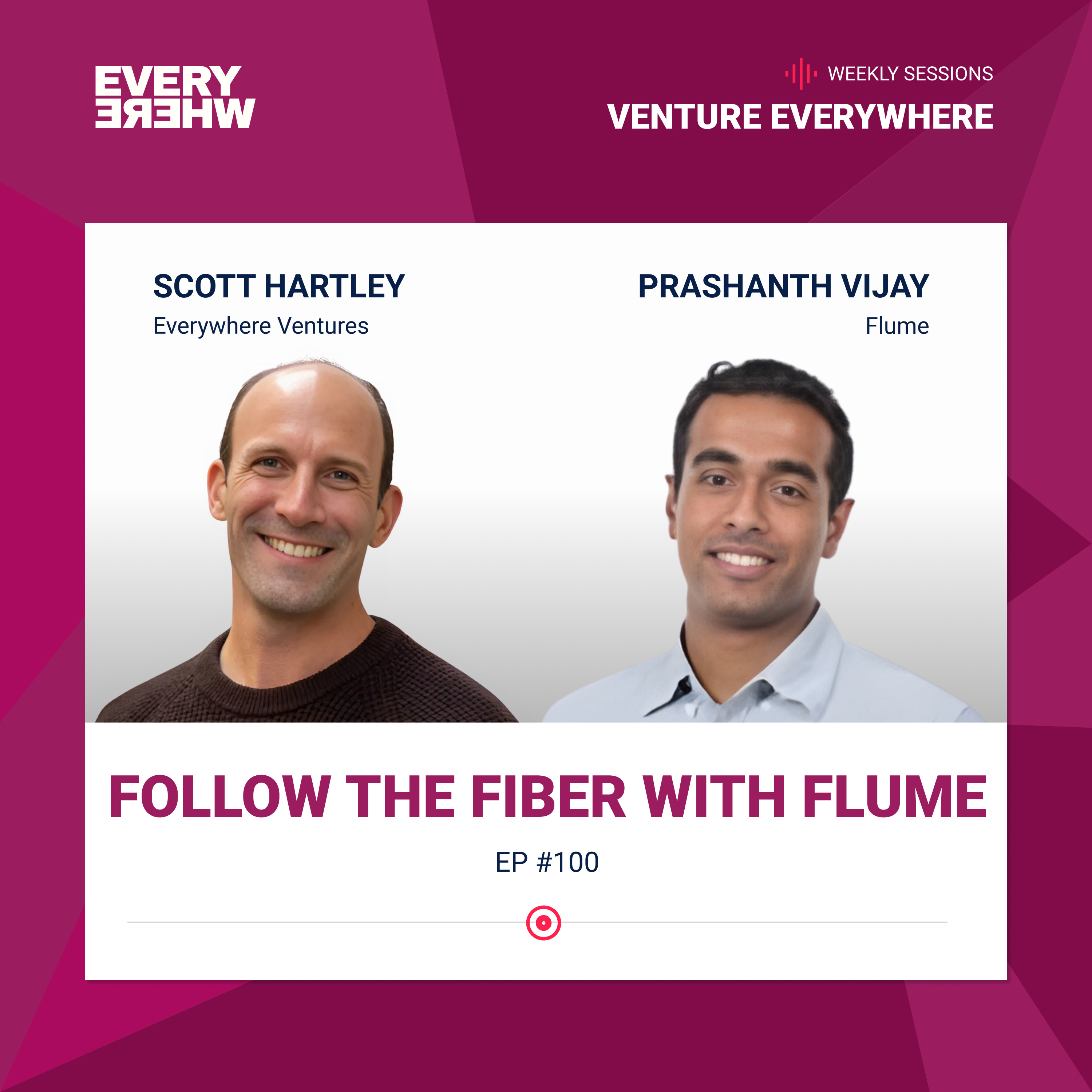
In episode 100 of Venture Everywhere, Scott Hartley, co-founder and managing partner at Everywhere Ventures, talks with Prashanth Vijay, co-founder and CEO of Flume, a New York-based internet service provider revolutionizing last-mile fiber connectivity across urban America. Prashanth shares his journey from nuclear engineering and traditional telecom to recognizing a massive infrastructure gap where many households still rely on outdated coaxial cable from 25 years ago. He discusses how Flume is leveraging unused dark fiber assets to bridge the digital divide and bring modern internet infrastructure to underserved communities across the country.
In this episode, you will hear:
Leveraging unused dark fiber to deliver modern internet without costly overbuilding.
Bridging the digital divide where 85% of U.S. homes still lack fiber connectivity.
Building intelligent network operations for the explosion of connected home devices.
Securing government contracts to deploy fiber in underserved urban areas.
Positioning as infrastructure for AI, robotics, and autonomous vehicle bandwidth demands.
If you liked this episode, please give us a rating wherever you found us. To learn more about our work, visit Everywhere.vc and subscribe to our Founders Everywhere Substack. You can also follow us on YouTube, LinkedIn and Twitter for regular updates and news.
TRANSCRIPT
00:00:04 VO: Everywhere Podcast Network.
00:00:14 Jenny Fielding: Hi, and welcome to the Everywhere podcast. We’re a global community of founders and operators who’ve come together to support the next generation of builders. So the premise of the podcast is just that, founders interviewing other founders about the trials and tribulations of building a company. Hope you enjoy the episode.
00:00:32 Scott: Hi, everybody. I’m Scott Hartley, co-founder and managing partner of Everywhere Ventures. Super excited to be here in what may or may not be the hundredth or hundredth and first, we’ll see, episode of the podcast, Venture Everywhere.
00:00:46 Scott: I’m here with one of our portfolio CEOs, Prashanth Vijay. Prashanth is the co-founder and CEO of Flume. What Flume is really doing is last mile internet service providing via dark fiber and connecting that fiber to last mile communities across the U.S., mostly in urban centers.
00:01:05 Scott: Prior to founding Flume, Prashanth is a prolific angel investor. He’s also worked across a number of other startups and earlier in his career, was really working across national labs, background in nuclear engineering, and then working in telecom at both Pilot and Verizon. Prashanth, welcome to the podcast.
00:01:21 Prashanth: Thanks for having me, Scott. Excited to talk all things infrastructure.
00:01:26 Scott: We have some fun stories in New York. A few years back, you invited me out to a colocation data center that’s in the middle of New York city. It was a fascinating experience for me because I always had wondered what these brick buildings were in the middle of New York with zero windows and lots of antennas on the roof.
00:01:44 Scott: And you sort of say, “Is this like a place full of international spy agents or what exactly is going on here?” You enabled me to go inside and go to the roof and sort of learn about this colocation data center for streaming. It kind of gave me a tiny glimpse into the world of problems that you’re solving. So maybe you can tell everybody a little bit about your backgrounds and about the impetus for starting Flume.
00:02:06 Prashanth: My background is generally in hardware engineering and then a little bit of nuclear energy. Just viewing the world with a lot of first principles outlook. Thought that networking was a really fast growing field 15 plus years ago. Today, the broadband usage since then has 1000X per home. So I think it generally ended up being the case.
00:02:29 Prashanth: I have a traditional work at a traditional telecom company, worked in oil and gas for a little bit before that and had a very first row view of how much money gets spent on infrastructure every year in America.
00:02:45 Prashanth: About five years ago, right at the beginning of the pandemic met my co-founder who was working at a fixed wireless company, a company that was trying to solve a similar problem, but using wireless infrastructure and rooftops. We realized there’s a ton of unused assets around the US, whether it’s the data center that we toured or lots of unused cabling underground that we could use to then start our own connectivity business.
00:03:14 Prashanth: It’s been about five years now. A lot of the inspiration came from my background and the industry continues to change a ton, every year or so. It’s been really fun.
00:03:25 Scott: It’s fascinating because I think even the acronym ISP and internet service provider is a term that I remember from growing up in the Bay area and the mid nineties. I think of ISPs as how we had the modem making those funny sounds when an early dial up. And then when we got early broadband and various things.
00:03:45 Scott: So to have the foresight to be building a modern ISP in the year 2025, walk us through the observation that you had. I guess it was around the existing infrastructure that’s kind of in place and then the fact that this existing infrastructure can be forked and extended and provided to last mile communities.
00:04:04 Scott: There’s ample government incentives and subsidies and various things in the public private partnerships, but what was it that jumped out at you to start something that is a bit contrarian.
00:04:15 Scott: To think about starting an ISP in the year 2020 when everyone has their Verizon Fios and they have the main three or four that we all love to complain about when we get our internet bills every month and have upload and download speeds that don’t exactly match the promises on the websites, I would say.
00:04:31 Prashanth: The biggest question I definitely get is like, Hey, is this a solved problem? And I think if you have good internet, you don’t really realize it, but large parts of the country still don’t. That’s why a lot of these satellite internet providers are really popular right now as well.
00:04:48 Prashanth: But in the US, let’s say there’s your older cable internet, like coaxial cable and set-top box and internet that way. And then there’s the newer class of fiber internet where you can get one to five gig speeds, download a movie in five seconds and all these awesome benefits.
00:05:07 Prashanth: In the US, there’s only about 14 to 15% fiber to the home penetration. And the rest, the vast majority of countries still uses cable or coax, which like you said, that sounds weird 25 years after the fact. There’s a lot of interesting market dynamics at play as well as where the infrastructure was built that have caused this gap.
00:05:31 Prashanth: About 65 to 70% of the country has a fiber cable on its doorstep. So our goal is to kind of bridge that gap without having to go overbuild and spend thousands of dollars a home. Studying the market over five, seven years in the industry, we realized the word digital divide is thrown around a lot almost as a political term these days, but there’s really a physical infrastructure divide as well. And that’s what we have built the technology to kind of enable and take advantage of.
00:06:03 Scott: There’s a fascinating metaphor where I think of early model T Fords in the turn of the century when cars were starting to be developed and cars had thin tires and the tires didn’t have a lot of traction. There was also horses on the road and there was horse manure and cars were slipping and sliding and not getting traction. They were on dirt roads.
00:06:25 Scott: The reality was the infrastructure was built for horses and for that world. And cars were sort of a new innovation that were using old infrastructure and were not really optimized. As cars became more, more popular, the roads were obviously paved. They were built into super highways under Eisenhower. Then cars became the connection of America.
00:06:47 Scott: Similarly, when you talk about cable versus fiber, it’s almost like we’re running the internet on a set of old dirt roads. We now have modern cars and we’re still trying to drive them, slipping and sliding across these old infrastructure channels like cable because obviously coaxial cable was built not for the internet. It was built for a prior world. And then fiber, which is more like the super highway of today, is being built but still maybe isn’t totally there.
00:07:15 Scott: So it’s an interesting example. And a lot of the naysayers of the day about cars weren’t so much about the actual car not working. It was really a complaint about the infrastructure. And I imagine this same debate happens today of, oh, I don’t like streaming video. Well, the reason you probably don’t like streaming videos because you’re doing it on a dirt road. You’re doing it over infrastructure that’s maybe not optimized for that type of delivery mechanism.
00:07:40 Prashanth: The working from home really exacerbated this. A lot of the legacy networks aren’t really built for upload. Either kind of one directional, you can download or stream video decently well. But then conversations like this Zoom call involve a huge two way stream of data. We’re both uploading a lot of traffic over a set of cables through Zoom servers and then to each other. And that’s what more modern networks are built for.
00:08:09 Prashanth: When you look at other countries, even when you normalize for household density, countries like Mexico, Canada, European countries have way more fiber to the home, like 70% penetration because they didn’t build a ton of this legacy infrastructure. They went straight to the better roads. That’s the gap we want to fix across the US.
00:08:32 Scott: One of the books that is in your office and one of the books that’s on my bookshelf is a book by Andrew Blum called Tubes. This is a fun book for anybody that’s interested in the infrastructure layer of the internet and how fiber and connectivity and all these things connect together.
00:08:48 Scott: In Andrew’s book, he mentions that his internet goes out in Brooklyn and he starts to go down the rabbit hole to figure out why his internet’s out. The ISP guy comes and says, “Well, it looks like a squirrel maybe chewed through the coaxial cable or whatnot.” And he starts to realize that the internet as we know it as this digital thing, quote unquote, “in the cloud” is actually deeply physical across a number of cables, fiber networks, under the ocean.
00:09:16 Scott: If you kind of think about this Zoom call right now happening between Colorado and New York, what is happening with the data? How is it leaving my computer going into the ground, going up to space, coming back down to New York? Walk us through a little bit of the mechanics. How does the data move around?
00:09:33 Prashanth: It is crazy that to some extent you can trace a physical wire that connects my office router back to the router in your house. And that’s generally how internet is delivered everywhere today.
00:09:48 Prashanth: So from my laptop, it’s hitting a wifi access point in our office, and then we do have Flume internet here at our office. And so it travels back over a fiber cable underground in New York city, from this access point to that data center that we toured maybe a few years ago. And then from there, Flume uses transit providers.
00:10:13 Prashanth: So the internet is kind of this huge mesh of air traffic control. We’re just at the data center and handing off our packet to these long haul providers, similar to like long haul package delivery. And they’re taking it on their fiber cables that were probably built about 15 to 20 years ago between New York and Colorado.
00:10:38 Prashanth: And that could mean literally, physically directly there, in a direct transit way, or it could be going to both your packets and mine could be meeting at a Zoom server in Dallas or something in between. And that’s how each data gets exchanged.
00:10:57 Prashanth: So we have to send a packet from here to LA and back directly. We can do that in about 20 milliseconds or so. It’s very similar to sending a physical package over to your house. It’s just we’ve built out all these cables that can do it at the speed of light with fiber optics.
00:11:16 Prashanth: We tell this to investors sometimes where there’s DTC and hardware startups and Flume is maybe on the highest order of difficulty in that world because it’s like selling a DTC product into every home and connecting each home with a string in the entire network. This is all physical and the networks are expanding every single day.
00:11:39 Prashanth: So there’s thousands of network engineers out there who make sure these packets get delivered the right way. They have a lot of cyber security and security layers on them. So the internet, I think a lot of people don’t realize how complicated it is to deliver.
00:11:57 Scott: Yesterday I was in my hometown of Palo Alto. There is a building in downtown, which I didn’t really know about as a kid, but I learned about over the years. And on the side, I always thought the inscription, was P-A-I-X, was just some old Roman numerals that were etched into the side of a sandstone building.
00:12:16 Scott: But P-A-I-X actually refers to Palo Alto Internet Exchange, which was one of the early recipients with SRI and Moffett Field and MIT where the original internet connectivity and cables were connecting a few places in the entire world.
00:12:32 Scott: And thinking about where we started in the eighties and nineties and with the advent of that, and then modernizing the internet with web browsers and enabling more human ability to navigate it without technical expertise. And then obviously to where we are today with thousands of network engineers, millions upon millions of miles of fiber and all these things.
00:12:52 Scott: So thinking about the past, the current, and then the future, what do you think about space? What do you think about what’s happening with Starlink? What do you think about the whole flurry of activity and conversations?
00:13:01 Scott: And we even have investments in the space. For example, Ascendarc, which is doing geosynchronous satellites or broadband connectivity across the world, working mostly with nation states that don’t have the infrastructure or don’t have the fiber laid down and want to have quote unquote “self-sovereign platform” to be able to provide broadband to their people without being beholden to Starlink or SpaceX.
00:13:24 Scott: But walk us through how you think about where infrastructure has been, where you guys are innovating and where you want to take it and how it interplays with some of these other aspects of space and other delivery mechanisms. Cause I imagine that all of these are both necessary and collaborative and it’s not one or the other. It’s really about last mile connectivity, fiber, space, and a number of other modalities.
00:13:50 Prashanth: Every network today is what we call heterogeneous. No one uses just one physical medium to get from one point to the other, because why would you just preclude a bunch of customers from being able to connect?
00:14:05 Prashanth: So, similar to education or roads or most other infrastructure, it’s all a question of the costs to connect an individual home. And then does that individual subscriber or internet market have the subscription capability to pay you back for that cost?
00:14:23 Prashanth: We know tons of other smaller and larger fiber providers, and they all today use either point-to-point fixed wireless links or sometimes satellite links to get them to their end users. So even Flume’s, there’s certain parts of Brooklyn or upstate New York where we actually can’t find an unused fiber cable anywhere nearby. So we will look at a satellite or a wireless option to connect and then do the last mile again to our subscribers.
00:14:56 Prashanth: It’s all a question of how quickly can you get – and efficiently – from the home back to that data center. Let’s say you have Starlink at your home in Colorado, you’re still beaming up to the Starlink satellite back down to a Starlink ground station. And then that ground station is connected via fiber to the Zoom server somewhere on the ground.
00:15:20 Prashanth: One day we’ll have Zoom servers spinning around up in space. That’s a pretty hot topic right now, data centers up in space. But it’s essentially a question of how efficiently can you do it?
00:15:32 Prashanth: A LEO satellite that might be 5, 10 kilometers up in the air right now has about 25 milliseconds, 30 milliseconds of round trip leads. It’s almost very much the exact same thing. It’s just cheaper to use that for certain use cases.
00:15:50 Prashanth: For example, anything that moves is a great market – airplanes, boats, trains. I’m personally looking forward to amazing Zoom calls on all of those moving mediums where you can’t stick a physical cable along any of those.
00:16:06 Prashanth: And then the homes where their ability to subscribe and pay for internet is not enough to cover. Think about your last home in town on the farm up a hill, spending $2 million to connect their house as a provider is going to raise the costs of everybody in the town to cover it when the average cost is way less. Those are like amazing use cases for satellites and wireless networks.
00:16:35 Scott: It’s fascinating to talk about the heterogeneity of the network and how we’re basically all using many different modalities already. And we think of it as, well, I use Verizon Fios or I have Comcast or I have whatever it may be. But these networks are hopscotching their way across different infrastructure.
00:16:54 Scott: And as you mentioned, and as we talked to Chris and David Kagan from Global Star at Ascendarc, about geosynchronous satellites, which are much farther out in space and have even longer latency. There’s a need for geosynchronous LEO satellites, data centers in space, infrastructure in the ground, telecom towers with backhauling and fiber out to last mile delivery.
00:17:19 Scott: It’s fascinating because in a dense urban network where there are a thousand apartments in a given mile – well, if it’s a million dollars a mile to connect fiber, what is that per house? Oh, it’s a thousand dollars per house. Maybe we can amortize that cost over a number of years. And this makes economic sense to connect this dense area. If you’re in the rural US, even in the suburbs or exurbs of any cities, sometimes that the economics don’t make sense.
00:17:46 Scott: There’s a big push for infrastructure, government spending. Are there a lot of public private partnerships or are there a lot of ways that Flume has tapped into the city of New York and some of the expectations and desires of politicians to connect certain communities or certain parts of the city that haven’t had connectivity before?
00:18:06 Prashanth: In the last five or six years after the CARES act, which was the first set of funds that came out during the pandemic, we realized that there’s a huge need to upgrade infrastructure apolitically. Our fiber infrastructure is well behind most other countries.
00:18:24 Prashanth: Similar to the re-industrialization of manufacturing or energy, there’s this clear national need to do this. While individual users in really nice areas or class A apartment buildings have pretty good internet, the usage of the general internet is blowing up still at a very rapid rate.
00:18:45 Prashanth: Soon we’re going to have robots using the internet. We’re going to have agents, the ability to create on-demand video by just sticking in a sentence into something. These are all huge bandwidth hogs.
00:18:57 Prashanth: In some of our single-family home markets, we see people’s Teslas uploading a hundred gigs a month of data. So if you’re going to be in a world where your car might be affecting your Netflix streaming. We don’t want to make the digital experiences worse.
00:19:14 Prashanth: So the government presciently realized this and has embarked on this 10 year deployment plan to say, let’s get more fiber in certain areas. That’ll feed more satellites to the rural areas. In New York state, Flume is actually currently building an 18,000 home network with a big government contract, multimillion dollar contract.
00:19:39 Prashanth: The idea is if you build more underlying fiber into these areas, the businesses, the satellite backhaul and more data center capacity can be built on top of that. So very analogous to energy or let’s build more manufacturing fabs. We will figure out the use cases for those fabs because we all believe that they are coming.
00:20:04 Prashanth: There’s been a lot of private public work recently. A lot is talked about with rural internet and that’s where the satellite and other solutions are great. There’s about 30 to 40 million ex-urban, suburban and dense urban homes that also don’t really have connectivity. So we focus there. And there’s plenty of state initiatives that are addressing that as well.
00:20:28 Scott: It reminds me a little bit of this asymmetric growth rates of different technologies. Back in the day when we had cameras that were starting to have bigger megapixels and started to do digital photography and you would have hundreds or thousands of photos on your device or your physical camera. And then you had this small USB cable that you had to connect in to download the photos. And there was a huge asymmetry between the ability to take photos, the ability to download and save photos.
00:20:56 Scott: You’ve run out of storage on your computer and we didn’t have cloud storage yet. And you think about today, the evolution of say, self-driving cars, autonomous vehicles, the data that’s in your Tesla versus the connectivity that’s maybe in your garage, it’s almost the same set of problems at larger scales over and over again.
00:21:15 Scott: But it’s really fascinating. And that leads me to my next question. You did mention one thing, which is human traffic versus machine traffic and thinking about the differences in that and the volume differences where in the early internet, it was mostly people navigating websites and various things.
00:21:31 Scott: Now, it’s a lot of web crawlers and API pings and various machines moving across these data packets. But how do you see AI altering the impact on physical infrastructure?
00:21:43 Prashanth: The data center landscape has changed a lot in the last two to three years. There’s now more data center investment than all of other commercial real estate combined.
00:21:53 Prashanth: If you listen to the latest leadership from Microsoft or CoreWeave, a lot of them are moving to more distributed campuses like WAN based AI. So wide area network AI data center campuses. A lot of these need a ton of bandwidth to do tons of inference queries or training runs between each other at low latency. So we see a lot of commercial fiber usage going to the data centers.
00:22:20 Prashanth: And similar to the original internet, this is a lot of download, like folks pulling down data from these commercial data centers and doing your own queries or inference requires reasonably quick latency. But in the next 18 months, we’ll start seeing the opposite, similar to Zoom calls on the applications and robotics proliferates. There’ll be a huge need for uplink connectivity back to the data centers and to each other as well. Tesla’s being an early use case of that.
00:22:52 Prashanth: There’s a lot of investment and thought going into the networking and optics. You hear Nvidia with NVLink or it’s really the networking that’s some of the differentiator. We see a huge spike in need for both networking infrastructure as well as know-how and engineering. It’s going to be competing for broadband use with your AI agents and your robotics.
00:23:18 Prashanth: It’s still probably 18 to 24 months away, but these things, to your camera and digital photo point, they don’t happen in nice gradual jumps. One day everyone, even in Flume networks and some of our denser apartment buildings, we see a lot of folks now buying these Matic robots, like the vacuums, and we can see the bandwidth that they use to do their image processing. It’s very cool to see the promise of IoT and devices is finally here for in-home use.
00:23:52 Scott: We like the term picks and shovels businesses, but Flume takes it to another level of literally picks and shovels underground with fiber and thinking about all these trends.
00:24:03 Scott: It’s fascinating to me too, because I had a conversation with one of our partners, Anna Barber from LA the other week, and we were talking about non-consensus or contrarian positions founders take. What we arrived at was it’s not about being non-consensus or contrarian. It’s actually about spotting consensus before it becomes consensus.
00:24:24 Scott: So thinking about the future and as you’re thinking about where you’re skating to kind of where the puck is going to be, are there ways that you’re tweaking the vision around Flume given some of these trends that you’re seeing?
00:24:38 Prashanth: Constantly watching where the market is changing is one of the funnest parts of being, startup CEO. Recently we’ve actually seen a lot of demand. So we actually sell usually to the city or to the property ownership, like a big portfolio of buildings. And they’ve seen a huge increase in demand and just usage of a variety of connectivity hogs, if you will.
00:25:01 Prashanth: So EV charging requires a lot of point of sale, network monitoring. There’s HVAC, water leak detection, smart locks. So it’s been a gradual growth, but across thousands of different types of devices. So we’ve started building a lot more features in our software.
00:25:21 Prashanth: We started off building features that allow folks to buy wholesale broadband from us and offer it to their tenants in the rent or if you’re a city in your utilities collection. Now, we’re getting a huge demand from folks saying, Hey, I have 10 point solutions. I have to pull up a smart lock portal, a HVAC sensor portal, and you guys can actually tell if everything is working or not based on if it’s transmitting traffic..
00:25:50 Prashanth: We would never offer a ton of these robotic use cases, but we can create a lot of interesting telemetry over that, showing you what’s working, what’s not, if your internet has any threats from something because it’s doing the wrong thing.
00:26:05 Prashanth: There’s a huge budding market in helping everyone manage all of these devices and websites and AIs. So as the connectivity provider, we see all these devices, they’re all unique IP addresses on our network. So we see a lot of good opportunity there.
00:26:21 Prashanth: And customers are already asking for it, which makes some of the consensus prediction a little easier on our end. But there’s going to be a world where someone’s going to have to help end users make sure a lot of these things are doing what they say they’re doing. They’re not sending you your data to certain places. I’m pretty excited about that along with growing the network to cover more homes.
00:26:45 Scott: I was just thinking of an analog within the wine world. You have different types of wines where you have estate wines, where somebody owns the physical ground and they grow the grapes and they pick the grapes and they harvest them and they make the wine.
00:26:59 Scott: And then you have others that just buy the grapes from somewhere else. Or others where they just buy the processed wine and they just do the distribution and the sticker and the label and the name of the wine. And there’s different tiers.
00:27:11 Scott: And as you think about telecom operators, I imagine there are that first bucket where there are large, large players that have all the infrastructure and the hardware and maybe 50% of it, or some percentage of it is their own hardware and their own network and their own fiber and their own satellites. And then others are piggybacking on existing infrastructure.
00:27:31 Scott: How do you see that world of the Starrys versus the Verizons versus where Flume is sitting in this ecosystem of owning your own infrastructure versus leveraging existing infrastructure?
00:27:43 Prashanth: It’s always amazing to own the infrastructure where it doesn’t exist yet. Even in New York with some of our government contracts, the goal is to build the first fiber networks, maybe using unused conduits or cables into certain areas and that’s really valuable in those areas.
00:28:02 Prashanth: But then in other areas, like we just publicly announced being available in thousands of homes in Phoenix. In the last four or five years, there’s been five fiber providers that announced new build-outs in Phoenix.
00:28:15 Prashanth: In certain markets, we view that the real value is going to be in the automated network operations, provisioning, automated customer service, as well as owning the customer relationship for like 5, 7, 10 years. Broadband’s extremely sticky business.
00:28:34 Prashanth: It’s like where there’s too many assets, maybe like an Airbnb type of model, we actually own the highest value is always going to be owning the customer relationship. So that’s how we split it up, is the truly underserved areas. There’s a huge logical business sense in owning some of these assets.
00:28:54 Prashanth: And then in the areas where there’s too much and it’s becoming a commodity, can we be this intelligence and customer service and have data center networking layer over those networks?
00:29:06 Scott: It’s really incredible. Thanks for walking us through that. It gives people visibility into the heterogeneity of not only how this market works, but even the companies that operate in this market. And it gives me just a ton of respect for what you’re building and the level of difficulty of what you’re attempting to do and the vision and mission around last mile connectivity for communities across New York and across the world.
00:29:33 Scott: Incredibly excited to be a small investor in Flume. I’ve loved getting to know you over the last number of years and for the tour of the colocation data center in New York, which gave me a totally new appreciation for how my own Verizon Firehouse worked in my Brooklyn building.
00:29:48 Scott: In quick summary and wrapping up with our speed rounds, other than Tubes, is there a book or a podcast that you’re currently reading or enjoying?
00:29:56 Prashanth: I’ve recently read and loved Abundance from Ezra Klein and Derek Thompson. They actually talk about a lot of this, like how regulation and permitting really impacts infrastructure and then how that impacts the application layer and technological progress.
00:30:12 Scott: If you could live anywhere in the world outside of New York City, what would be your number one?
00:30:17 Prashanth: Three or four months ago, I got engaged in Paris. My fiancee has a lot of friends there and we loved it there. It’s a magical city with food and wine and so… probably live in Provence or Paris somewhere for a year.
00:30:32 Scott: As far as your productivity hacks, as a busy guy in New York running an incredibly complicated business, anything that you can recommend as far as saving time?
00:30:41 Prashanth: I’ve started loving the use of Wispr Flow. It’s one of these AI speech to text apps. As opposed to typing, I basically just weirdly whisper into my laptop and it’s 3X to my typing speed. So I recommend.
00:30:57 Scott: Finally, where can listeners find you on the internet?
00:31:00 Prashanth: Pretty active on Twitter and LinkedIn. Our office is in Madison Square. Always down to jam with entrepreneurs physically as well. Generally try to stay active in the venture and digital communities where I can.
00:31:14 Scott: Thank you so much for spending time with us today on around our 100th episode of all time. We’re incredibly excited to be small participants in the Flume journey. Thanks for spending the day with us.
00:31:25 Prashanth: Definitely. Thanks for the support. I’m one of the earliest folks who came aboard. Always love staying in touch.
00:31:33 Scott Hartley: Thanks for joining us and hope you enjoyed today’s episode. For those of you listening, you might also be interested to learn more about Everywhere. We’re a first-check pre-seed fund that does exactly that, invests everywhere. We’re a community of 500 founders and operators, and we’ve invested in over 250 companies around the globe. Find us at our website, everywhere.vc, on LinkedIn, and through our regular founder spotlights on Substack. Be sure to subscribe, and we’ll catch you on the next episode.
Read more from Prashanth Vijay in Founders Everywhere.