
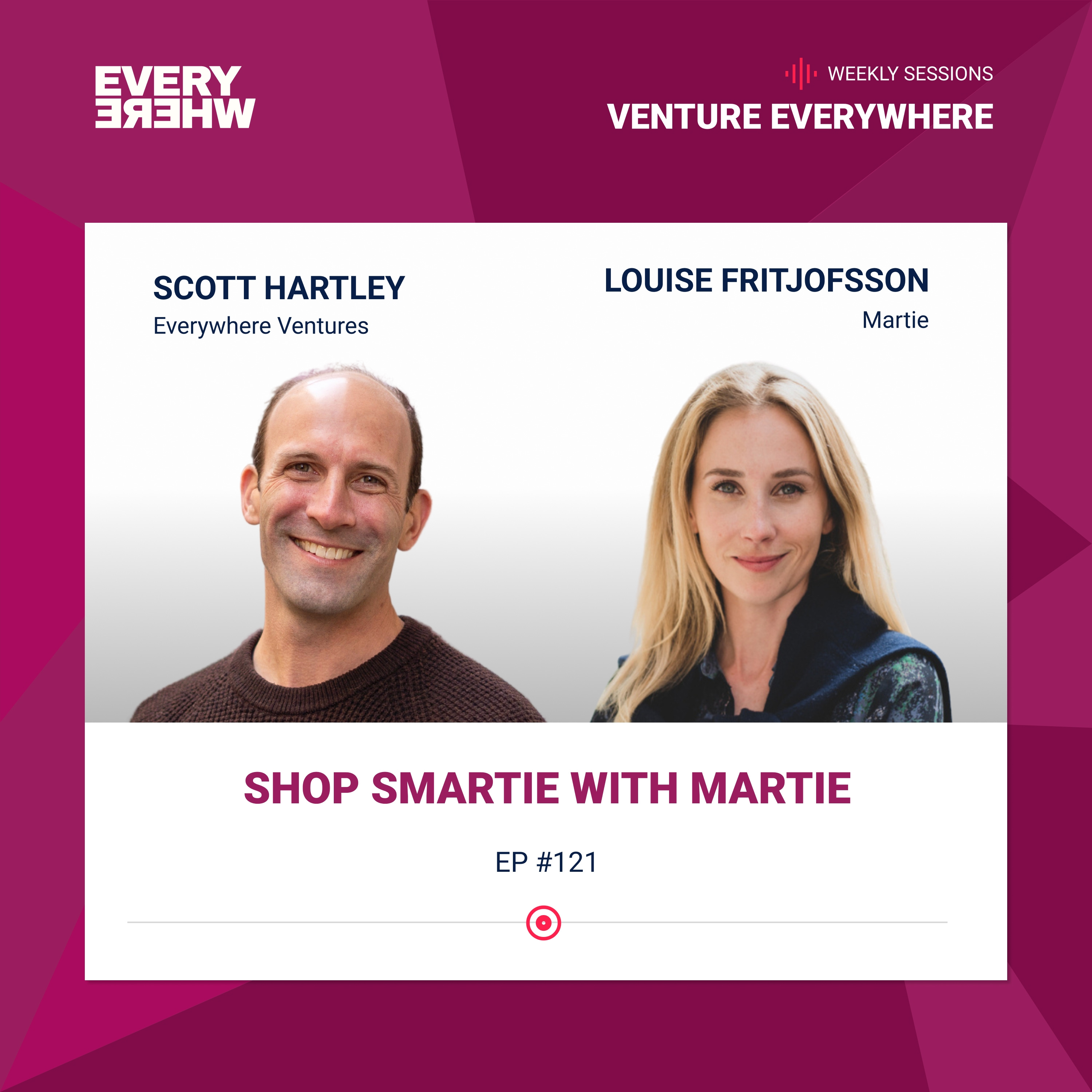
In episode 121 of Venture Everywhere, Scott Hartley, a General Partner at Everywhere Ventures, talks with Louise Fritjofsson, co-founder and CEO of Martie, a marketplace creating access through the world of excess by selling surplus and overstocked food and household goods from name brands at a discount. Lou shares how a leftover holiday cookie mix from an earlier startup exposed a broken industry: up to 40% of perfectly consumable products go to landfill because brands have no outlet for their overstock. She discusses Martie’s vision to become the household name in liquidation, building a brand where quality, savings, and sustainability all come together.
In this episode, you will hear:
Sourcing surplus from brands locked out of traditional liquidation channels.
Landing partnerships with large retailers to anchor the vendor marketplace.
Deploying MATE to screen 6,000 SKUs weekly with a lean buying team.
Prioritizing assortment depth and loyalty over membership tiers.
Testing mystery boxes and new formats to diversify the customer base.
If you liked this episode, please give us a rating wherever you found us. To learn more about our work, visit Everywhere.vc and subscribe to our Founders Everywhere Substack. You can also follow us on YouTube, LinkedIn and Twitter for regular updates and news.
Transcript:
00:00:04 VO: Everywhere Podcast Network.
00:00:14 Jenny Fielding: Hi, and welcome to the Everywhere Podcast. We’re a global community of founders and operators who’ve come together to support the next generation of builders. So the premise of the podcast is just that, founders interviewing other founders about the trials and tribulations of building a company. Hope you enjoy the episode.
00:00:32 Scott: Hi, everyone. I’m super excited to have Louise Fritjofsson. Lou, as I would call her, is a four-time founder. She’s the co-founder and CEO of Martie.
00:00:42 Scott: Martie is an incredible marketplace that helps provide surplus and overstocked foods and household goods. I personally use Martie all the time. I love getting my Martie pizzas in the mail.
00:00:51 Scott: It’s really a mission-driven business that thinks about economic and environmental impact. I know that there’s a lot of food waste out there and you’re doing a great job helping get things that are off the shelves into people’s homes that maybe haven’t moved.
00:01:04 Scott: Lou, welcome to the podcast. Thanks so much for being with us today. Tell us a little bit more about Martie.
00:01:10 Lou: Thanks for having me. We’ve been around for about four and a half years. Martie really is about creating access through the world of excess.
00:01:16 Lou: We stumbled into this market, as you mentioned, as my fourth startup. I really came into this wanting to build companies that make people healthier. Was looking at the CPG space, the food space.
00:01:28 Lou: Thinking deeply about the 80-20% rule. 80% is what you eat, 20% is how you move. So if I want to build a company that makes people healthier, how can I do so in food?
00:01:37 Lou: It’s an interesting journey of getting here. I spent a couple of years looking at where’s the gap in the market, MVP-ing a ton of different things. In this period of time, I found my co-founder, Kari, who’s a seasoned CPG founder and operator. She had just sold her company, Morris Kitchen, and was looking for something new.
00:01:53 Lou: Some of the things that we really felt deeply worried about when we started looking at this is we have 40 million Americans that are food insecure. We have more people than that that are just struggling to put good food products and general consumables in front of their family. And cheap usually comes with less quality.
00:02:11 Lou: So when we started looking at this space, we said, how do you change the narrative? How do you create access with good products to more people? In this period of MVP-ing, we actually started different companies.
00:02:22 Lou: We went out and we said, what if you would build the next Procter & Gamble that don’t have ingredients that cause cancer, that actually are accessibly-priced still? What would that look like?
00:02:33 Lou: We started spinning up multiple brands with the help of influencers as brand owners. We came to the holidays and one of our companies had a holiday cookie mix. And the holiday came and the holiday went, but we still had a lot of holiday cookie mix on our hands.
00:02:47 Lou: We started looking around and we were trying to figure out who could buy this after the holidays. There are some massive companies out there operating in this space. The liquidation industry here in the U.S. is $800 billion so there’s plentiful of buyers.
00:03:00 Lou: But we were a small up-and-coming brand and we did not want to work with any of them because of the brand erosion of living in a space like the dollar store or the Five Below Five.
00:03:11 Lou: We started talking to many of our other brand owners that we knew and everyone more or less had the same experience of like, yes, it’s a necessary evil at times. We prefer not doing it. Many of them reported actually tossing their products to landfill instead of giving it a second chance.
00:03:28 Lou: When you start looking at that, 30% to 40% of products that are being produced actually go to landfill despite the fact that they’re perfectly fine to consume.
00:03:35 Lou: This was a light bulb moment of saying, wait, there’s definitely a space here to build a good brand, a brand in the space of liquidation where we buy overstock, we buy things that is, in this world, considered short-coded.
00:03:49 Lou: And I will say here in the U.S., anything that is less than 12 months before best before date is considered short-coded because some of Whole Foods will not take it on at that point.
00:03:59 Lou: Me and Kari, we felt very strongly that we have two different positions here to win this market as it pertains to moat. We said, we know that we can build a brand that vendors want to be connected and work with.
00:04:10 Lou: We know that we can build a brand where we take care of the brand affinity in the market and we actually can use this experience as like, a new customer acquisition tool almost for these vendors. We know that we can build an experience where consumers feel like they’re winning when they’re shopping us.
00:04:24 Lou: And then on the other side, we also realized that this is a very old school industry when we’re looking at liquidation. None of them have really come into this world of tech or AI or any of it to make their life easier, more efficient and higher margins.
0:04:42 Lou: So we said we actually were coming from that world too. So now we have this position to win with brand and win with technology as it pertains to selling consumables, the brands you know and love at 40% to 80% off, sent to your door with high efficiency. That’s how it started.
00:04:59 Lou: Today, we offer around 1,500 SKUs at any given one point in time. Martie is an experience where you don’t have to pay membership. You don’t have to pay subscription to come and shop. You simply pick the things that you want. You get free shipping at $50.
00:05:12 Lou: We operate mainly in consumables. We do shelf-stable grocery. We do beauty and skincare. We do home goods, household and pet. The future definitely is a space where we’re looking at electronics. We’re looking at small kitchen appliances as well. Definitely a future where we can continue expanding our TAM here.
00:05:27 Scott: It’s amazing. When we first met you, the real light bulb moment for me was in realizing that even shelf-stable products that have a long duration of quality really are being liquidated off of the shelves of the Whole Foods. And these are perfectly good products that still have six months, nine months of longevity.
00:05:46 Scott: Just because they’re below a certain threshold, they get pushed off the shelves, to your point, 30 to 40% of those, into landfill, which is just outrageous when you think of those 40% of Americans that don’t have access to just filling their pantry or filling their kitchen.
00:06:00 Scott: Talk a little bit about how you built this two-sided marketplace in some sense. It’s always tricky. Did you go more to the supply side first and get partnerships with some of the large retailers on the liquidation side and then build the brand and brand presence around demand generation?
00:06:16 Lou: It’s interesting. Many, many, many moons ago, I read a book called Crossing the Chasm, which is a marketing book. And it really resonated at the time that I read it. It’s remained a true North Star in how I’m thinking about building demand for any business. And it really is about building the top of the iceberg first.
00:06:32 Lou: When we launched this business, we knew that we want to get the best vendors on our platforms. Because when we get to sell their overstock and other brands start seeing that we’re working with the Drunk Elephant and the Osea and the Fishwife and the Momofuku and they’re online and they’re 50% off, that brings such trust to our platform.
00:06:51 Lou: That we can continue building assortment with not only the tippy-top, coolest brands that are up and coming, but we can actually widen the scope after that.
00:07:00 Lou: The second thing that happens when you start working with these best brands in each category and you make sure that you build a close relationship and you get their inventories, the audience that you’re getting.
00:07:09 Lou: So we’re looking at the same process when we’re looking at who’s shopping. Martie. We have shoppers today. We have shoppers nationwide. We have actually quite a wide swath of users as it pertains to who the customer is. But 80% is women. The largest age group that we have is 30 to 40 years old.
00:07:24 Lou: It’s interesting because the largest densities that we have is New York and Los Angeles. These are actually shoppers that are quite affluent who otherwise shops Whole Foods and sometimes Sprouts and Erewhon and Credo.
00:07:35 Lou: Why they’re coming is because they’re seeing that they’re feeling really smart. They’re like, oh my God. I get Whole Foods products at 50% off? It’s brag-worthy at this point. So they tell all their friends. All of a sudden what’s happening is that’s also then an affluent aspirational audience where we can continue building audiences as we go.
00:07:53 Lou: It’s really hard to start super wide or lower down on kind of like totem pole and build yourself up. But if you start just getting the aspirational brand and getting the aspirational shoppers, it is easier then to build wider and more audiences as you grow.
00:08:08 Scott: Two fun facts. Geoff Moore used to sit next to me at my old venture fund, Moore Davidow. He was a venture partner, the author of Crossing the Chasm. Geoff and I have had many conversations about the early adopters, the early majority, the late majority, the laggard.
00:08:21 Scott: It’s so true that Fishwife, Becca, they have such an aspirational brand. And that is something where even though I love the product and I’m paying full price for it, sometimes I love even more seeing it on Martie.
00:08:32 Scott: So you go after the aspirational retailers, those key brands, build this brand worthy platform that scales the demand, and then you can move into these adjacent categories.
00:08:41 Scott: Now that we’re on the precipice of AI and agentic commerce and all of these new tools, how are you guys seeing that change how you’re building product or how you’re interfacing with customers? Has it made inroads yet or is it still early days?
00:08:55 Lou: I will say, first of all, it is such an interesting time to be building a company. It is the most fun and it’s the most challenging. And it’s the most challenging because it’s always been fast to build startups, but the speed of things happening now is just exponentially faster.
00:09:11 Lou: One of the things that we did, which is core to our business, is building out a system called MATE, Martie Agentic Trade Engine. It’s an agentic buying tool. This is very important for what we’re doing.
00:09:22 Lou: How we’re operating, what we’re doing could not have been done five years ago. We look at more than 6,000 SKUs every week as an organization, and we buy between 200 and 500 of those.
00:09:32 Lou: The data that goes into understanding what those products are and how we price them and how we present them to our audience, I would have needed probably 15 to 20 buyers as a buying team minimum.
00:09:43 Lou: We would probably have missed a lot of the inventory still that we’re seeing. We would not have been buying inventory to be cash flow positive and neutral, which is the fact of what we’re doing now. I have two buyers in my team just operating all of this, using our tech tool as the go-to agentic buying tools. This is the heart of our organization.
00:10:01 Lou: When you’re looking at MATE, MATE is completely rebuilt if you’re looking at the technical pipelining in the last year. Whatever we had done before, all of a sudden, we’re not up to speed. Was not up on par with how we’re building and how tools are accessible and how efficient they are.
00:10:18 Lou: Which means that you constantly need to go in and redo the work to not fall behind and for the system to have the best chance of succeeding as it pertains to its self-learning capabilities, in terms of how it’s using all the data that we’re piping in.
00:10:33 Lou: It is super exciting. We’re a very small team. We’ve been around for four and a half years. We’ve 3X our revenue in the last two years. There’s nine of us. When you start looking at how you can build very efficient teams as you’re surrounding each core team member with agentic tools, it is incredible.
00:10:51 Lou: The efficiency is just out of this world, but you’re moving incredibly fast. The most challenging part with that is keeping everyone aligned. I’ve always thought one of the hardest things is everyone locked in with what we’re doing because one week can be different than last week.
00:11:06 Lou: We’re moving very fast, and that moving fast is no longer just our own business. It’s the entire environment and the tools that we’re using, how we need to redo the things that we’ve done previously. It’s a different speed. It’s a different process of trying to keep everyone up to speed.
00:11:22 Scott: What we see a lot is the adoption of AI tools, supercharging some of the folks in your team, giving them, for the same input or the same effort, 10x or 100x the output. There’s an amplification of the skills that you hire for.
00:11:36 Scott: And it’s not that you can cut staff and leverage AI to produce the same output, the skinny argument. It’s really you go strong and you supercharge your output.
00:11:46 Scott: It sounds like you guys have built MATE to help optimize SKU purchasing based on demand throughput. Are there certain categories that you’ve seen that have surprised you?
00:11:58 Lou: 100%. I think is where we saw the gap in the market and the industry as well. Buying inventory for this type of business is really hard because you can’t restock the products that sell well.
00:12:06 Lou: That’s normally what you do with an e-commerce. Buy from a marketplace. You just sell more of whatever is popular. In our case, the popular product will sell out and it will not come back in stock immediately. We usually see it again, but not on a stock-to-stock basis.
00:12:19 Lou: Then you need to predict sell-through on products that you’ve never seen to fill the gap for that one product. What this tool is able to do is look at each individual shopper and their shopping patterns. We know when they’re coming back.
00:12:30 Lou: We understand what they have in their cart as it pertains to category, but also what’s the ingredients? What’s the attributes? Where are these products normally selling? Is it a Whole Foods product or a Walmart product? What was the price off? What was the other certifications that this product has?
00:12:45 Lou: Because we can’t come back and say, hey, you bought Barebell’s Protein Bar and here’s a KIND bar. That will never jive. So if we’re going to come back to you and say we’ve stocked their store with the things that you want, it needs to be a BUILT Bar or a Prima Bar that is on par to the Barebell’s.
00:12:59 Lou: To put that work on a buyer, to understand what is it that we need to stock the store with, with such detail, all the intricacies, it’s too much if you’re keeping pace and you’re buying 2 to 500 SKUs a week, launching that number of SKUs on the side and you have such a small team.
00:13:14 Lou: It’s super powerful. And again, it’s wild to think about where we were five years ago. You could probably build something similar, but it would have cost you a lot more money and it would have taken you a lot more time to set this up. Where we are today and all the things that we’ve been able to do with such a small team is actually just incredible.
00:13:31 Scott: As a buyer and user of Martie, it is something that I noticed, that product adjacencies, like here’s a Nutri-Grain Bar, here’s another type of Nutri-Grain Bar.
00:13:40 Scott: It’s drilling down into the data of where did this bar come from? What’s the quality or price point? What’s the discount? The adjacencies that I see when I go to the site really help me increase my basket size. And I do feel that.
00:13:52 Scott: Over the four and a half years that you’ve been building this company, you and your co-founder, what would you say the breakdown is between the two of you or your particular superpowers and what you’ve been able to build over these four to five years?
00:14:04 Lou: We do have a very clear division. I’m more on the marketing and tech side. And Kari, she has a background building her own CPG company. She has a really good handle of building inventory, building relationships with our vendors, understanding how that all comes together.
00:14:20 Lou: She has been a big part of setting up operational warehousing and that partnership as well. Both of our backgrounds really comes into play. It’s been really cool to see how we have just different strengths and together we really have been able to make everything come together.
00:14:36 Scott: On the operational side of the business, how do you guys think about density of population, density of shoppers, where you build these inventory stocks? Because obviously with a national product, there’s some complexity to that.
00:14:51 Lou: Maybe even more so with our product because we constantly rotate our inventory. A SKU usually stays in stock for about 30 days. And again, we have about 1500 SKUs. The operational overhead of getting SKUs in and getting SKUs up on the side and then something sells out, it’s an ongoing.
00:15:07 Lou: We decided a couple of years ago to try and remain with one warehouse as long as we can, just for the efficiency of building that. We know that we have two big growth levers.
00:15:16 Lou: One is the inventory depth and the amount of SKUs that we offer. We’re getting higher AVs. We’re getting lower CAC. We’re getting all the things as we’re building our inventory. It’s a huge growth lever for us.
00:15:27 Lou: And then of course, we have our other growth lever, which is acquisition marketing. We’ve made a conscious decision of trying to stay in one warehouse as long as we can. That is actually in Dallas, in Texas.
00:15:36 Lou: It’s very cool for the purposes of we know who we are. We promise savings. We promise you’re going to get the best deal on the internet when you’re shopping Martie. You’re going to get quality goods. It’s true to that initial mission vision of creating access to the world of excess.
00:15:52 Lou: But we’re not the most convenient. What I mean with that is you will wait for your box. If you’re in California, you will wait four days to get your box. You will save 50, 60% from going to shop the same products at Whole Foods, but you will wait four days.
00:16:07 Lou: We don’t sell you your eggs and your milk. And we have no plans of going into reefer, like refrigerated or frozen aisles. Everything is shelf stable. We’re just very, very clear with who we are, what we promise the consumer and are very gung-ho staying true to those savings.
00:16:22 Lou: It’s really easy to get off track and start having everyday low prices. All of a sudden your pricing is similar to what you find at Walmart. That’s a dangerous path to go because if you’re not staying true to your moat, you could never survive with a four-day ship time if you don’t have really, really good pricing.
00:16:37 Scott: In that same vein, one of the biggest challenges as a founder is having the conviction to stay in your swim lane and know who you are and what you want to build. And also have the ability to listen to feedback from other folks that also have experiences in and around the category.
00:16:53 Scott: Over the four years, what are some of the contrarian viewpoints that you’ve held or disagreed with investors, disagreed with board? Have you had those moments and how did you stay true to that north star?
00:17:05 Lou: Many, and that’s for the purpose that we are a small team. And it’s hard. It’s hard to be very mindful and say no to things because there is so many shiny objects. There are so many things that you wake up being excited, wanting to build and try and figure out how to get it done.
00:17:20 Lou: But this could be anything from, we have really strong opinions that this should be a subscriber-based access, for instance. That you should pay something to get access to these prices.
00:17:31 Lou: Just from a vision standpoint, that goes against what I’m wanting to do. I want to create access through the world of excess. We want to change the narrative that cheap usually comes with less quality.
00:17:39 Lou: We currently have an affluent audience. Again, I think it’s a very great position to be in. It’s not the end all. I’m here to build a household brand name. I want everyone to be able to shop Martie. I don’t want it to be bougie. I want it to be accessible, fun, modern, and all the things.
00:17:55 Lou: I want to be the IKEA of liquidation. Everyone should know us and everyone should know that we’re affordable, but no one should be ashamed to shopping it. That goes against an idea of having a subscriber wall, for instance, where you need to pay to access these prices.
00:18:09 Lou: So that’s something that I’ve come up again and again, where we’ve said this is not what we want to do. And similar programs, which probably will come in our future. And I think some of them are just a timing where, again, what’s the biggest upside for all the things that we have to work on?
00:18:21 Lou: Should we launch membership right now where it’s choose your own adventure and you can pay up for a membership? That’s absolutely going to be a future of what we can offer to get faster shipping or free shipping at a lower threshold, et cetera.
00:18:35 Lou: Do I think that’s where we’re going to make up most our revenue now more than focusing on building deeper assortment or building better loyalty funnels or all the things that we’re working on? No. We’re pushing that in the future.
00:18:47 Lou: There’s so much to do and it’s really hard to stay focused. We definitely have had a lot of pull from even internally to do something like everyday low prices. But again, I am very, very cautious and wary about “We need to be a lot cheaper than Walmart to succeed,” and stay true to our mission and vision.
00:19:06 Scott: I love that you brought up IKEA. Just building the brand, Martie, and the colorful palette and the friendliness of the brand, I think you guys have done an excellent job making it accessible, making it fun and forward-leaning.
00:19:19 Scott: But as you brought up IKEA, and I know you’re from Sweden originally, was there any influence or inspiration, perhaps, from that experience or just the scale of that opportunity and that being locally Swedish in origin?
00:19:32 Lou: I started my first company when it was not cool to be an entrepreneur. I was 19. I was very lucky to get a job out of school. I didn’t know what I wanted to do at university. So I was like, let’s take some time.
00:19:43 Lou: I started working for this entrepreneur and a small company. And everyone’s like, why would you do that? Startups was not a cool thing. But I did that. And in that experience, I’m like, yes, he’s asking me to do things where I have no idea what I’m doing.
00:19:56 Lou: I saw these opportunities swirling around me. And I was like, oh, if I can work for him and just figure it out, maybe I can do it for myself. I was very lucky to end up at that job and end up in a community in Stockholm that was the post-IT bubble, still working in startups, doing all the things.
00:20:13 Lou: I just got to know a lot of people that were real, founder DNA, had done it for multiple years. Again, they’d gone through the IT bubble and had successes and then crashed and they were at it again. Seeing that had me feel very confident that I could try and do my own thing at 19.
00:20:31 Lou: Again, it was not a cool thing. All my friends were like, what’s wrong with you? Are you not able to go to school or get a real job? That’s how my journey started. And then two years later, my first business was acquired.
00:20:42 Lou: And then I started another business. In that period of time, as I was building my second business, Spotify came up. Mojang started being built. Klarna started coming up as a shooting star.
00:20:53 Lou: And the tech ecosystem in Stockholm formed in the years that I was having my first couple of years as a founder. That was super formative. So all of a sudden, it was cool to be a founder.
00:21:03 Lou: You could see these great successes and you could start feeling like you could also be on the trajectory of building a unicorn and so forth. I think it was just a very exciting time to be young and have those couple of first startups and couple of first early successes with these companies being built around me.
00:21:20 Scott: Fun fact for those of the listeners who haven’t been to Stockholm. Stockholm has a parallel to San Francisco in Soma. In San Francisco, it’s South of Market. And in Stockholm, it’s Sodermalm.
00:21:30 Scott: And I love that when I went to Stockholm, I said, oh gosh. I feel at home. It’s like I’m in Soma again, except for it’s way more beautiful. Tiny bit cleaner, a tiny bit nicer, a tiny bit better in all respects.
00:21:42 Lou: It was a cool time. Stockholm is not a huge city. So you get to know everyone in the tech ecosystem and everyone’s super helpful and supportive and the tight knit community. That definitely was super formative.
00:21:53 Scott: Shifting gears a little bit, just to ask you about the marketing side of the business. How do you think about channels and how have channels changed over the last few years?
00:22:02 Scott: Do you guys lean heavily on content development? Or how do you think about the mix of channels to drive CAC down and get to this first order revenue profitability and then obviously huge retention over time as people get to know the brand?
00:22:17 Lou: As a startup, you want direct conversion. We live and die with our products. So for us, we launch more than 30 new products every day that is brands you know and love at high discounts off. It is kind of like a marketer’s dream.
00:22:31 Lou: When you put those in product ads on Meta, the likelihood of them converting pretty well is fairly high. We’ve been doing that throughout these years.
00:22:39 Lou: Anytime we put on our big girl pants and wanna get out and try something that is more content driven or other channels, we get cold feet pretty quickly because the cycle is longer and the customer acquisition cost just is higher. We, again, are gearing up to say we need to diversify our marketing portfolio. We need to do more things.
00:23:00 Lou: With the recent build in categories for us like beauty and skincare, I do think there is other channels that we are ready to get into now that we haven’t yet but that we have on the roadmap for this year. But we are looking to do more but we’re just very efficient with our product ads still.
00:23:17 Scott: Are you seeing in that mix of products that you put on to Meta changing consumer grocery habits or behaviors that you’ve noticed shift over the last four years? Is there a push toward greater health more than there was four years ago? Do you feel that in the market?
00:23:33 Lou: Honestly, even when we started like, the fastest moving segments in grocery was better-for-you, organic, specialty. If you’re looking at any growth report throughout the last four or five years, that has been the strongest segment and that just continues growing faster and faster.
00:23:49 Lou: That is our biggest assortment. That’s really interesting because we’re seeing that what we’re doing is we’re also getting a lot of users that consider themselves being air quotation but like, “a Whole Foods girly” but priced out of Whole Foods.
00:24:02 Lou: We’re just getting a really big audience to come find us with huge excitement because these are products that they want to get but they’re priced out. So we become just super important for this audience and that’s also how loyalty and retention really builds.
00:24:17 Scott: Do you guys foresee a world where you would have product adjacencies created by Martie in the mix given your co-founder’s background?
00:24:24 Scott: I know that obviously you’ve got off-the-shelf white label products in Whole Foods and obviously in Trader Joe’s. Is that a direction that you could foresee where there’s maybe higher margin opportunities by taking on categories that you see hype movement in?
00:24:39 Lou: We’re not writing it off. We don’t have it on the roadmap as of yet. It is also something that I’ve come up as a question again and again. And I think we are seeing some interesting brands working with the same type of inventory.
00:24:52 Lou: But there’s a lot of cool companies using the end parts, the inventory that is not being used up, et cetera. where you could probably create some pretty cool brands and products where we see the data of it moving.
00:25:05 Lou: But as of now, we’re very heads down with what we’re doing and supporting the vendors and brands that we’re working with to make sure that they get the best outcome for anything that is overstocked for them.
00:25:15 Scott: I know that you guys to some have been likened to… it’s TJ Maxx of Whole Foods. Do you like those comparisons? This is a… absolutely enormous category with a huge opportunity. But how do you think of that next five years and where you want to take the business?
00:25:30 Lou: I want to build a household brand name. I want everyone to know Martie. I want everyone to know that you’re smartie because you’re shopping Martie. It’s great for the environment. It’s great for your wallet. It has some discovery.
00:25:40 Lou: We’re seeing a phenomenal pattern amongst our users where they usually come and pick out 12 units in a box. Half of them are just, I don’t care what it is. It’s staples for my home. It’s a pasta sauce. It’s nut butters, pasta itself. It’s rice. I don’t really care about the brand. I just want a good brand at a good price.
00:25:58 Lou: And then it’s some of the things that maybe draw them in. Like, oh my God. Drunk Elephant at 50% off. Or maybe someone else is obsessed by another Supergoop. We’re seeing this pattern where we can continue building compounding revenues effect. So I want to build a household brand name. I want to build enormous loyalty and just compounding revenues.
00:26:17 Lou: For me as a founder, when I’m looking at unit economics, I think it’s really interesting to think of your business as a SaaS business when it’s a direct-to-consumer business.
00:26:24 Lou: How can you make sure that revenue just compound month over month because you’re building your cohorts and they keep spending with you? That’s what we want to produce and create. I truly think if you’re focused on building that type of value and that type of loyalty in a direct-to-consumer, you will have phenomenal outcomes.
00:26:42 Lou: That’s, every day, what we’re marching towards and what we’re looking at is are we creating those habits and that behavior? Are we seeing revenue compounding over time? Because then we’re going to be safe from all the unit economics and revenue that we need in the future.
00:26:55 Lou: And thinking deeply about our brand. How do we show up and what channels? How are people talking about us? How do we make it fun? How do we make it a treasure hunt? How do we sincerely help people saving money and just having an easier everyday?
00:27:07 Scott: On the fun bit in the treasure hunt comment, I know you guys recently launched these surprise boxes where people get a number of goods. Talk a little bit about how you had that idea and what’s the market? It’s resonating quite well.
00:27:19 Lou: It’s wild. Who knew people love some mystery? I will admit we were looking at a couple of items that we transparently overbought. Phenomenally great products. They had great velocity in our store. We knew people love them.
00:27:35 Lou: We were just not moving at high enough pace to sell out before we wanted to. We wanted to realize the revenue here. So we said, what about putting it in a mystery box? Because we do think there might be a different behavior for a mystery box buyer than our core buyers.
00:27:49 Lou: Our core buyers are on our site every week, picking the things that they love. They’re just in there. And then we said, there is some buyers that just want to make it easy and they want savings.
00:27:58 Lou: Why don’t we present the mystery box and see if we can get a couple of new users from our database to commit to mystery box and they can also get these great products?
00:28:07 Lou: And the first time we did it was only probably at 500 boxes, but it sold out in 20 minutes. We didn’t even have time to send the email. We put it on the site, it was gone. It led up to a couple of weeks of trying different price points. Is it a theme box? Is it a mix box?
00:28:21 Lou: So it’s really exciting. We have been building on this. We’re doing a bigger launch for a mystery box at the end of the next week as an ongoing product because it definitely seems to have legs.
00:28:31 Lou: For us as an organization, this is the year we can continue 2, 3X-ing our revenue. But as a startup in the consumer landscape today, figuring out what are the green shoots that you can get out and really put efforts behind testing and either doubling down or killing it, if it works or not, those are the things that can 4X your business.
00:28:48 Lou: So mystery box is just one of multiple things that we have slated this year to see how else can we merchandise and present our products to attract an audience who’s slightly different than the everyday shopper from Martie.
00:29:02 Scott: I was gonna say I am a smartie because I shop at Martie, but I have not yet bought the mystery box. But I do think this user behavior for somebody that’s busy, that’s just fatigued with decision fatigue, you go to the shopping page and you say, oh, another 20 things I need to decide today.
00:29:18 Scott: There is a user behavior that just wants to click mystery box, have it come every month, have it be full of delicious snacks, whether you’ve got kids or it’s for yourself. It’s a great innovation that I think will drive really interesting behavior for Martie.
00:29:32 Lou: It’s super fun. One of the best parts of building a company is getting to try these new things and getting to learn about user behaviors across multiple different cohorts and products.
00:29:42 Scott: Just to wrap up, I know that you spend some of your summers in the beautiful archipelago of Sweden. If you weren’t in Los Angeles and you weren’t in Stockholm, where on planet earth would you choose to live?
00:29:55 Lou: Man, I have such a boring answer for you because I think about where I should live all the time. If I didn’t want to live here, I would live somewhere else. I freaking love living here.
00:30:04 Lou: And this is through extensive conversations and looking at everything from business opportunity to weather to where is kids happy? Where is our family? Where is our community and friends? Where do we feel most grounded and home?
00:30:17 Lou: Me and my husband are the crazy people who we travel to someplace and we’re like, should we live here? So we’re just constantly gauging. Is the grass greener somewhere else? But I’m so happy to report this is where I want to live.
00:30:31 Scott: Los Angeles is incredible. Tell me as a founder of a business and four-time founder of a business, what’s one of your biggest productivity hacks, especially as a mom as well?
00:30:40 Lou: Some people may have heard this. There’s different versions of this. Again, it’s funny when you think back at the things that you kind of like learned when you were very young and that stuck with you.
00:30:49 Lou: I felt very scattered with spinning tons of plates in one of my earlier businesses. Having a team and how do you make everyone happy and someone comes into your room and you want to help them. So you’re like, letting everything go to like, figure this thing out for them.
00:31:04 Lou: I got this productivity hack to say, every task is a monkey. If you don’t contain the monkey, everything is going to be just whack. Monkeys are tossing papers and they’re stepping over your computer and it’s just wild. It’s not a good thing to have in your office. You never want a monkey in your office.
00:31:20 Lou: So everyone that comes to you with anything that they’re asking you for help with or to do, that is a monkey. If you’re going to take that monkey, you better contain it. You better understand you need to then figure it out, contain it. That’s on you.
00:31:35 Lou: But best case scenario is that this person leaves with a monkey. You don’t have time for another monkey. Another monkey is going to wreck your day.
00:31:42 Lou: It sounds so stupid, but thinking about anyone coming to you with things and that’s a freaking monkey. And I can’t have it here right now because I don’t have time to contain a monkey. I have other things happening.
00:31:52 Lou: For me, it worked really well. Figuring out how that person leaves and taking the monkey with them sounds stupid, but it’s a very good visualization for me.
00:32:01 Scott: I love that. So one question off script, I have to go back to Stockholm roots. Between the duality of Spotify or SoundCloud, where do you come down across the fence?
00:32:12 Lou: Oh, Spotify.
00:32:14 Scott: Spotify? Okay. Good answer. That’s my answer, too.
00:32:17 Lou: Oh, but here’s the thing. I’m a SoundCloud user, but if I’m looking at the corporate structure and how I want to build my company, it’s Spotify. But that’s only because I know more people at Spotify.
00:32:27 Scott: For those who don’t know, this is a classic Stockholm-Berlin debate.
00:32:31 Lou: Yes, but I’m definitely a SoundCloud user more than a Spotify user for my own music.
00:32:35 Scott: Love it. Finally, where can listeners find you online?
00:32:39 Lou: My name is great because you can find me on LinkedIn super easily. I am pretty active on LinkedIn, but Martie Goods. Instagram is @martiegoods. And I pop in there, and that’s a super fun account to follow. I’m probably most active on Martie’s Instagram account more than my own. Martie Goods is probably actually the best location.
00:32:59 Scott: That’s where to find Lou. Thanks so much for being with us today. If you’re able to get outside and enjoy the perfect LA weather, I wish that for you.
00:33:08 Scott: Thank you for everything that you’re doing to help solve food waste in America and make America healthier. It’s an incredible platform, and I hope that everybody who listens is able to pop on there and buy a mystery box.
00:33:18 Lou: Thank you. Me, too. Get on with the mystery, guys.
00:33:22 Scott: Thanks, Lou.
00:33:22 Lou: Thanks.
00:33:24 Scott Hartley: Thanks for joining us and hope you enjoyed today’s episode. For those of you listening, you might also be interested to learn more about Everywhere. We’re a first-check pre-seed fund that does exactly that, invests everywhere. We’re a community of 500 founders and operators, and we’ve invested in over 250 companies around the globe. Find us at our website, everywhere.vc, on LinkedIn, and through our regular founder spotlights on Substack. Be sure to subscribe, and we’ll catch you on the next episode.
Read more from Louise Fritjofsson in Founders Everywhere.