
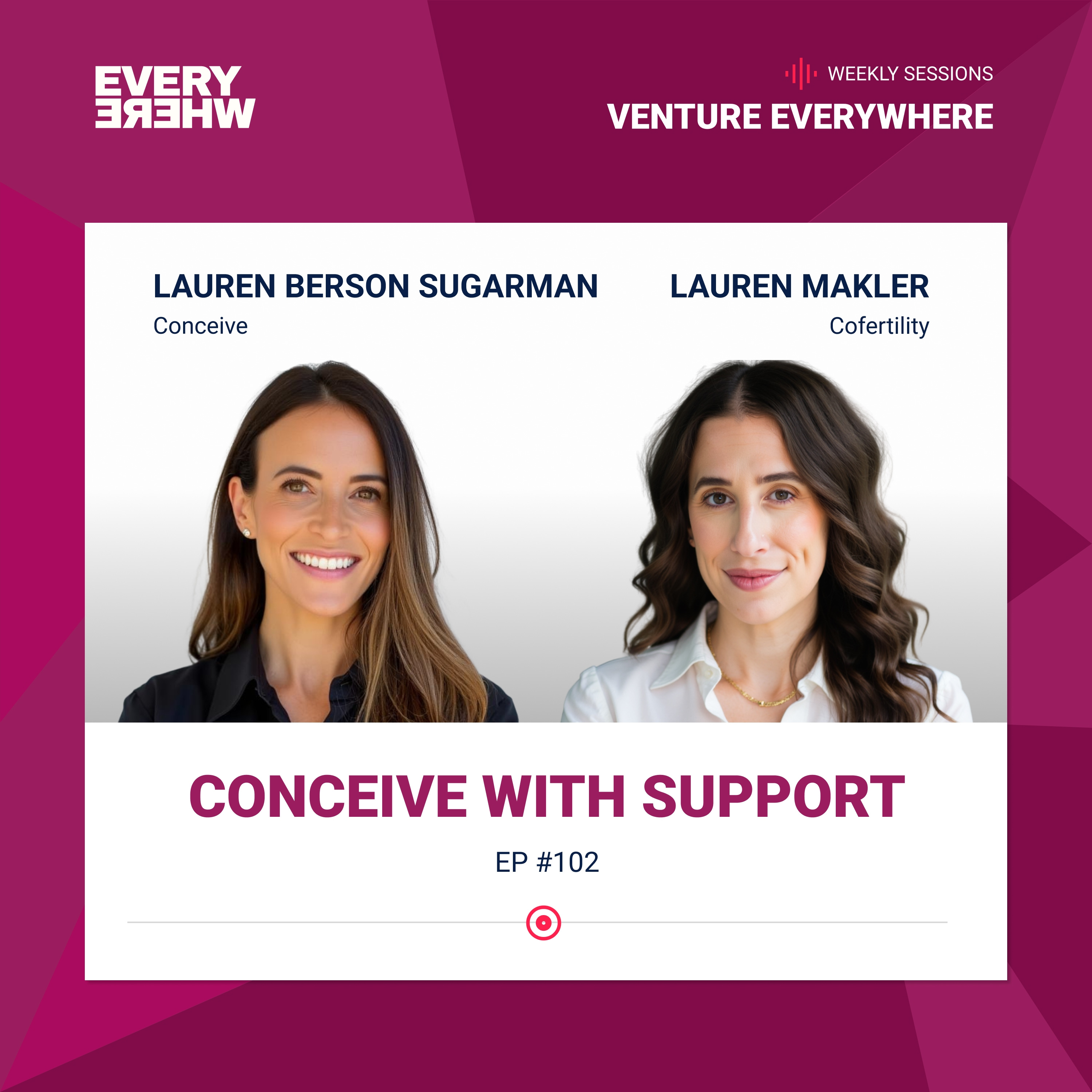
In episode 102 of Venture Everywhere, the host is Lauren Makler, CEO and co-founder of Cofertility, where women freeze their eggs for free when donating half of the eggs retrieved to intended parents who need the help of an egg donor to have a baby. She chats with Lauren Berson Sugarman, CEO and co-founder of Conceive, an AI-powered full stack support platform for women navigating fertility and pregnancy. She shares how her experience investing in digital health and building community-based wellness models led her to found Conceive after her own three-year infertility journey. She discusses how Conceive transforms fertility care by delivering the continuous emotional and informational support that time-strapped providers cannot offer, helping patients feel empowered and less alone during one of life’s most challenging journeys.
In this episode, you will hear:
Combining AI and human coaching for personalized fertility support.
Using a B2B2C clinic partnership model for seamless patient care.
Measuring impact through anxiety reduction and babies born.
Creating community-based support for the emotional fertility journey.
Addressing the three-leg stool of fertility: physical, financial, and emotional support.
If you liked this episode, please give us a rating wherever you found us. To learn more about our work, visit Everywhere.vc and subscribe to our Founders Everywhere Substack. You can also follow us on YouTube, LinkedIn and Twitter for regular updates and news.
00:00:04 VO: Everywhere Podcast Network.
00:00:14 Jenny Fielding: Hi, and welcome to the Everywhere podcast. We’re a global community of founders and operators who’ve come together to support the next generation of builders. So the premise of the podcast is just that, founders interviewing other founders about the trials and tribulations of building a company. I hope you enjoy the episode.
00:00:33 Lauren M: Welcome to the Venture Everywhere podcast. I’m Lauren Makler, CEO and co-founder of Cofertility. I’m here with my friend and fellow founder CEO, Lauren Berson-Sugarman from Conceive. Welcome, Lauren.
00:00:47 Lauren B: Hi, Lauren. I’m so excited about this.
00:00:51 Lauren M: So Lauren and I are dear friends and we did not meet until we had started our companies, both in the fertility space, both start with the letter C-O and we have the same name.
00:01:03 Lauren B: We are the Laurens.
00:01:05 Lauren M: We are the Laurens. We have very long conversations from time to time where one or both of us will go on a walk and just do what we call spilling the fertili-tea.
00:01:17 Lauren B: It’s my favorite pastime, I’ll be honest.
00:01:19 Lauren M: And so I feel like we are just inviting everyone into one of those conversations.
00:01:25 Lauren B: Yes, which is so nice and fun. What a treat for us.
00:01:28 Lauren M: I know. I think before we get into the fertili-tea, let’s quickly just tell everybody what each of our companies does so they have the context on who we are and how we’re coming into this conversation.
00:01:42 Lauren M: At Cofertility, we help women freeze their eggs for free when they donate half of the eggs retrieved to intended parents that need the help of an egg donor to have a baby. And so we’re both making egg freezing more accessible while making egg donation less transactional at the same time.
00:01:58 Lauren M: Conceive plays a really nice role alongside that. And so I’ll let you explain what you do and then we’ll get into it.
00:02:06 Lauren B: Amazing. I am a happy investor in Cofertility, which makes me very happy. I just am obsessed with your model and what you’re really bringing to bear along the lines of access, which is such an important piece.
00:02:18 Lauren B: At Conceive, we’re focused both on access to care and care itself. So really redefining how women get care for fertility and pregnancy. We combine really vertical AI and patient care along those spaces and we offer a full stack fertility platform.
00:02:34 Lauren B: Really what that comes down to is everything from preconception testing, so allowing you to get blood work and diagnostics to determine whether you have things you should look into along the fertility journey, all the way through 24/7 texting with nurses and coaches.
00:02:50 Lauren B: We act as an extension of the care team of your clinic or a direct message friend for you, pairing both the beauty of coaches who’ve been in the shoes of the patient and can handle questions around the emotional part of the journey, how you talk to your mother-in-law and set a boundary when she’s asking when she’s going to have grandkids.
00:03:08 Lauren B: All the way through, help me with my IVF injections tonight. I am overwhelmed and I don’t know how to do this. And layered on top, we offer community groups. We think of ourselves as this end-to-end support system for you.
00:03:20 Lauren M: Literally for me. I should mention too that I’m a proud graduate of Conceive in the sense that I brought home my beautiful conceived baby in July. As someone who, I work in this space, I consider myself someone who’s incredibly well-versed in the world of IVF and in family building through assisted reproductive technology, I still needed and truly benefited from the support of Conceive.
00:03:52 Lauren M: When you share all the things that you guys do, it’s so clear to me, both your solving and how you’re solving it. A lot of people are great at identifying a problem, but the solution here totally works even for the people who are the most well equipped to overcome this major barrier.
00:04:11 Lauren B: That’s right. Some of our most engaged members are the most resourced and connected people out there. But the reality is care doesn’t stop in between and after appointment. There’s so much of this journey that requires research and understanding. The unknown unknowns. If you have more preparation and you don’t discover that by chance, you have a better shot at success.
00:04:34 Lauren M: What helped you fall in love with this problem as an entrepreneur?
00:04:38 Lauren B: I am beyond obsessed with this problem. I consider this my life’s work, so I feel really lucky to do that. So the passion is exactly right. I know we’re so lucky. It gives so much meaning and purpose beyond just the day to day.
00:04:51 Lauren B: But really, I came about it from my own personal journey like many, but I had had this sort of unique front row seat to digital health for a while. So it all collided. I spent a lot of time mostly in tech, building communities and products and my superpowers really connecting people to make really big impact on businesses.
00:05:08 Lauren B: I did this at startups, Google, and then had this opportunity to go over to Andreessen Horowitz over a decade ago when we spun up our first biotech and healthcare fund and started investing in digital health companies. Everything from meeting founders who were trying to cure cancer all the way through to founders who were just trying to scale the first telemedicine business.
00:05:29 B: I just had this very unique front row seat into how they were thinking about the problems they were solving and how they were actually solving them. I became fascinated at the time you had in consumer health or wellness or whatever we called it then, biohacking.
00:05:42 Lauren B: You had sleep apps and meditation apps and fitness apps and all these things were so bifurcated and fragmented. I became obsessed with like, what is the platform bringing these things together? Because you have to treat the whole human. How you eat affects how you sleep, affects how you move.
00:05:58 Lauren B: I had this opportunity to go over to Weight Watchers for a couple of years and build out their platform beyond weight loss. If you think about Weight Watchers, they really pioneered community-based and coaching-based models.
00:06:11 Lauren B: Coaching is now newly in other areas of healthcare, but they’ve been doing this for years. And then people who had success on the program became coaches, which is very much the Conceive model. That’s what I stole from my time there.
00:06:22 Lauren B: But there I built out sleep, fitness and meditation programs. I was looking at how do we expand the offering beyond just weight loss. By the way, this is before GLP-1, so if we can think back that far.
00:06:34 Lauren B: I dipped my toe and really got my hands dirty in both. How do you breed digital health products that succeed, but also how do you create safe spaces online? Because that was the thing that drew me to the company.
00:06:44 Lauren B: I was very familiar with Reddit and Twitter and other online communities where there’s a lot of negativity and trolls. I was not aware that there were these beautiful safe spaces that really didn’t even need to be monitored because people were so clear why they were there and they were there to support each other and to get support.
00:07:01 Lauren B: As I was doing that, my two things collided. I went through infertility for a very long time. It took over my life. The first time for three years and then has continued since then.
00:07:13 Lauren B: My daughter just made an appearance before we started recording this podcast. So this story ends well. She is six and she is the light of my life. She is like an angel and was worth the wait.
00:07:24 Lauren B: But all of those challenges I encountered along the way, I became obsessed with solving and initially started at this patient focus journey. How do you combat the loneliness and isolation that everyone feels the moment they enter into this shitty experience? The reality is so many people around me were going through it and they just were suffering in silence.
00:07:43 Lauren B: And then secondly, how can technology really allow for you to get the answers you need to your questions? It just felt like such a solvable problem, but I wasn’t finding one, seven, eight years ago when I was Googling.
00:07:55 Lauren B: And so started there, but realized very quickly by helping patients get the right information at their fingertips when they need it and connecting them with people who’ve been through it. We also significantly help fertility clinics and these clinic networks who are looking for efficiencies, looking for better ways to educate patients, looking for ways to better retain their patients.
00:08:18 Lauren B: We have this win-win model where by helping clinics and patients. We all win.
00:08:24 Lauren M: I remember the first time we talked about Conceive and you talked about Weight Watchers. And you talked about how this model, it has worked in other areas where people are trying to overcome something that involves their health that can feel really lonely and isolating. That tech enablement has really moved the ball forward in so many ways – And so clearly understood what you’re trying to do instantly.
00:08:50 Lauren M: It doesn’t hurt that Weight Watchers, for me, has always been a company crush. I don’t know about you, but I have company crushes. I think it’s important to know who has been through some version of what you’re trying to do ahead of you and set some North Stars in that way. So really love that.
00:09:09 Lauren M: But also I think your openness to thinking through, yes, you fall in love with this problem. That’s what every entrepreneur needs to do at the start. But realizing that the clinics as a channel to reach your member is something that is really smart and might not have been your first approach, is that the case?
00:09:32 Lauren B: It is the case. I always knew that we would somehow be an enterprise, B2B2C company. I didn’t quite know who that would be. I did know though, it wouldn’t be employers. I’ve said this a million times, but I think that’s a garbage channel for many reasons.
00:09:47 Lauren B: One of which is the engagement is just so low. And so your product gets so watered down. You’re hoping that an employer tells an employee about it at the moment that they need it and that they feel comfortable taking advantage of it within the context of their employment.
00:10:00 Lauren B: For me, I’ve seen that at Weight Watchers, my husband’s company sells to employers. I knew that wasn’t going to be an area I was focusing on. So I thought it was either going to be clinic or payer.
00:10:10 Lauren B: What we saw very quickly was that the more we got to know the clinicians. That was something I set out to do early on, and you probably did this as well Lauren, I was obsessed with why this problem hadn’t been solved yet.
00:10:21 Lauren B: You look around and there were tons of community oriented businesses that had been out there that had either failed or were struggling. I was trying to understand like, well, why? Because it feels like such an important problem.
00:10:34 Lauren B: I know I’m not alone in it. Why don’t these things take off? Part of it is that direct to consumer community orientation is great and it feels good, but there are Facebook groups and there are Reddit forums and there are kind of free spaces to get information.
00:10:48 Lauren B: And so what I realized was not only could we deliver information, but we could deliver the information that your clinic already delivered to you, but you were so overwhelmed in that appointment that it didn’t land.
00:10:59 Lauren B: We’ve all been there. For many people, this is the first time they were really involved in our healthcare system. Not that they should be an expert in fertility, but they don’t understand how things are navigated and how to get through.
00:11:11 Lauren B: You go to these appointments, half the time you expect to see your doctor, you may not, depending on what kind of clinic you’re at. There’s just so much that’s confusing and not contextual until the moment it is. And so to have someone holding your hand through it and saying, Lauren, your doctor is to do an HSG next. Here’s what that means. Here’s how to prepare. Here are some questions you might want to ask them before the next appointment.
00:11:32 Lauren B: It just helps relax the nervous system, but also helps move you through the journey quicker and get you closer to your goal of that delicious baby.
00:11:41 Lauren M: So much of what you guys are able to provide is license to advocate, not just license, but the how to advocate for yourself.
00:11:52 Lauren M: We try. For me, what I realized going through my own journey to become a parent is that for this whole thing to work, it’s a three-leg stool.
00:12:02 Lauren M: One is physical, you have to be able to like endure all of the tests and all of the treatments and everything physically. You have to be able to financially endure it. You have to be able to like, have coverage or have the means yourself to get through this full process. And then third is emotionally and mentally. Do you have the ability to get through the emotional roller coaster and the waiting that comes with fertility treatments?
00:12:33 Lauren B: The hurry up and wait. Because sometimes you’re racing, we just had a member the other day who was just so upset that she couldn’t get another cycle in before the end of the year. It just didn’t work out that way. Devastating.
00:12:45 Lauren M: The companies that are going to be the most successful in this space are the ones who are able to nail one or two of those legs on a stool. For me, in working with Conceive, I needed help on understanding the medical, physical part of what is possible with my body in this time period. How do I do it?
00:13:09 Lauren M: You guys made sense of that. And then the emotional part of just feeling like, I just got out of my appointment. If I call my husband right now, he’s not gonna have any idea what I’m talking about. And so I wanna call my coach at Conceive, who’s going to like, be excited to hear from me and understand what was just told.
00:13:24 Lauren B: We had a member the other day as well who was ready to get about an altercation with her husband. I mentioned it to my husband. I didn’t say any details, but he was like, “People tell you that stuff?” And I was like, “Yea, they do because it’s hard. It’s part of it.”
00:13:38 Lauren B: My husband is an incredible, supportive feminist. All the things that I still remember. He’s the best, but like, as is Jake, I still remember after our miscarriage, he was like, we’ll get him next time. And I was like, that is not what I needed to hear right now. Not in the least.
00:13:54 Lauren M: I love the stool analogy in this space. I think about it a lot. Those of us that are thinking about how does the thing that we’re working on just keep that stool as stable as possible for as many people as possible. That’s how you win in this space.
00:14:11 Lauren B: 100%. It is the thing that the clinicians themselves just cannot provide. Even the best, most thoughtful clinicians, and there are incredible ones. We just did the Hope and Heart Awards, which was this beautiful testament to shout out to your doctor or your nurse or your partner or your friend who’s been there with you through these challenging moments.
00:14:32 Lauren B: But they just don’t have enough time. The reality is there’s not enough supply. There’s way more demand and they can’t spend an hour on the phone talking through next steps the way that other models can and that’s why they fit nicely into each other.
00:14:47 Lauren M: It’s interesting. I do feel like I’m doing my life’s work and I think that we’re really lucky to feel that way. Just knowing how many entrepreneurs are listening to this conversation, I think a lot about the concept of ikigai. Is this something that you’re familiar with?
00:15:04 Lauren M: So ikigai is a Japanese concept that is really the reason for being. And so it’s an overlapping… is at concentric circles. I feel like you have found your ikigai. You are doing something that you love. It’s something that you’re good at. The world needs it. And hopefully it pans out and it’s something that you are paid for.
00:15:27 Lauren M: I think you are being paid for it now, but hopefully it’s something that on a large scale really is ultimately successful. And those of us that are building for-profit companies have to think about, especially with investors. But if you can nail the company you start being your ikigai, there’s nothing better than that.
00:15:46 Lauren B: Right. We talk about this and the hard moments, obviously there’s so many and they feel terrible, but they don’t feel as terrible. You just pick back up and you keep going because you’re like, I know I can get there. I think it’s a different feeling.
00:15:58 Lauren B: I imagine Lauren, you’ve seen this pan out as well. You see this in teams. We’ve been around long enough work since ‘21, ‘22 to see that first wave where it was impossible to hire. It was so competitive.
00:16:11 Lauren B: The hiring market, the job market has gone in crazy waves since we both started our companies. For us, I feel like we’re so lucky because it’s just so binary. People are either obsessed with this like we are, or they’re not.
00:16:22 Lauren B: And so it’s very different than like… no offense to SaaS problems and their SaaS companies and companies building very sexy things with AI where maybe there’s a really passion about making billions of dollars. But this is just very different. This speaks to people in a way that is insane. I mean, we have thousands of nurses who’ve applied to work for us. We have thousands of coaches who’ve applied to work for us.
00:16:44 Lauren M: One of your KPIs is literally babies born. So beyond babies born, what does success look like?
00:16:50 Lauren B: I think that the most beautiful thing you can do is bring a baby into the world. I remember back to when I started the company, there were so many parallels with Weight Watchers. I would think to investors and they would be like, but you can’t get someone pregnant. You can’t always do it. So it’s like, what does success look like?
00:17:04 Lauren B: We care a lot about a couple of things. One is babies born. We have over 160 babies, I believe so far, which is just so meaningful to me. We also measure things on the emotional side.
00:17:16 Lauren B: Part of our thesis is that when you feel more supported, when your nervous system is more calm, you can both be more productive and get more done, but you also ideally have better outcomes. This is not about stress leading to stress and things like that. That’s not what I mean by this.
00:17:33 Lauren B: But I think if you have a better support system, you can do better. It’s just common sense. And so we measure things like anxiety reduction, improvements in levels of gratitude, improvements in feelings of support. We map to the PHQ-9 on these metrics of mental health.
00:17:47 Lauren B: So when a member comes in and signs up, we check in on how anxious are they feeling, and then we check in at the end. That means a lot to us. We have marked differences there. I believe off the top of my head, 42% reduction in anxiety rates and a lot more.
00:18:01 Lauren B: The other things that we care a lot about are how are patients moving towards their goal? We ladder up to the KPIs that the clinics care about. That’s patient retention, time spent with clinicians.
00:18:14 Lauren B: We’re able to markedly reduce time spent per patient per month by upwards of three hours. We’re able to move patients through treatment faster because they have better information at their fingertips and they feel better prepared. So that’s about a 40% improvement.
00:18:28 Lauren B: So some of these things, sort of like inefficiencies at the clinic level, an industry that’s been ignored by technology forever, other than technology in the lab. We are able to do. We’re able to move them through. So those are some of the things we’re really proud of.
00:18:42 Lauren M: Before I started Cofertility, I started Uber Health at Uber, which is now emergency medical transportation for patients. We realized that if you’re trying to get someone who’s low income or elderly to take an Uber ride to the doctor, that having the doctor pay for it is actually a good idea or the health system or the hospital because they are trying to solve for their inefficiencies.
00:19:04 Lauren M: If someone misses a pre-op appointment, they can’t have the operation, which is a problem for the health system. If you try to figure out what moves the needle for the clinic, like what do they care about? How are their dollars spent and where are they trying to create efficiencies? If you solve their problems, they’ll welcome you all day long.
00:19:25 Lauren B: That’s right. And so they cover the cost to conceive for their patients, everyone wins. What do you guys measure at Cofertility? How do you measure success?
00:19:33 Lauren M: Wow. So our model is inherently a marketplace. On one side, we have intended parents who need the help of an egg donor to have a baby. They come to us looking for a match. And then on the other side, we have women who are interested in egg freezing, who are also donating eggs to those intended parents.
00:19:49 Lauren M: We care a lot about time to match on both sides of the platform. It’s important to us if an intended parent comes to us and says, I’m looking for a donor who reflects my heritage or my background, that we have that supply. And we want to make sure that we are meeting the intended parent demand. That’s really important to us, time to match.
00:20:08 Lauren M: I always think about at Uber, we were obsessed with ETAs. It’s the same thing. It’s like how quickly can we match supply and demand? We talk a lot about the time to cycle. We know that an intended parent who needs the help of an egg donor wanted a baby yesterday. They wanted a baby years ago.
00:20:26 Lauren M: For a donor to like get held up in clinical review of her medical record or for the genetic carrier screening to take a long time sucks for everybody involved. We have taken a process on one side that was over four months from start to finish is now 2.1 months from start to finish, from signature to cycle.
00:20:47 Lauren M: That makes a really big difference when these intended parents are devastated that they can’t do another cycle before the end of the year. It’s the last week of December.
00:20:54 Lauren M: Literally every day counts. And so we do our best to care deeply about what our members on both sides care about. We try to find out early, what are you indexing for? Are you indexing for speed? Are you indexing for cost? Are you indexing for the most perfect match out there on the planet? Or like, tell us the things you care about so that we can help solve that.
00:21:14 Lauren M: But I’d be lying if I said I don’t care about babies born. That to me is just the coolest. I love it. Like our Slack channel, we have a hype room Slack channel, It is the best. I think having a channel that is just a constant steady drip of your team’s wins when you are having a low-low as an entrepreneur or just a moment that feels harder, to just scroll through the hype room and have it be ultrasound photos and baby photos and announcement, It’s the best.
00:21:45 Lauren B: It’s actual magic. I remember you said to me too, how you describe to Eden, your daughter, your firstborn, what you do all day, which was so helpful actually, because we both work a lot and we love our children and we spend as much time as we can with them. But I helped make babies.
00:22:02 Lauren B: And so I adopted that for my daughter, Elle, and they also think it’s the coolest thing ever. That’s exactly it though. There’s just so much magic. I often wonder what it would feel like if our members saw the 45 people cheering every time we get a positive data.
00:22:17 Lauren M: Yeah, we’re the little elves in the background that just deeply, deeply, deeply want you to have a baby. It is wild. I mean, as someone running a company, there are days that have high highs and low lows all within an hour.
00:22:33 Lauren M: Okay. I’m curious from your perspective, why in this particular moment is what you’re building the exact thing the world needs? The first time I met you was in super early ‘22 or late ‘21. What has changed from then to now, whether it’s on the fertility side, healthcare generally, or just in the world that makes this the moment?
00:22:58 Lauren B: What’s interesting is I have very firm beliefs on consumer behavior and what people want and need and I’m always willing to change that. What we’ve seen in the last two years with AI alone to me is wild. Just the way that people are using technology to get answers to questions or to do anything, literally to do anything.
00:23:19 Lauren B: I don’t know about you, but all day long I’m doing something with ChatGPT or Gemini and it helps me be a better leader, be a faster decision maker, all the things.
00:23:27 Lauren B: I think that what’s so amazing is there’s so much information out there and there always was. There was always Google and you could go on Facebook groups and things like that. I think now there is this notion of personalization. What’s really cool is we are building the best possible answer to your question because we not only have millions and millions of chat data but we also have access to what’s called standard operating procedures at the clinic level.
00:23:52 Lauren B: And so what that means is, and this is something that is talked a lot about infertility if you’re a patient, of the varying ways that doctors will treat you, because there’s not a very clear cut plan necessarily compared with other areas of healthcare.
00:24:07 Lauren B: So if you do IVF and I do IVF, it’s not gonna be the same at all. We may have different protocol, different what they call timing opportunities. All different kinds of medications. We may be doing different numbers of cycles. And there are all of these add-ons. There’s all of these other things you can do along the way in fertility to help get you closer to your goal.
00:24:28 Lauren B: We have all the information from the clinics that we partner with about how they approach that care. What that means is you really can get in an answer in under five minutes, the answer that your doctor would give you which is, I think, the coolest thing ever.
00:24:42 Lauren B: Because in this day and age of getting answers to anything, like, help me figure out this email, help me parent my child, help me cook dinner tonight, whatever it is, to be able to get that kind of an insight is where we should be, but it’s not necessarily where technology is.
00:24:57 Lauren B: I believe that you need the best of technology and humans, and when you bring those two things together, everyone wins. And so I think now is the time for a solution like this, partly because of AI but also partly because this space has also been a bit more destigmatized and conversation around it is at the forefront, both politically with Trump’s IVF bill where we’re having a national stage in a White House press conference talk about IVF is unprecedented.
00:25:25 Lauren M: Not to interrupt you, but I think that is one of the coolest tail ends in this moment in that birth rate or the decline in birth rate is something that everybody is worried about. It is both sides of the aisle. We cannot argue that we have a declining population and we need to focus not just on incentivizing people who already have a lot of children to have more children, but instead work on increasing access for people who desperately want children.
00:25:58 Lauren B: That’s exactly what it is. It’s the technology and then it’s the political environment is really bringing us in in a way that’s completely unprecedented and is so necessary. Because I talked a little bit about access to care. I didn’t really talk about how we do it.
00:26:11 Lauren B: I’ll say this briefly, but one of the things that strikes me as wild about fertility is that high school sex ed teaches us just to like abstain or makes you think you can blink and get pregnant. Of course it’s a lot more challenging. It’s a 20% chance in your twenties every month and then continues to decline as you age. I don’t say that to be scary. I say that so that people get educated.
00:26:31 Lauren B: But the problem is we weren’t educated about this, or at least I wasn’t. And it wasn’t until my mid thirties that I found this out. I was told, try for a year and then come back, which to me is insanity, my partner could have no sperm in his semen. I could have blocked fallopian tubes. There could be all of these issues.
00:26:47 Lauren B: What we’re enabling on the access side, it’s just early testing. It sounds like such an obvious thing, but the reality is I think you should be able to get this once a year if you want. In this day and age where you can get Function Health, 100 blood biomarkers drawn in a moment. Why do you have to wait a year to find out if you could even get pregnant by trying?
00:27:06 Lauren B: And now is the time because of all of these massive underlying investments and areas of focus. It’s exciting for both of us.
00:27:14 Lauren M: Cool. Okay. Let’s move to the speed round here. So number one, what’s a book, newsletter or podcast you’re currently enjoying?
00:27:23 Lauren B: I’m going to go to what most founders don’t talk about, which is fiction novels. I just read a book, one of which was called The Safe Keep, which is set in the 1950s, 1960s. I’ll just say the twists and turns this book took were so unprecedented, just so shocking, still freaking good. I cannot recommend it more. It was a highlight.
00:27:50 Lauren M: If you could live anywhere in the world for one year, where would it be?
00:27:53 Lauren B: Oh, this is so hard. There’s so many places. I’ll give an easy answer, which is, I just got back from Costa Rica three days ago and it was just a magical place. I am not a very comfortable in the water human. And yet I did three surfing lessons. The weather was perfect every day. The food was delicious. People there were just beautiful. I met monkeys and Halloween crabs, and I’m obsessed with hermit crabs. I adored it in every which way. It’s just an absolutely beautiful country.
00:28:26 Lauren M: The next one is your favorite productivity hack.
00:28:31 Lauren B: This is an easy one too. I wish I had some magic, oh, here’s what you do. But really it’s blocking my calendar. That’s literally it. One thing that we do at Conceive is we try to the best of our ability. I know as we get bigger this will no longer be feasible, but we do try not to have team meetings on Wednesdays and Fridays.
00:28:53 Lauren B: What that means is you get blocks of work time. Now, of course, other things seep in, external meetings, things like that. It’s not realistic for that to be completely blocked. But I cannot do my best thinking on the product side, on the writing side, and I do quite a bit of writing, unless I have those open moments. And so just blocking the calendar really works.
00:29:15 Lauren M: I really like that. Sounds simple, but believe it or not, we are not all doing that. Where can listeners find you?
00:29:23 Lauren B: You can find me mostly on LinkedIn. I’m on Twitter, Gamma, Instagram, although I’ve been on a little bit of a hiatus the last week, which has been nice. And then weconceive.com, most importantly. What about you, Lauren? Where can we find you?
00:29:36 Lauren M: You can find me @laurenmakler, M-A-K-L-E-R on Instagram and on LinkedIn and @cofertility as well or cofertility.com. But this was fun and perhaps this has to become a regular thing for us.
00:29:54 Lauren B: I think it must.
00:29:56 Lauren M: The Fertili-tea with Lauren and Lauren.
00:29:58 Lauren B: The Fertili-tea.
00:30:00 Lauren M: Lauren, thanks for joining us.
00:30:02 Lauren B: Thanks, everyone. Thanks, Lauren.
00:30:05 Scott Hartley: Thanks for joining us and hope you enjoyed today’s episode. For those of you listening, you might also be interested to learn more about Everywhere. We’re a first-check pre-seed fund that does exactly that, invests everywhere. We’re a community of 500 founders and operators, and we’ve invested in over 250 companies around the globe. Find us at our website, everywhere.vc, on LinkedIn, and through our regular founder spotlights on Substack. Be sure to subscribe, and we’ll catch you on the next episode.
Read more from Lauren Berson Sugarman in Founders Everywhere.
Read more from Lauren Makler in Founders Everywhere.