
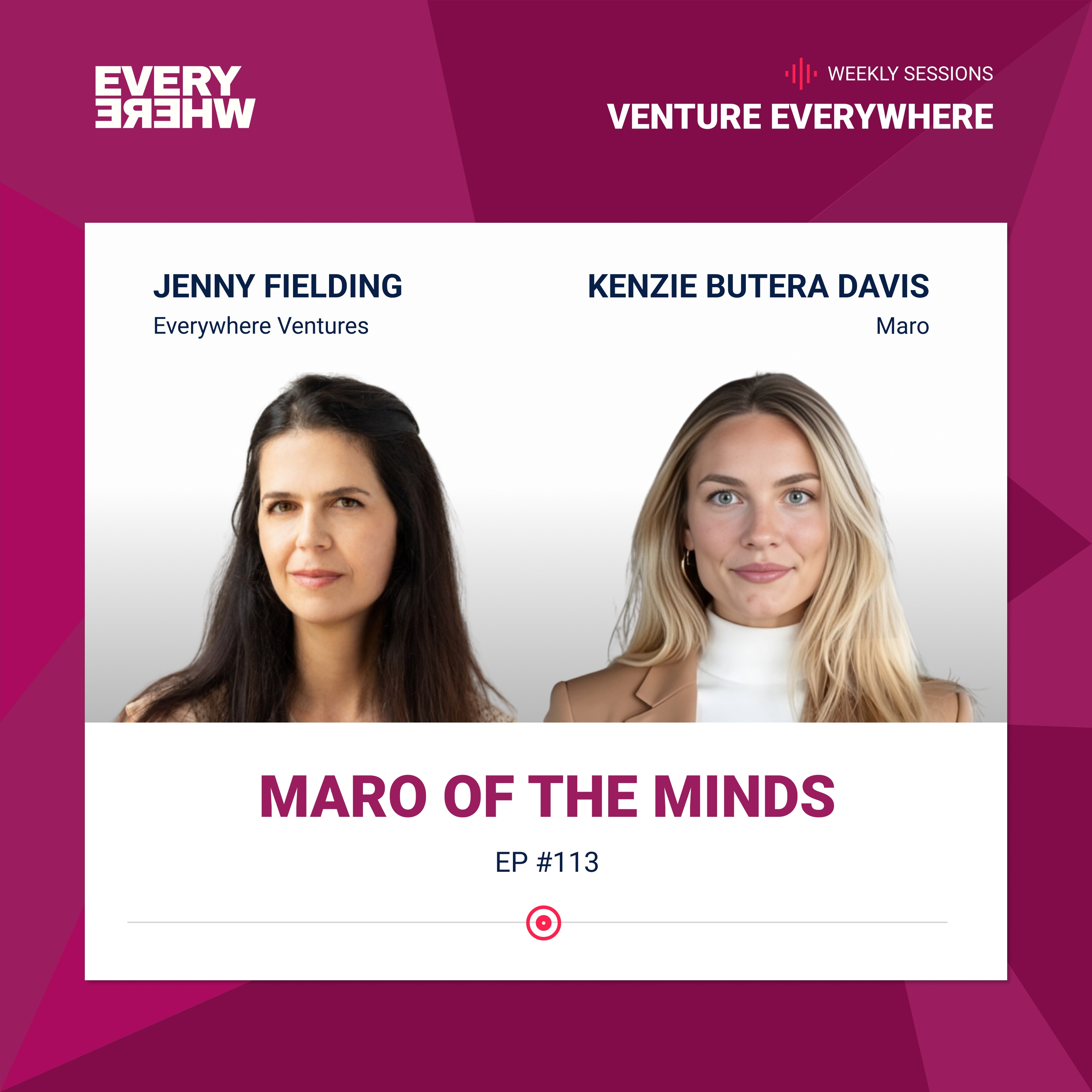
In episode 113 of Venture Everywhere, Jenny Fielding, General Partner at Everywhere Ventures, talks with Kenzie Butera Davis, founder and CEO of Maro — a platform providing early intervention and risk detection for youth mental health in K-12 schools. Kenzie shares how a personal family experience pushed her from nonprofit and venture work into building the infrastructure schools were missing. She discusses how Maro challenges the entrenched belief that mental health has no place in the classroom, instead unifying universal screening, family communication, and care coordination into one system that identifies struggling students before they fall through the cracks.
In this episode, you will hear:
Deploying universal screening to close the gap between first symptom and treatment.
Building school-based infrastructure to bridge families, health plans, and providers.
Navigating parent consent and data privacy in K-12 health adoption.
Leveraging state screening mandates as a distribution accelerant.
Expanding from screening tool to full-stack school and health system network.
If you liked this episode, please give us a rating wherever you found us. To learn more about our work, visit Everywhere.vc and subscribe to our Founders Everywhere Substack. You can also follow us on YouTube, LinkedIn and Twitter for regular updates and news.
TRANSCRIPT
00:00:04 VO: Everywhere Podcast Network.
00:00:14 Jenny Fielding: Hi, and welcome to the Everywhere Podcast. We’re a global community of founders and operators who’ve come together to support the next generation of builders. So the premise of the podcast is just that, founders interviewing other founders about the trials and tribulations of building a company. Hope you enjoy the episode.
00:00:32 Jenny: Welcome everyone to Venture Everywhere, where today we’re very excited to have Kenzie, the founder of Maro, a platform that provides early intervention and risk detection for youth mental health.
00:00:44 Jenny: I love the mission of Maro, focusing on children, which I feel have been overlooked in some way. So excited to jump in there. But I’d love to start with, tell us a little bit about yourself. Give us a little bit of background, Kenzie, as we learn more about the company.
00:01:00 Kenzie: I have a huge passion for working with startups. It didn’t start off that way. I used to work in the nonprofit space. So I spent quite a bit of time working for policy and advocacy organizations, education, and then did a short stint in direct service as well, where I was working for a rape crisis and domestic violence shelter that served women and children in 16 counties in the Chattanooga, Tennessee area.
00:01:26 Kenzie: I really loved that work, but generally in the work that I was doing, felt frustrated because a lot of our funding was earmarked for specific needs that were determined by the grants that we were receiving. And they weren’t always applicable to the actual needs of the people that we were serving. And so there was this innate tension to the work.
00:01:49 Kenzie: I applied for an internship with an accelerator program, something that we have in common. So I got this internship with The Company Lab, is what it’s called, in Chattanooga, Tennessee. So quick aside, Chattanooga was the first area in the country to get The Gig. So we’re the fastest internet in the nation. We get a shout out in Ironman 3.
00:02:10 Kenzie: And so we built this incredible accelerator program around that notion. Brought founders into the city to build the early days of an entrepreneurial ecosystem. I got to benefit from that and get a lot of exposure to early stage companies through this accelerator program. It was very early. Precursor to the Techstars and YCs of the world.
00:02:30 Kenzie: Through the nature of working there for a few years, I built a relationship with one of the board members, and she ended up bringing me on to work for her venture fund. It’s called the Jump Fund. They invest early stage, pre-seed through Series A and women-founded businesses.
00:02:47 Kenzie: I just got a lot of exposure to what it looks like, what it takes to build an early stage company and get off the ground. We did quite a bit of work in education and healthcare as well. So I was already personally really interested in that side of the work and just got the professional education to back it.
00:03:04 Jenny: I always tell people that an accelerator is this amazing training ground because of the volume. I spent almost eight years at Techstars and it was just reviewing not dozens or hundreds. It was literally like thousands of applications and pitches.
00:03:18 Jenny: So I think it’s a great transition point for many people that don’t necessarily have exposure to entrepreneurship. The accelerator is such an interesting onslaught of entrepreneurship. I love that you ended up there and that maybe informed your trajectory of being your own founder now.
00:03:35 Kenzie: And I think people would be surprised at how many pivots you could fit into a 12-week period. So you see a lot of what the startups are going through in those early days.
00:03:45 Jenny: So then tell us about the early days. Obviously, everything that you just described is the perfect confluence for this company – your experiences with not-for-profit, with communities, with all those things. Was the idea like, you woke up one morning, you’re like, this is what I need to do? Or was it more of a slow burn, you’re figuring out where the opportunity set was?
00:04:05 Kenzie: It was more of a slow burn. I wrote an academic thesis during my junior and senior year on the implementation of healthcare in schools. I was looking at sex education at the time, but pivoted to mental health in my personal research post-academic thesis after seeing it up close and personal.
00:04:25 Kenzie: I had a younger family member who was really struggling. She ended up in and out of inpatient hospitalization for suicide attempts. And I was so surprised because I feel like I’m super close with her. We have a great relationship. And I didn’t believe that I didn’t know that she was dealing with what she was dealing with.
00:04:46 Kenzie: It was a big wake up call for me to start looking at how do you more systematically track when kids are struggling, if they’re private, or if they don’t have the language to put around the things that they’re experiencing. I just started deep diving into what ultimately I found was screening and learning more about how screening takes shape in K-12 schools.
00:05:10 Jenny: Give us a little color on the early days of the company. I’m sure you’ve experienced some twists and turns along the way. So tell us about getting the company off the ground in those early days and then fast forward to maybe where things are now.
00:05:24 Kenzie: I would say what really put us in the map in the early days, early career experience was we pitched at ASU GSV, which is the world’s largest education conference. So they used to have this massive pitch competition where they bring in… over 900 companies from 60, 70 different countries.
00:05:45 Kenzie: It’s a multi-round pitch competition from application to the original pitch, and then you have to make it to the final. And we won. The final competition is at the Radieshell Amphitheater in San Diego. Kareem Abdul-Jabbar was there, which was very cool. I’m a very short person, and he’s not, so being backstage with him was pretty funny.
00:06:07 Kenzie: But Wendy Kopp, the founder of Teach for America, spoke. And so we kind of had this really incredible opportunity where we were just sharing this vision that we had for what youth mental health could look like in schools. The final winner is selected by educators.
00:06:22 Kenzie: And that’s what put us on the map. We were able to close our pre-seed round and hit the ground running from there. And then now, we’re really starting to figure out how we expand beyond mental health in schools to partner with health plans, providers, families, and the school systems.
00:06:39 Jenny: What do you find the most challenging part about working in this space? Obviously, there’s some regulatory things, there are some traditional cultural things. What’s super challenging, would you say, about the space in general?
00:06:52 Kenzie: With screening, it’s actually pretty controversial. It’s very evidence-based. We do screening in so many other areas of healthcare, and it’s preventative. If you actually do go see a therapist or even in pediatric office settings, a lot of times they will do mental health screening now.
00:07:10 Kenzie: But bringing this to the masses has been more controversial than I originally anticipated. What that means from an operational standpoint is just there’s a lot of trust to build.
00:07:21 Kenzie: The only way to really do that is through data to show, hey, this population got better because we identified kids who are struggling that maybe weren’t on your radar. We did that without overburdening your school system or overburdening a broader health care system. We only refer, on average, 2% of students out to external care. The rest is usually feasible to be managed by the school, which is really incredible.
00:07:50 Kenzie: So there’s that piece. And then there’s the parent communication piece as well, which is we want to equip schools with all of this information about parental rights. You, as a parent, absolutely have the right if you want to choose whether or not your child is screened at school.
00:08:06 Kenzie: And just making sure that people don’t feel like, oh, there’s this scary company that’s going to come in and screen my student. That’s not what it is, but that can be people’s perception until they engage with the materials.
00:08:18 Kenzie: And so I think that’s been one of the harder challenges of building specifically within K-12 schools, where they are often a politicized place for healthcare, and then specifically within screening.
00:08:29 Jenny: You’ve used that term before, building trust with the community. So can you talk a little bit more about how you’ve been able to do that? The education part and conveying that this is optional, but any other methodologies you’ve learned along the way for building trust with those communities?
00:08:45 Kenzie: It’s all about collaborating with the district. They know their families and what they need the best and just being really transparent. We tell you the questions that your child would be asked if you consent to screening. We make it really easy for you to opt in or out. We try to be as clear about what that process looks like. So the transparency piece.
00:09:06 Kenzie: And then, in terms of the collaboration with the schools, it’s really just customizing all of the communication and making sure if there is a question that you know your parents are going to want to know, let’s pull that out of the FAQs. So instead of sending 40 FAQs, we’re sending this really custom 5 or 10 that we know are most relevant for your community.
00:09:24 Kenzie: And we’ve seen this play out. For example, we see this a lot in our rural communities. I’m from Montana. All my family’s in Tennessee and Mississippi. I have a huge heart for rural healthcare. And that tends to be where we run into the most questions about privacy and student data. And so we’ve just been really thoughtful about how do we make sure that parents don’t feel blindsided when we implement screening.
00:09:47 Jenny: Talking about opportunities, which also can be challenges, sounds like some of the states are implementing their own compliance mandates. And so that could be an accelerant for you or potentially the other way. So I think, people listening, there’s a lot of this that is collaborative with government as well.
00:10:09 Kenzie: Illinois is a really good example of this. They have recently passed legislation to require screening for grades 3 through 12. They did a wonderful job. They did a landscape analysis. They talked to educators. They went to communities. The policy is informed by all of this community feedback. And they have a phased implementation plan. So it’s not all happening at once.
00:10:33 Kenzie: What we’re doing for schools that are adopting us in Illinois is we’re saying we recognize that no matter how informed this policy is, implementation is still really scary and it’s hard when you are under-resourced as a school. We’re going to take that off your plate and here’s how we do that specifically.
00:10:49 Kenzie: So I think there is a huge opportunity in screening alone. And then there’s this bigger opportunity that we’re growing toward, which is there’s still a lot of missing infrastructure when you go to implement… or I guess as a family, when I go to engage with intersection of the health system and the school system. And so as we grow, that’s where we think we can play a really big role.
00:11:12 Jenny: Walk us through a little bit of where you are today. I think I read somewhere that you’re in more than 60 schools. What does the future look like for you guys?
00:11:22 Kenzie: Currently, we’re serving just over 70,000 students and growing, especially with the Illinois accelerant there. So we are primarily in Illinois and Northern California, although there’s nothing stopping us from serving students in any other state.
00:11:35 Kenzie: We’ve been really focused. You know the startup mantra, start small. And we did. We started small with just screening and just focusing on mental health and building relationships with schools.
00:11:48 Kenzie: We are seeing significant evidence of product-market fit with this tooling. Now, we’re growing toward this bigger opportunity, which the vision has always really been. There’s this network effect that you can build if you have distribution of schools, if you can really own that channel, you can reach families and you can build trust with families.
00:12:11 Kenzie: That’s something that’s really hard for health plans and providers to do. And so you create a lot of value by being that intermediary. As we’re growing, there’s a lot that we’re doing in stealth right now that we’ll be able to share soon from a product line standpoint, but it really is about building that infrastructure so that families engaging with the school system and health system don’t meet points of friction.
00:12:34 Kenzie: Just one really specific example of that is if you’re trying to share your immunization records at the beginning of the school year so that your child can compete in sports or just generally attend school.
00:12:47 Kenzie: That’s something that is a huge pain point. Really annoying and requires a lot of manual effort, believe it or not, in this day and age. That’s a prime example of a high friction pain point that involves all of those parties where we can play a role.
00:13:00 Jenny: Since you worked in an accelerator, you obviously know the value of mentorship and surrounding yourself with more than capital. So can you talk about how you got that support around you as you were building, especially in the early days?
00:13:14 Kenzie: Two very specific people come to mind in my early days, and I will shout them out. Jessica Millstone, she really took me under her wing. We were her first investment out of that fund. I met her in one of my very first presentations in New York, pitching the concept. She’s just been someone who has mentored me all along the way, now sits on our board.
00:13:35 Kenzie: And then, Dr. David Adair was also one of our earliest investors. He is a maternal fetal health doctor and supported a lot of high-risk pregnancies and just has worked with a lot of young women who, often, their health issues are coinciding with mental health concerns.
00:13:53 Kenzie: He was just a big believer from day one and has always been a sounding board every time we have challenges. And he also runs a venture firm on the side, so it’s a great combination. So I feel like I’ve received just a lot of people who are willing to be there through the pivots.
00:14:07 Jenny: So speaking about your supporters, what’s an idea that experts in your field say that you disagree with. So what’s the common parlance and you’re just like, I don’t think that’s right?
00:14:19 Kenzie: Mental health experts will not say this. This is more on the education side, but there are a lot of folks in academia who just don’t see a place for mental health in schools.
00:14:29 Kenzie: The argument is that if you’re a teacher or an academic counselor, your role should be purely academic and that time spent away from an academic orientation in the classroom is not time well spent and that the health system is there for health or the school nurse is there for health, but the classroom time is just for the class.
00:14:50 Kenzie: There is a growing body of research to show that specifically anxiety and depression are the number one student self-reported barriers to academic progress. That’s from a certain national survey of 220,000 students conducted by Youth Truth.
00:15:07 Kenzie: We see evidence of this as it relates to adverse childhood experiences and trauma. We see it as it relates to some levels of social, emotional learning as well.
00:15:16 Kenzie: So there really is a growing body of evidence that we are hoping to contribute to to say, hey, actually, the 5, 10 minutes that it takes to universal screening, although it is taking that out of advisory period or what have you, it’s worth its weight once you see how students progress post receiving an intervention… screening plus intervention.
00:15:37 Jenny: I get why people thought that in the 60s, but mental health seems to be the biggest issue these days across categories, adults and children. We had a school nurse at our school. Let me tell you, that was where you went when you wanted to like get out of your math test.
00:15:51 Jenny: There wasn’t much happening there. I don’t think that’s changed in many places. That’s crazy that people still think of the separation between students thriving at school and their own mental and physical well-being. That’s insane.
00:16:06 Kenzie: It’s challenging for sure to still see this difference. When we’re going to implement in schools and realize, hey, there is quite a bit of education that still has to be done. There’s a lot of opportunity there.
00:16:18 Kenzie: We’re going through the Georgetown Thrive Research Program right now, working with their researchers to actually develop our own body of research around this and show that mental health can improve attendance, can improve certain academic factors related to grades and graduation.
00:16:33 Kenzie: One of the areas where even if you don’t see eye-to-eye between, for example, us and a school administrator that you can start to align is school safety, because that’s so intertwined in mental health.
00:16:46 Kenzie: Students are committing acts of violence or if they are harming themselves. If you meet someone who doesn’t agree, that’s a problem. They probably shouldn’t be working in the school system.
00:16:57 Jenny: When people think about you, what do they think is your superpower? I love this question because, especially as founders, we have to wear a lot of hats and be multidimensional, but if people kind of distill it down to that thing that you’re really great at, that you’re known for. Your passion and your mission here is so clear, but what’s the thing that people say, yeah, Kenzie’s amazing at that?
00:17:19 Kenzie: It’s been two things. One has helped me as a founder and one that has helped me as a leader of my team. So when I say founder, I mean really fundraising, which is storytelling.
00:17:29 Kenzie: The benefit of working for an accelerator program is you hear a lot of pitches. You also pick up on a pattern. And so I coach entrepreneurs now on this. One of the things is I try to coach them to go against the grain of the pattern because people tune out without even realizing they’re tuning out if you don’t trip them up on what they’re expecting to hear.
00:17:48 Kenzie: That’s been a really fun skill set for me to refine because I’m an absolute theater kid and I’ve enjoyed that part of the work.
00:17:55 Kenzie: But I think what I’m learning as I make that transition from founder to CEO and I’m leading the team is connecting the dots between the bigger vision and the day-to-day work and feeling really comfortable navigating policy and painting the picture for our health plan, who are receiving this new product line that we’re building out.
00:18:19 Kenzie: Versus been jumping into a call with one of our school counselors who’s just working to smoothly implement universal screening in their school. That’s been an absolute requirement from the past year of being a founder.
00:18:32 Jenny: I guess my last question before our speed round is what does success look like for you personally and for the company?
00:18:39 Kenzie: Success for the company near term is our mission, which is to eliminate the average 11 year gap between first symptom and treatment in youth mental health.
00:18:49 Kenzie: Over time, it’s what I keep hitting at with regard to just making sure that when parents are engaging with the school system and the health system that they’re not running into friction that makes them stall, not receive the access to care that they need. On a personal front, I just had a baby so being a good mama.
00:19:10 Jenny: I love it. Well, congratulations on that. Okay. speed round. So these are just very fast answers to the questions before we wrap up. Is there a book that you’re reading, a podcast or some media that you’ve been having fun with or excited about?
00:19:23 Kenzie: Honestly, aside from the news, most of what I’ve been reading is very specific blogs about healthcare interoperability and some of the latest policies coming down the line with regard to individual access to health records.
00:19:36 Kenzie: If anyone listening happens to be nerding out over that subject, one of my favorite new blogs is from a startup called Fast and Health and their founder, Jason, writes great content. And then Brendan Keeler, of course, has a blog called Health API Guy. Your other investment, Nirvana, I’m sure they read that all the time.
00:19:56 Jenny: If you could live anywhere in the world for just one year, where would it be and why?
00:20:00 Kenzie: There would be some European beach just because Europe and it’s warm.
00:20:05 Jenny: Favorite productivity hack these days?
00:20:07 Kenzie: We’ve been doing a lot of coding with Claude and experimenting with that to create internal products, both personally and professionally. Just give a really quick example. I know this is a speed round, but we had a client the other day give us a potential hurdle we could run into.
00:20:22 Kenzie: In a day and a half, I was able to spin up a tool that completely solved that for them. And so it’s just amazing, the speed to which you can respond to challenges that come up versus just throwing something on an agile roadmap that you hope you eventually get to.
00:20:37 Kenzie: And then I’m using it personally, too. Like the things that takes the most time on the weekends is meal prep for the family and going through the Pinterest board. And so I’m creating an app that does all of that for me.
00:20:48 Jenny: Where can listeners find you?
00:20:51 Kenzie: Just LinkedIn or you can reach out on our website, which is www.meetmaro.com.
00:20:58 Jenny: Well, thank you so much, Kenzie. This was so fun to get to know you a little bit more and your journey and your company is very inspiring. It seems like you definitely have founder market fit. Best of luck and talk to you soon.
00:21:09 Kenzie: Thank you so much, Jenny.
00:21:12 Scott Hartley: Thanks for joining us and hope you enjoyed today’s episode. For those of you listening, you might also be interested to learn more about Everywhere. We’re a first check pre-seed fund that does exactly that, invests everywhere. We’re a community of 500 founders and operators, and we’ve invested in over 250 companies around the globe. Find us at our website, everywhere.vc, on LinkedIn and through our regular founder spotlights on Substack. Be sure to subscribe and we’ll catch you on the next episode.
Read more from Kenzie Butera Davis in Founders Everywhere.