
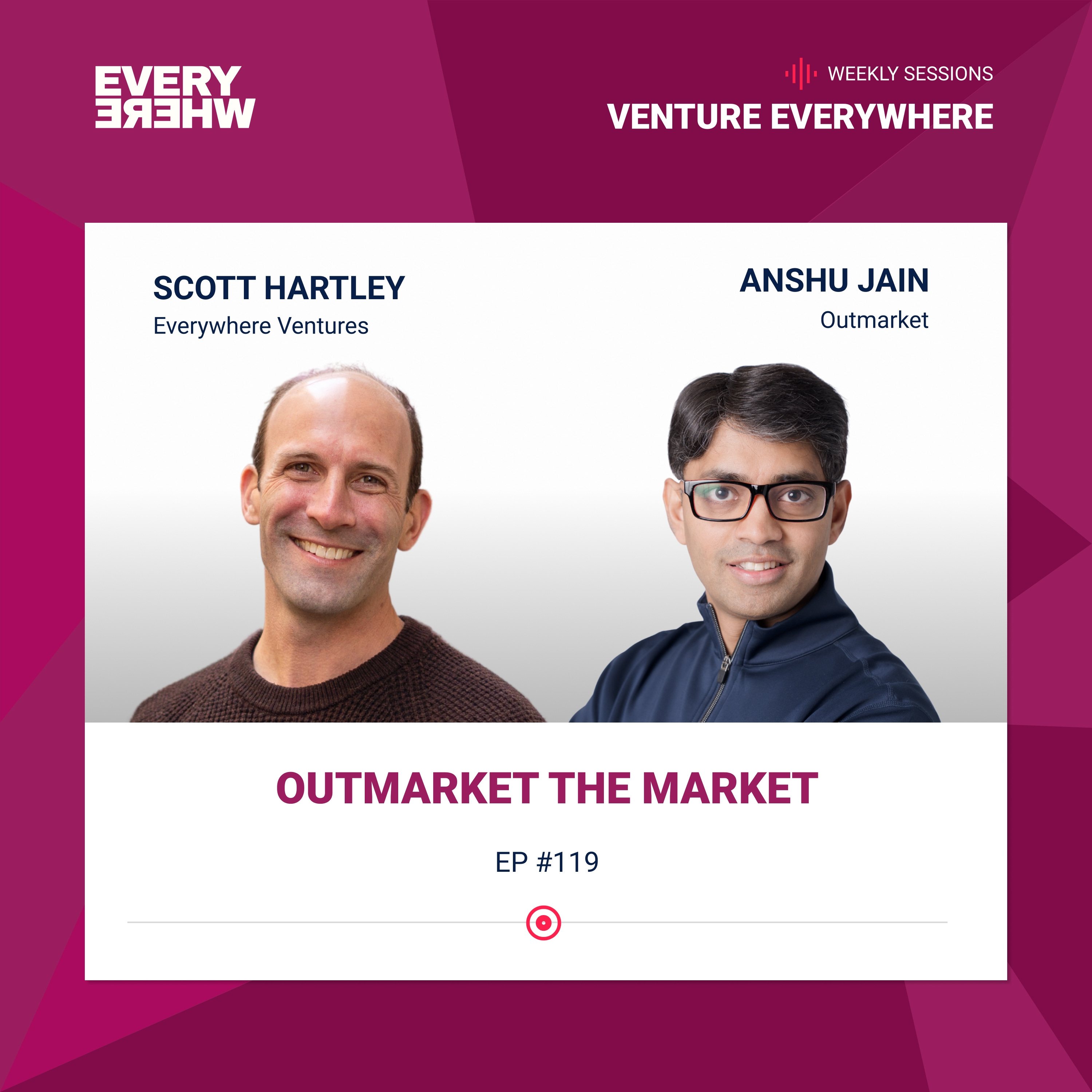
In episode 119 of Venture Everywhere, Scott Hartley, co-founder and General Partner at Everywhere Ventures, talks with Anshu Jain, co-founder and CPO/CTO of Outmarket AI, an AI-native platform that helps insurance brokerages grow revenue, reduce errors, and close more policies. Anshu shares how years at IBM Research, Meta, and Ethos Life revealed that insurance agents were drowning in manual data entry, buried exclusions, and uncompared quotes, with zero tools to help them. Outmarket’s vision is to become the AI infrastructure layer for insurance distribution, modernizing a chronically underinsured market by giving every agent the intelligence of a team behind them.
In this episode, you will hear:
Closing America’s chronic underinsurance gap with smarter agent tools
Catching policy exclusions and coverage gaps before claims surface
Evolving pricing from seat-based to usage-based to revenue-share
Turning policy data and agent workflows into proprietary AI advantage
If you liked this episode, please give us a rating wherever you found us. To learn more about our work, visit Everywhere.vc and subscribe to our Founders Everywhere Substack. You can also follow us on YouTube, LinkedIn and Twitter for regular updates and news.
Transcript:
00:00:04 VO: Everywhere Podcast Network.
00:00:14 Jenny Fielding: Hi, and welcome to the Everywhere podcast. We’re a global community of founders and operators who’ve come together to support the next generation of builders. So the premise of the podcast is just that, founders interviewing other founders about the trials and tribulations of building a company. Hope you enjoy the episode.
00:00:32 Scott: Hi, everybody. I’m Scott Hartley, co-founder and general partner at Everywhere Ventures. Everywhere Ventures is a global pre-seed fund, and I’m super happy to be here today with Anshu Jain.
00:00:43 Scott: Anshu is the co-founder and CTO of Outmarket AI. Outmarket is transforming the insurance industry by bringing AI native intelligence to brokerages so that they can grow revenue, make things more efficient, scale smarter.
00:00:57 Scott: He’s also a programmer by training who’s found his way into the heart of insurance over a storied career. But I know that prior to founding Outmarket, you worked at Meta, Ethos Labs, IBM, SAP. So, Anshu, welcome to the podcast. Thanks for being here with us today.
00:01:13 Anshu: Thank you, Scott. Really appreciate the opportunity.
00:01:16 Scott: Given you’ve been living in AI land for much longer than most of us, give us the 60,000 foot view of what you’ve seen over your career studying and working in AI and how fast the world is changing today with this new evolution that we’re all experiencing.
00:01:32 Anshu: I appreciate that question because it takes me 20 years back into my life journey when I first joined IBM Research, which is when I got into natural language processing and text analytics. That allowed me to be a part of the original AI commercialization effort, which was the IBM Watson effort.
00:01:47 Anshu: Around the constraints of computing at that time, took a very different approach, which was a rule-based approach to AI. Things, of course, evolved significantly different when deep learning and neural networks came.
00:01:58 Anshu: But even the best of us who were deep into deep learning and neural networks, except for the few who had the real vision long back, could not see it coming until it almost started tipping over in early ‘21. That this seems to start to have the appearance of a brain of its own.
00:02:17 Anshu: I think it took everybody by surprise as to how good it got, how the act of next token generation can start to define and generate what are very intelligent sounding reasoning tokens. Everybody had to react.
00:02:32 Anshu: Even though we understand that it is in the end token generation, it is not true intelligence. The technology and frontier has come so far that it’s great and good enough to change an industry landscape for the next decade, even if it were to stop all model innovation today.
00:02:46 Anshu: If there was nothing beyond Claude Opus 4.7 and GPT 5.5, it will take 10 years for the industry and world to realize all the gains from what has happened. It’s been overwhelming.
00:02:56 Scott: It’s pretty remarkable. I’m midway through reading the book by Sebastian Mallaby. He was one of our speakers at our annual meeting a couple of weeks ago in New York City. Sebastian wrote The Power Law, but his most recent book is a deep dive into Demis Hassabis and the evolution of DeepMind. He’s actually gone 10 years of interviews with Demis.
00:03:15 Scott: What’s so fascinating, as you alluded to with IBM Watson, the deterministic rote form of AI, and really his background in neuroscience and thinking about non-deterministic ways to build these neural networks that were moving in the direction toward where we are today.
00:03:33 Scott: On the investor side, I don’t think we’ve seen a fundamental shift like this since the advent of the iPhone and the App Store, and maybe before that, the internet.
00:03:42 Scott: The last 15 years, we’ve been living in sort of a rinse-repeat SaaS world of very specific growth curves, very specific KPIs to manage and navigate and scale very predictable pathways to IPO. We’re completely in a sea change that we probably haven’t seen since 2007, and maybe before that, 1995.
00:04:02 Scott: So it feels like a fundamental restructuring of venture capital the way startups are scaling. You guys predicted this going after a huge market like insurance two or three years ago when the writing was not totally on the wall, not everybody was a believer in AI. What gave you that confidence?
00:04:19 Scott: Was it the fact that you were in these worlds 20 years ago and you saw the evolution, how quickly things were changing? And you said, “Gosh, we got to get ahead of this and where are the biggest opportunities in the market? Well, let’s go after insurance.” How did you guys arrive on this particular industry, this particular go-to-market?
00:04:37 Anshu: I call this the Medici effect, where it was the intersection of different streams of thoughts which happened for us. You could always call it accidental when you connect the dots back. The fact that me and both Vishal, my co-founder, we spent our lifetime in technology.
00:04:52 Anshu: Vishal had done a startup in doing sentiment mining from social networks more than a decade ago. I was at the frontier of this at IBM Research. He was at the frontier of it in the social landscape, and we knew this technology, and we were following it very closely.
00:05:06 Anshu: But then what happened was we both were at Meta. So Vishal joined Meta, I joined the same team there. That’s where we started serving some of the largest businesses of Meta, and that’s when insurance first happened to them.
00:05:18 Anshu: I started managing the FinTech and insurance vertical, and we were serving their ads worth hundreds of millions of dollars. We started working closely with the insurance industry, and I understood, hey, how much the insurance industry spends to do distribution, acquisition.
00:05:31 Anshu: One thing led to another, we started helping Ethos Life, which was a direct-to-customer life insurance MGA reseller. We said, “Hey, we could help you do this.” And when they saw the impact our background brought into this insurance world, they said, “Hey, why don’t you just join?”
00:05:47 Anshu: So we joined Ethos Life. Vishal went there first. He headed the product there, and then I joined to head the platform team. That opened our eyes completely in two ways.
00:05:57 Anshu: From the technical side, for me, understanding how much of a big data problem insurance is was mind-blowing, because I believe that insurance is the original big daddy of big data, even before there were computers.
00:06:09 Anshu: 200 years ago, they were having these thick registers where they were handwriting the probabilities and computing the stats to insure the ships which were traveling through the sea to get to India and America. More than that, it was also about complex natural language, which is contracts.
00:06:27 Anshu: All these contracts are essentially natural language, very hard to understand by machines, at least until recently. They are the things that make or break the actual policy. They can have multi-million or even hundreds of million dollars of consequences.
00:06:40 Anshu: Understanding that technology landscape of it, that there are some technical limitations which have stopped this industry from being benefited, but they are on the cusp of being solved, was one thing.
00:06:50 Anshu: The other thing, even the consumers for life insurance would not be inclined to buy the life insurance unless there’s an agent who they can call. The single biggest experiment which increased our return on ad spend was putting an agent phone number there.
00:07:02 Anshu: So we decided to build an agent business at Ethos. Towards building that business, both Vishal and I participated in a lot of interviews where we literally shadowed them. “Hey, just show us what you’re doing.”
00:07:12 Anshu: Many of these agents were actually PNC agents who were trying to get into life. But when we saw the actual work which they do every day, it blew our minds because they had zero tools which are helping them. They just had a monitor which was allowing them to do data entry.
00:07:27 Anshu: But their actual work, it’s deep underwriting work which agents were doing without a law degree, without a data science degree. They need help. This is a technology which is ready for revolution.
00:07:38 Anshu: At that time, I had enough understanding. I was already using ChatGPT to write code. This was using the browser ChatGPT 3.0 and ChatGPT 3.5, I was using to write code. I could see this going in that speed and scale.
00:07:50 Anshu: Three years ago, I was shouting at the top of my voice on LinkedIn that “Guys, this is bigger than we think. This is not 10 to 20% productivity improvement. You could be writing three times the code with this very soon.” And we knew that this would happen in other domains.
00:08:03 Anshu: I also look back at this and say we were fortunate to choose the timing right. Because to me, when the internet was happening, I was still in high school. To me, this is the next big or as big or bigger than internet.
00:08:13 Anshu: We are at the cutting edge of this and in that confluence of we being technology providers who understood insurance as a business first was the biggest driver of the fact. We’re just lucky to have that sequence of events happen to us.
00:08:25 Scott: It’s really fun, having spent time on the ad team at Google 20 years ago, on the platform team at Meta 15 years ago, sometimes being in those positions where the day-to-day mechanics of the role maybe weren’t that interesting.
00:08:38 Scott: But getting to see the 60,000 foot view into an industry, I remember in my early 20s being absolutely perplexed by the amount of ad spend in some industries that I didn’t know were that big.
00:08:48 Scott: You would say, “Gosh, these guys are spending this amount. They must be generating 10 times this amount of revenue.” And it’s some obscure business that you had never conceived of being at that scale.
00:08:59 Scott: So part of that 60,000 foot view of you guys being at Meta, seeing the ad spend from insurance coupled with that age old idea that insurance is really an underwriting, is an understanding of data and probabilities and risk, which are maybe the things that machines can do infinitely better than humans. So it’s a natural combination of effects.
00:09:19 Scott: Taking a step back to what Outmarket is doing as a company, walk us through how you guys are baking AI into some of these agent roles and helping supplement. Because in legal, for example, there’s the black letter law of precedent of what the mechanics of the law. But then there’s also a very commercial layer that’s much more human-driven, that’s much more nuanced-based on a client risk profile, based on a client goal.
00:09:45 Scott: So I imagine there’s both agentic machine part of this, and there’s also the human layer part of this of leveraging Outmarket and some of the intuitions, but also baking in these human elements that a good agent knows how to structure a contract or how to push a deal forward. Walk us through a little bit of the business of Outmarket and how you guys are enabling these agents.
00:10:06 Anshu: You absolutely called out a very unique aspect of this industry, where the same function/role is so significantly a relationship-based role, which has so many touch points with the customer, and then so significantly a data processing and information processing role. Because they’re not the underwriters, but they have to do a lot of work, which is in the same vein of understanding risk and exposure.
00:10:29 Anshu: The legal parallel is great because they’re effectively acting as the lawyers for their clients. Some of the largest corporations, one of the biggest job of the lawyers there is actually to have airtight insurance policies.
00:10:40 Anshu: But most businesses cannot afford that set of lawyers, and that’s why they depend on their agents to do that. That’s an actual big aha for me that, “Hey, these guys are actually doing complex legal work. The precedents of law also apply here.”
00:10:53 Anshu: But also there is this notion of endorsements and exclusions, which is what makes the policy. So there is the deck page of the policy, which says, “Hey, this is the amount of coverage you have for these different sections.”
00:11:05 Anshu: And then there is a bunch, not necessarily hidden, but deep, embedded into the 400 page policy on page number 262 that, “Oh, by the way, digital theft is excluded from this.” Or, “Oh, by the way, you cannot be performing service in a specific industry if you want this insurance.”
00:11:23 Anshu: The agent, if they don’t look at it deeply, may not realize that the client I’m giving this insurance to actually is in that industry. This is a true story that the first insurance we got for our cybertech liability had an exclusion in it that you cannot be in professional services in finance.
00:11:40 Anshu: The agent failed to notice because it was buried on some last page that we are actually in the insurance industry. For six months we were exposed. And when we were putting it through our own policy review system, building that AI, we actually found out that this was a gap.
00:11:54 Anshu: This is a huge nuance of this industry, exclusions and endorsement, which make or break the industry. And we have intersected there as the first thing. So going back to your question of where are we addressing the problems of this space? It starts with a touchpoint, which is how do you gather the context of the client.
00:12:08 Anshu: Because that’s necessary to be able to tell them what’s the right risk exposure profile for them and what kind of markets I can bring them. We start from the point they have a lead. I’ll also touch upon that.
00:12:18 Anshu: Why do we start from the point we have a lead? Because bulk of this industry today is not stuck at lead generation. They have more leads than they can process on their desk, but they cannot get through enough of them.
00:12:28 Anshu: Even though our background was distribution and lead generation at Meta, we said, “Hey, let’s park that problem for now. Let’s focus on the lead to close problem and then the operations problem.”
00:12:38 Anshu: So we say from the time you get the lead, understanding the customer context, filling up the forms, taking your last two policies, and then instead of having to do data entry, use that information to automatically fill up the forms.
00:12:50 Anshu: From that point, having the quotes, application forms being submitted to comparing the quotes which come back from multiple carriers. That’s a very complex task. You’re not just looking at premium, which is what people do because they don’t have time.
00:13:01 Anshu: But buried under those 40-page quotes is some exclusion which talks about the same coverage, the same premium, but this one is much better for your client. Or in fact, higher premium, but this one is much better for your client.
00:13:12 Anshu: They fail to see it because the client themselves are also indexed on the premium and the coverage, but not the details. So now every day, our agents are coming back and saying, “Hey, Anshu, I was able to sell a policy which was the higher premium because the conversation never went to premium. It went to the details of what’s covered in these quotes.”
00:13:30 Anshu: From that point, the quote comparison to then actually the policy being issued… in these steps, there are so many issues which happen in terms of fat fingering, human errors. You had eight vehicles you wanted to cover in the input application, but somebody missed it and there are only seven vehicles, or the VIN number got wrong.
00:13:46 Anshu: Figuring out all of these, which are hidden errors and exclusions. So until the actual accident happens of that vehicle, nobody looks into the policy to say that, “Hey, it’s entirely missing in the policy.”
00:13:54 Scott: We have a number of cybersecurity companies that we’ve invested in. And thinking about pen testing, of looking for vulnerabilities in the code base or vulnerabilities in the potential threat mapping to what you’ve built, in some ways, it’s doing that in reverse.
00:14:10 Scott: What’s so fascinating about insurance is you get the benefit of the premium in the short run, but you have potential catastrophic costs of the payout or the claim in the long run. And there’s a timing mismatch where you really don’t know that you’re wrong catastrophically for a number of months or a number of years.
00:14:24 Scott: This was a pushback on some of the companies that went public, like the Lemonades of the world that were up and to the right on premium. But there’s this long tail of risk that may be baked into those companies with claims that may be poorly underwritten out a few years. You guys are effectively enabling real-time pen testing almost in between risk exposure and client archetype.
00:14:47 Anshu: 100%. That takes me to the 100,000 feet vision for the company. America is underinsured. Be it businesses, be it individuals, be it homes, we are underinsured.
00:15:00 Anshu: As an example, very recently with some of our own friends in Los Angeles, the risk was clear for many years making. Even then, most houses were underinsured. When it came to the actual recovery and rebuilding, they’re now suffering because of lack of information, lack of time, lack of attention.
00:15:18 Anshu: It’s not like there was no intention of anybody to do this right. But because of the lack of tools and information and sheer time, there was not the right advice coming to the final insured. In this case, it was individuals. In some cases, it is businesses.
00:15:31 Anshu: We want to remove that entire inefficiency in multiple layers of this ecosystem so that agents can go back to focusing on what is the most important thing: advising their clients to be appropriately insured and giving them enough reasons to say, “Hey, a higher premium is better for me.”
00:15:47 Anshu: Ask the folks in Los Angeles, they’ll pay double the premium if they have to now. I think that’s the grand vision here. And that’s the opportunity that because everybody is underinsured.
00:15:55 Anshu: This is not about automating this world and removing the efficiency. It’s about increasing the TAM of this industry. The same agents will not be losing their jobs. In fact, they will be having more because they can actually do more.
00:16:08 Scott: As somebody that has to buy insurance and pay for insurance, the biggest risk is that you pay a high premium and you’re still not covered for the catastrophic things that you want to be covered for. So it’s kind of this mismatch of I’m fine paying a high premium as long as that I’m legitimately covered for the highest risk events that I may experience.
00:16:27 Scott: But there’s probably an information asymmetry there where sometimes I’m paying a low premium for the amount of risk coverage I’m getting and other times I’m paying an extremely high premium for very low risk coverage and helping kind of align those incentives.
00:16:40 Scott: To your point, I would maybe spend more money, therefore increasing the TAM of the market if I knew for a fact that there were real risk mitigation elements that I was paying for.
00:16:51 Scott: One of the most interesting things we’re seeing in this new AI driven world is an evolution of pricing. It used to be you kind of sell off the shelf SaaS for a fixed per seat per month model.
00:17:01 Scott: We’re really starting to see where you can drive asymmetric growth and revenue or asymmetric savings and cost, a pricing based on the Delta, the increase in revenue or pricing based on the efficiency of cost savings. How are you guys thinking about pricing in this new AI led market?
00:17:19 Anshu: This is the most active thread of go to market for us right now, Scott. We’ve experimented already. We’re starting to arrive at a very good place here. We started with a seat-based model in the early days because two years ago, nobody knew how to price this based on outcomes.
00:17:33 Anshu: Now that we have the credibility in the market and we’ve been the first to arrive in some sense, what we are starting to see is that the seat anxiety is actually a much bigger problem.
00:17:42 Anshu: I’ve never seen a product market fit like this in my lifetime of building software. Once somebody uses it, they cannot unuse it. They can never get back to not using it. The validation from our customers is that, “Hey, if we drop Outmarket, I’m quitting.”
00:17:56 Anshu: Now everybody wants a seat. The end customers and the CEOs are realizing that, “Hey, I need to give a seat to everybody.” But now the traditional seat model starts to sound very expensive for them also. So it’s been a great boon for us that adoption makes the traditional seat economics drive more anxiety for the customer.
00:18:12 Anshu: Then we were able to quickly experiment and pivot to a model where I think the innovation we ded was we normalize it to a very simple and understandable price point, which is per page of data ingested.
00:18:23 Anshu: Instead of trying to make it hit this workflow, this module, so many credits of usage, we said, “Hey, this doesn’t matter how many of ever times you want to use this. Bring in the data, bring the policy pages, the code pages, and we will just price it by page.” So it became a usage-based model.
00:18:38 Anshu: Within months of launching, we’ve done several deals now on that usage-based model, especially including the larger deals, because now a large insurance agency can say, “Hey, I can put it on all my 2000 employees and then just pay for usage.”
00:18:51 Anshu: The more pricier outcome for them is a happier outcome, which means it’s being adopted. So if they exhaust their entire usage, it just means that they are hyperproductive as an organization. That model is starting to play out.
00:19:01 Anshu: And then we are slowly now, from there, also evolving to a revenue-based model because even the page-based model has an uncertainty and an anxiety of, “Hey, what if I start to use it a lot? Will my budget just go double because I’ve used double the pages?”
00:19:13 Anshu: So from there, we are now able to move to a model which is revenue-based that, “Hey, this is your revenue.” If we can just say that, “Hey, this is the percentage of revenue. So forget counting pages, counting seats, nothing. It’s really tied to your outcome. The happiest case for you is the happiest case for us, that your revenue is doubling and our remuneration from that revenue is doubling.”
00:19:30 Anshu: We are evolving there, but I think the evolution cannot happen as a step function. It has to happen gradually as you build credibility. In some cases, we might still start with seat-based model, let them build trust into the environment and then say, “Okay, now that you know us, let’s do the revenue-based model.”
00:19:46 Scott: That’s a great learning that you kind of need a blunt go to market in the form of per seat per month, followed by maybe a volume-based pricing as you gain scale and then concluding with an outcome-based pricing as you’ve built credibility.
00:20:01 Scott: But a lot of people are trying to jump straight to outcome-based pricing. It’s hard. You guys have developed a simple model, but sometimes these modules with tokens and it’s very complex pricing. That’s a great intuition around seat to volume to outcome-based pricing, which I think would apply to a lot of different businesses that we see.
00:20:19 Anshu: Everybody using AI is struggling because the cost of gas in any SaaS, which is run by AI, is much higher than it used to be. Compute does not scale linearly. And for 100X usage, compute probably scales by 5X. But with AI, for 100X usage, AI usage scales 100X and that’s a big problem.
00:20:39 Scott: As you think about being on the inside of AI, a lot of the stuff that I read about and hear about is the coming crunch of compute,
00:20:58 Scott: Do you guys foreee a world in the coming couple of years where demand really outpaces the ability to keep up with compute supply? What does that do for the underlying cost structure of a business like yours? How do you think of those risks under the hood?
00:21:13 Anshu: My technology view as an AI researcher in the past, and as somebody who’s watching and reading every new paper which is published, especially in the compute efficiency domain, I believe there is a lot of hype going on in terms of this capacity issue.
00:21:28 Anshu: That’s the job of the industry to sell that hype so that they can capitalize on it right now. But I think there is a lot of people who are working on advances which drastically reduce the compute needed and the energy per token needed to do the same token generation.
00:21:44 Anshu: In a matter of a couple of years, it’ll start to show up in the actual technology landscape. In a matter of five, six years, it’ll also start to be in the chip and the silicon. That’s happening on one end. So I believe the long term, I don’t have to worry about pricing too much.
00:21:58 Anshu: In the short term, I feel like I can actually use it to my advantage. There is potentially this demand supply gap which will be there. That demand supply gap will reveal itself when, let’s say, the head of data or technology of a large insurance company says, “I’m going to build this myself using Claude and price to do it.” They will see that it’s actually hyper expensive to do it.
00:22:19 Anshu: It’s not easy to scale it out at their scale of economies. While at my scale of economies, when I am serving hundreds and thousands of those customers, I can manage that better as well as because I am having a deep technology team which is doing the token compression. When I say token compression, it’s not literal.
00:22:35 Anshu: Because of the knowledge graph I’m building, because of the knowledge compression I’m building, I don’t have to go back to AI for everything. I have actually been able to deliver the same outcome by using much fewer tokens because I’m not depending on AI to do everything.
00:22:50 Anshu: I have been able to break down the problem into many small steps, optimize each step, and then reuse the step, cache the step, whatever, to have a much higher outcome to token ratio.
00:23:02 Anshu: Then what? Somebody who tries to build the same thing themselves might still get the outcome somewhere in the vicinity. It will not still be the same accuracy, but will be paying much bigger price. So I’m going to use that to my advantage.
00:23:13 Anshu: I think that is the reason why people should not even try to do that. They should lean on somebody who’s specialized to do that. As a technologist, I feel it’s a short-lived problem and people are hyping it up more than necessary. But from a GTM, I can actually use it to our advantage.
00:23:27 Scott: What you said just there is so fascinating because one of the existential conversations that’s always bubbling around Ventureland is with the frontier models, “can’t Claude do that? Can’t Claude do that?”
00:23:38 Scott: You know, that’s the trope that constantly bandied about is that there will be no vertical specific solutions because there’s this one super model which can do many things.
00:23:49 Scott: But to your point, if you’re tapping that one model in a very blunt way and utilizing it for every bit of knowledge that you need to extract from it, you’re very quickly going to get to a price point that’s untenable as a business.
00:24:01 Scott: You’re then going to look for cost-effective alternatives. Which to your point, as a vertical specific solution, you can really do a lot of knowledge compression before ever tapping into AI so the outcome per token price or the outcome per ping to AI is actually much more economical for the business.
00:24:20 Scott: In the short run, while people may do off-the-shelf Claude builds to try to figure something out, I think they’ll very quickly eclipse a cost threshold that is tenable for the business and then be shopping for vertical solutions like Outmarket in the space of insurance, for example.
00:24:36 Anshu: Absolutely. This is really just something that any vertical stack should take into account as they build and as they start planning for this. I’ve lived through this crisis in my own head and I’ve come out on the brighter side of this that… can Claude do this.
00:24:49 Anshu: I’m going to get a little bit of flak for saying this out loud right now, and I’m happy to take the criticism that what is Claude under the hood? It’s just a model which is providing enough data centers to execute. It’s a model which is running on the chips and providing the inference.
00:25:05 Anshu: If you look at the evolution, Claude’s 4.0 technology, which is where we were starting to get very accurate results, is already there in open source right now. So Claude’s 4.7 will be there in open source in six months from now or maybe ten months from now. If you really peel under the hood, they have a great execution engine, but there is nothing proprietary about it at some point.
00:25:24 Anshu: What is the hard things Claude will never be able to do? The amount of calls I’m taking from insurance agents on a daily basis to support them. I have a big customer success team who’s saying, “Hey, these people are coming and saying, hey, my proposal needs to look like this. My output needs to look like that.” That can be done only by somebody who understands the vertical deeply and is able to invest in that.
00:25:44 Anshu: So I feel like what Claude has today is replaceable. I can actually literally replace Claude with OpenAI, but what I have today is not replaceable. I’m living much more peacefully with that concept now, now that I’ve seen it in action. And I, in fact, think that we can actually remove these technologies and these as a commodity.
00:26:00 Scott: Interesting. It’s almost the opposite of the platform reliance trope that’s often thought of in the sense that as these models get eclipsed and open sourced, there’s almost like a platform openness rather than reliance.
00:26:12 Scott: It is actually the vertical specific application that you guys are building, the deep domain expertise, the ability to service the customer, the ability to understand that nuance and that pen testing between buyer and underwriter, that really gives you guys a durable advantage.
00:26:27 Scott: We’re close on time. So I want to shift to the lightning round of just a couple of fun questions for you, Anshu. I know you’re in the Bay Area, been in Silicon Valley for a long time. If you didn’t live in the Bay, where in the world would you choose to live?
00:26:41 Anshu: I think of two places. So I’m going to put both the places which are extreme contrast of each other. I love warm beaches because you cannot get a warm beach here in the Pacific. So Hawaii would be that place. I could live and work on the beaches of Hawaii for life, not just one year.
00:26:55 Anshu: And then the other place, which I’ve always been fascinated by, I wish I grew up there, is New York City. The other place is if I could be on the Upper West Side overlooking the Central Park and spend my life there – because the energy that city brings is just next to nothing. I would definitely want to go back in New York and live there for a year.
00:27:13 Scott: That’s great. You could be Jenny’s neighbor on the Upper West Side.
00:27:16 Anshu: Yes, I know.
00:27:19 Scott: With all this stuff that’s happening in AI, you alluded to reading all the frontier papers. Are there any books or podcasts or ways that you keep up with how fast the world is changing?
00:27:29 Anshu: I’m a big podcast guy. That’s something I live and breathe by with all my rounds of dropping my kids to different places. On the AI side, Dwarkesh’s podcast is the most fascinating one. Dwarkesh speaks to most of the industry leaders in this space. He’s been doing that for many years. So that’s been a big help for me keeping pace with the future.
00:27:48 Anshu: I’m an absolute fan, if I was to not keep the AI lens on it, of the Acquired podcast, Ben and David. They literally do a podcast which is a book on a company.
00:27:59 Anshu: As an entrepreneur, I’ve actually made some choices in my startup which have been very helpful based on the learnings from that podcast because they talk about companies and how they evolve and their thinking.
00:28:10 Scott: Oh, yeah. You need a good three-hour walk or a full doubleheader soccer game with your kids or something to get through a three-hour podcast.
00:28:19 Anshu: The whole podcast lasts for a week for me, but it’s so educating in some sense. It’s my favorite. I would recommend that to every entrepreneur listening to this podcast. Acquired should be in your must-have listens always.
00:28:31 Scott: I know you guys are building productivity hacks for insurance agents and brokers. How do you guys use it internally? What do you use? How do you time block your calendar? Are there any AI hacks that you use to be more efficient as a CTO?
00:28:44 Anshu: My two biggest hacks is… one, of course, connecting Claude to my calendar and all my systems. So now I actually ask Claude a lot of questions. So Claude can connect to your Gmail, Claude can connect to your calendar, Claude can connect to your CRM and all of that.
00:28:58 Anshu: I start asking questions to my Claude rather than going into these individual tools and even ask it, “Okay, what’s my day looking like in the morning,” and scripting some of those things.
00:29:07 Anshu: The other one, from a technologist perspective, we’ve deployed in the company something called Claude Conductor. Conductor actually conducts and orchestrates a lot of parallel activities.
00:29:17 Anshu: So even as a person who’s spending all my time in client meetings and strategy and discussions, I’m able to, in parallel, have many development tasks. That is made so easy because now you’re moving out of the IDE. You’re not doing any more IDE.
00:29:30 Anshu: It’s all happening directly on the Claude Conductor console and it just manages so many threads. I’m sitting in a meeting, I think of an idea, I start that thread. It starts actually implementing it and I can come back to it tomorrow and see what’s happened.
00:29:40 Scott: Even just what you said there is a fundamental shift from the role of CTO 5, 10, 15, 20 years ago in the sense that it was sitting in the IDE, it was writing code, it was managing engineers.
00:29:52 Scott: And the fact that you’re able to spend half your day in client meetings, in strategy discussions, that is a fundamental shift already in productivity, the ability to be doing both at the same time.
00:30:03 Scott: Finally, where can listeners find you online?
00:30:05 Anshu: I’m most active on my social networks on LinkedIn. It’s my first name, last name together, Anshu Jain and always be able to answer questions or just connect.
00:30:14 Scott: Amazing. Thanks so much. Congratulations on the $17 million Series A you guys just closed and announced. I know that the business is better than ever and you guys are just in an incredibly exciting pole position on a huge market at the right place at the right time.
00:30:29 Scott: So hats off to you and Vishal for having the foresight and the conviction to be building in this space two or three years ago. We’re super excited to be a small player in the company.
00:30:40 Anshu: Thank you for this podcast, some amazing questions you asked. I mean, I’m going to go back and listen to it myself because we had some really engaging conversations. And thank you for being one of the earliest backers when me and Vishal were just two guys with not even a deck actually and just a mission. You took a bet on us and hopefully it’ll pan out in the right direction in the future as well.
00:30:59 Scott: Absolutely. I love it. All right. Thanks, Anshu.
00:31:01 Anshu: Thank you, Scott. Take care.
Read more from Anshu Jain in Founders Everywhere.