
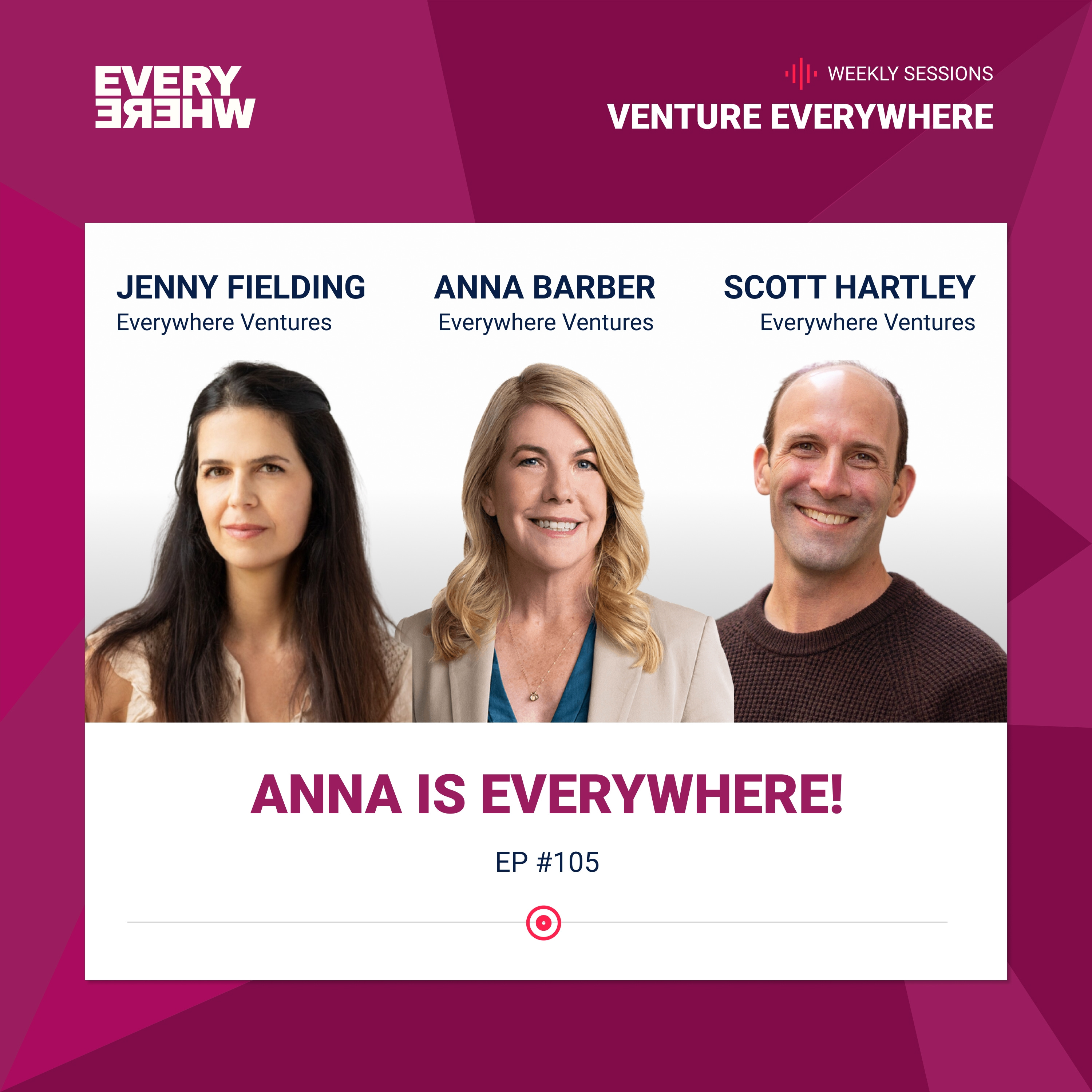
In episode 105 of Venture Everywhere, Jenny Fielding and Scott Hartley, co-founders and general partners at Everywhere Ventures, announce that Anna Barber is joining the firm as a third general partner. Anna brings extensive experience as a founder, former managing director at Techstars LA, and most recently a partner at M13, a multibillion-dollar West Coast fund. Anna shares her journey from the dot-com era at petstore.com through founding Scribble Press to becoming an investor. She explains how Everywhere’s community-driven platform of founders supporting founders is uniquely positioned for the AI era, where shortened learning cycles and human relationships outweigh pure technology infrastructure.
In this episode, you will hear:
Venture’s evolution from dot-com to mobile/cloud to AI-driven startups.
Why insight and relationships matter more than ever.
Shift to founder-led community platforms over traditional venture funds.
Human judgment and personal connections in identifying exceptional founders.
If you liked this episode, please give us a rating wherever you found us. To learn more about our work, visit Everywhere.vc and subscribe to our Founders Everywhere Substack. You can also follow us on YouTube, LinkedIn and Twitter for regular updates and news.
FULL TRANSCRIPT
00:00:04 VO: Everywhere Podcast Network.
00:00:14 Jenny Fielding: Hi, and welcome to the Everywhere podcast. We’re a global community of founders and operators who’ve come together to support the next generation of builders. So the premise of the podcast is just that, founders interviewing other founders about the trials and tribulations of building a company. Hope you enjoy the episode.
00:00:33 Scott: Today is a very special day. We have not only Jenny Fielding and myself, Scott Hartley, on the podcast here with Everywhere Ventures, but we’re really, really excited to make a big announcement, which is that we have a third person joining the team, Anna Barber.
00:00:48 Scott: Anna is somebody we’ve known for many, many years. Anna played a central role in helping scale what was The Fund New York to The Fund Los Angeles and broadening us out of our initial box in New York, helping us scale into the West Coast and Los Angeles.
00:01:05 Scott: Anna has a storied background as a founder. She’s also run Techstars LA and was most recently a partner at M13, which is a multibillion-dollar West Coast fund. Anna, welcome to the podcast. Welcome to the team. Why don’t you tell everybody a little bit more about yourself?
00:01:21 Jenny: Yay. Welcome, Anna.
00:01:24 Anna: Yay. Thanks, Jenny. Thanks, Scott. Thanks for that nice introduction. I could not be more excited to be joining you guys.
00:01:32 Anna: As Scott said, I’ve known Jenny and Scott since before they started Everywhere Ventures. My history with Jenny goes back 10 years when I joined Techstars and she was already a managing director there.
00:01:43 Anna: It’s a really rare opportunity in life to get to work with people with whom you’re so culturally aligned, share the same values, and see the world in the same way. I’m just incredibly excited for this opportunity and what we’re going to be able to do together.
00:02:00 Anna: I’ll talk about my background, but also where we see the world going and what that means for how we’ll be investing.
00:02:05 Jenny: Anna is no stranger to the Everywhere family, though, because we’ve worked with her for many years. She really helped us broaden our vision and our footprint around the world. It’s more of like a homecoming for us.
00:02:17 Jenny: Could not be more excited. And feel that the community that we’ve built is all about supporting founders and them supporting us. This feels very aligned with that mission. Take us back a little bit. Tell us your founder journey and how you went from founder to investor.
00:02:34 Anna: I got into the startup world actually in 1999. I worked at a venture-backed company in 1999, petstore.com. I left McKinsey to join PetStore. That was, of course, dot-com 1.0. There was this giant sucking sound of people leaving McKinsey and banking to go work in San Francisco at startups. I got hooked on startups and ended up staying in startups and early-stage for a long time.
00:03:18 Anna: I had some weird twists and turns. I was a talent manager in Hollywood for six years. I think you know a little of this story because I co-founded the U.S. Air Guitar Championships, which is always my fun fact whenever anyone asks you for a fun fact.
00:03:31 Jenny: Random and so good.
00:03:32 Scott: I think that beats anything that we could come up with.
00:03:34 Jenny: Pretty much.
00:03:35 Anna: I also slept in an igloo for 30 days, so take your pick. But in 2006, I met a woman on an airplane. She became my business partner in the last company I founded, which was Scribble Press, which is a kids’ education company.
00:03:47 Anna: That was a really interesting and fun journey for about six years of building both a retail and a digital platform and then selling the company in a very complicated transaction. I wasn’t planning on becoming an investor, but what I really wanted to do was help CEOs and founders become the best versions of themselves in order to scale their companies.
00:04:06 Anna: I had struggled myself as a CEO a bit with thinking my job was to have all the answers. I was very closed off to outside input that kept me from a lot of learning cycles that would have strengthened the company.
00:04:18 Anna: So figuring out how to engage founders with those high-velocity learning cycles was something I became really passionate about. I was going to do that through executive coaching.
00:04:30 Anna: But I got the opportunity to join Techstars. It seemed like a perfect vehicle for both supporting founders with capital, but also being able to roll up your sleeves and really work with them and for them in those critical early stages to help them build.
00:04:43 Jenny: I remember talking to founders that had gone through your Techstars program and I always remember that line, “Anna believed in me when others didn’t.” Talk a little bit about what it’s like to write that first check and follow that.
00:04:57 Jenny: There’s obviously a lot of disappointment because a lot of the companies that we invest in don’t work out, but there’s a lot of love and deep bonds, which is very special.
00:05:07 Anna: When you join with someone’s mission that early, it does create a really special relationship. I didn’t have a really strong thesis at that time 10 years ago, so I was very focused on quality founders. For me, quality was extreme founder market fit and unreasonable drive and ability to punch through walls.
00:05:27 Anna: One that really stands out to me was when I met Jing Gao, who founded Fly By Jing. She just had this crisp vision for what she wanted to create and how she wanted to transform the identity of Chinese cuisine in America.
00:05:40 Anna: She had an amazing product, but it was really about her vision that really attracted me. To have watched her do that over the past six years has been amazing. But you wouldn’t think of that as being a standard venture investment. But there was something about the combination of that interesting market that she saw really differently and her as just this incredibly gritty founder that really appealed.
00:06:02 Jenny: I actually love that example because I remember clearly when you told me about the company and I had some snarky response like you’re investing in a soy sauce company and you kind of rolled your eyes.
00:06:12 Jenny: But it does speak to your ability to find gems and not just chase what’s obvious. Obviously now that company is hugely successful.
00:06:19 Anna: And then you actually brought me one of my favorite companies in my Techstars program, which was theCut. You introduced me to Obi and Kush, who founded theCut. theCut is an operating platform for barbershops that involves marketing, booking, and billing, all in one platform.
00:06:34 Anna: And they’ve grown that into an amazing business where they own almost 20% of their market segment. But at the time they were really kids coming out of college. But you saw something in them.
00:06:45 Anna: What really is special about that team and what makes them very spiky is their intellectual rigor around their learning. They would run tests and if something wasn’t working, they would cancel it immediately.
00:06:57 Anna: They iterated and learned their way into a great business. So good at it that I had them teach other people how to do that. But you saw the same thing I did. One thing I love is we see the world the same way and we understand how important founders are in this whole equation.
00:07:13 Scott: We’ve all been investing for 10, 15, 20 years, been in tech for 20, 25 years. As venture investors, we have to zag when the world zigs and think about, to your point of Fly By Jing, things that are accretive, that are not getting funded in the market that you see something.
00:07:29 Scott: Not just being contrarian for the sake of being contrarian, but future leading consensus. Believing in something so much that you almost predict where consensus is going to be in one year, two years, five years.
00:07:41 Scott: In your experience over these last 20-something years in tech, what are the consistent points that you’ve seen through the through-line for some of your successful investments?
00:07:51 Anna: I started looking at being part of the venture ecosystem, as you said, in 1999. Since then, we’ve really had three waves. That was the dot-com wave, then we had that mobile cloud wave, and now we’re in the AI wave.
00:08:03 Anna: Through all those periods, some of the things that have remained consistent is, as you said about, not to be contrarian for its own sake, but imagining where consensus will emerge in the future but hasn’t yet, and then investing behind those waves. That remains important, whether we’re in an up cycle or a down cycle.
00:08:21 Anna: The other important thing about that is to continue investing and deploying capital steadily, paying attention to where you think the world is going, and ignoring a bit those up and down wild swings that you see around you in the market.
00:08:35 Anna: There’s a tendency when everything feels really hot to want to invest more, and when everything feels really cold and depressing to want to invest less. The best strategy is to continue investing.
00:08:44 Anna: I do think our world has changed in a structural way in the last five years. A lot of people have written about the consolidation of capital and the fact that the largest venture funds really aren’t venture funds anymore, they’re asset allocators. And that has had a really big effect on the overall market and what we do.
00:09:03 Anna: We think the path forward for a successful, smaller, earlier, high conviction firm is very clear, but judgment matters more. The ability to support your companies matters more. Velocity matters more, the ability to make a quick decision in a low information environment.
00:09:22 Anna: One thing I think is really interesting and exciting is the fact that you guys have built a platform that, to me, perfectly positions us to be able to invest that way.
00:09:32 Jenny: It’s been really fun to watch you at M13. Your role there has changed. You’ve had some incredible investments. Seeing you go from a first check investor to being able to invest in, write some chunky checks.
00:09:44 Jenny: I remember you calling me and being like, I’m putting a $10 million check in. I’m like, oh my goodness. What was that like? How do you see the continuum of venture from early stage through Series A?
00:09:55 Anna: The first time I wrote a big lead check, I was terrified. As an earlier stage investor at Techstars and through angel investing and other platforms, I’d been writing checks, $25, $100, $200K, something like that. The first one I wrote, there was a $6 million lead check. I was breaking out in a cold sweat a bit.
00:10:13 Anna: But getting all those reps out at M13 and sitting in that investment committee for five years with a group of people that had been writing those checks and getting to parse and talk through deals in that setting with them, I built my own confidence in my own taste, my own ability to really understand the story and the why behind writing a big check from 360 degrees and then to be able to confidently go out and lead.
00:10:38 Anna: And then win those deals. It’s not just the deciding. It’s the process of winning the lead when you’re writing that term sheet. There’s a sweet spot of being able to make a real high conviction bet in the form of leading a round.
00:10:52 Anna: But maybe at an earlier stage that I think is really appealing about what we get to do at Everywhere, there’s a nice middle ground here between what I’ve been doing at M13 and what you guys are doing, where I think we’ll be able to play well. We write sometimes 20-page memos. I don’t see doing that, but I think that level of depth of analysis can be valuable.
00:11:16 Scott: It’s cool. I think there’s almost two symbiotic learnings between those many, many experiences that you’ve had from Yale Law School to McKinsey to dot.com boom and bust to Techstars to M13 and now to Everywhere.
00:11:28 Scott: But thinking about just the lessons between Techstars and M13, what Techstars teaches both of you guys is that muscle of rinse, repeat and deploying capital steadily through the ups and downs. There’s always the next cohort no matter what’s happening in the macro environment. It trains that muscle of steady deployment.
00:11:45 Scott: And then the M13, in my limited experience at Mohr Davidow, just thinking about the rock and the tumbler and being in those meetings where you have 8 or 10 smart people poking holes in a business, whether it’s from a technical standpoint, a go to market standpoint, a founder archetype standpoint, a legal standpoint, you’re seeing the world from 8 or 10 viewpoints.
00:12:04 Scott: Even if you’re not vocalizing a rebuttal or you’re nodding yes to a deal, you’re kind of learning all those different hard edges and the rock and the tumbler being in those meetings for five years.
00:12:16 Scott: Seems like you really have a comprehensive set of experiences across being a founder, the steady muscle of Techstars, and then wearing down those edges and coming to your own conviction around writing bigger checks with M13.
00:12:28 Anna: I try to always practice strong opinions loosely held, like I say this to founders and it’s how I try to invest is like you have to have a very strong point of view about a deal.
00:12:38 Anna: One of the most humbling things about being an investor is the lack of feedback. We don’t know if a particular investment decision is going to turn out to pay off for sometimes 7 to 10 years. We have to look for feedback and learning feedback from other places.
00:12:53 Anna: It’s feedback from our peers, feedback from the market. Does it turn out the way we expect in the near term? I’m a learner. I am a sponge. If I’m not learning, I’m not growing. I’m not getting better. I want to get better every day.
00:13:06 Anna: I am never at the point where I feel like I know it all, I know what I’m doing and I’m ready to stop learning. Surrounding myself with people who are deep thinkers, whose opinion I respect, who can help me dig into things is essential to me to doing this job well.
00:13:20 Anna: I’ve had that at M13. It’s been great. I have that with you guys too. I feel we have really rich conversations around deals and where the market’s going that make us all better.
00:13:29 Jenny: Are you saying I’m a deep thinker?
00:13:33 Anna: She’s definitely a spicy thinker.
00:13:34 Jenny: There we go.
00:13:35 Anna: But yeah, you’re also a deep thinker.
00:13:37 Jenny: On that point, aside from the fact that we all have worked together, we love working together, talk about how you see our complementary skills. I’d love to hear it from you how this trio is going to work.
00:13:48 Anna: Oh, yeah. I feel like we’re superheroes. We’re coming together as the Justice League.
00:13:53 Jenny: Are we going to save venture?
00:13:57 Anna: We all need capes and we all have superpowers. But in all seriousness, Jenny, your ability to connect with people and draw people in and speak to an audience in a very authentic way is incredibly powerful. Founders just resonate with you so deeply. That’s not just your brand, that’s who you are. And that’s what makes it so powerful.
00:14:17 Anna: Scott’s just one of the smartest thinkers I know. I was just reading back through a lot of the work that you’ve written over the past few years about the market. It’s not just the great ideas, because I do think you have great ideas and frameworks. It’s the way you communicate them. Storytelling is the absolute most important skill for anyone. You’re absolutely brilliant at that.
00:14:36 Anna: I love to do deals. I was a corporate lawyer. I did outsourced corporate development for a while. I’ve invested in over 100 companies. I’ve really built a muscle of understanding deal dynamics, understanding how to put down a term sheet and win the deal.
00:14:51 Anna: And then I think a lot about portfolio construction and management strategically. I think about myself as a closer, or a strategic financial architect of how to create value. As obviously reductive, we’re all so much more than that. But I do think we have these interesting spikes that together make an amazing team.
00:15:10 Scott: Jenny and I have often said over the last seven or eight years, we really want to build a firm, not a fund. A firm means a full platform suite of offerings to founders at various stages.
00:15:21 Scott: What Jenny and I have been developing over a number of years has been a pre-seed platform where we’ve written 300 pre-seed checks. The opportunity is that those companies have been very successful and gone on to raise about three and a half billion dollars of follow on capital.
00:15:36 Scott: And even with our beloved friends at AngelList, putting up with us running over 100 SPVs, we’ve only been able to deploy about 15 or 20 million dollars into those subsequent opportunities.
00:15:46 Scott: Talking about the platform and Jenny, you could go into how we envision this platform evolving in two directions, both going earlier and partnering with founders at day zero and going a little bit later into the seed stage and how we think about supporting some of the breakout portfolio companies that we’ve invested in.
00:16:03 Anna: I think every VC firm says they have a platform. What you guys have that’s really special is it’s a platform, a network and a community. Choose the word that you want that works because the people in it actually show up for each other.
00:16:17 Anna: I’ve seen that come to life when someone in the Slack community needs an intro to their cloud provider because they’re having a problem with their billing and got an intro immediately to the CEO from someone else that they might not know. But just that has a strong affinity for the Everywhere community that you guys have built.
00:16:36 Anna: In this day and age, capital feels very commoditized. Founders are able to grow their companies more quickly using AI tools and rounds are happening faster. Everything has sped up.
00:16:49 Anna: The differentiator isn’t going to be access to information. AI workflows can do that for you. It’s not going to necessarily be capital. People are the differentiator and the ability to connect you to the right people who’s either been through what you’re going through, has the right introduction, can help you with what your specific problem is.
00:17:06 Anna: I just see that every day. I’ve been part of this community since you guys started it eight years ago and I see it working.
00:17:12 Anna: When we think about the future and what that could look like, there’s a lot of different ways to expand that in service of those founders and that existing portfolio company that you guys have built of 300 amazing companies all around the world.
00:17:27 Jenny: When you meet a special person, you want to be part of that journey as long and for as much as you can. The form and shape that that takes, we’ll see, but ultimately, we want to be supporting founders even earlier. We have in the works planning and building out a residency.
00:17:44 Jenny: And then keep on supporting them as we do with SPVs and all kinds of other side vehicles. Can we build that and make that even stronger is what’s exciting for me.
00:17:55 Anna: Same.
00:17:56 Scott: When you think of the history and evolution of venture, one of the things that Jenny and I talk about a lot is multiple waves of how the model has evolved.
00:18:03 Scott: Wave one in the seventies, eighties, nineties was the very formal GPLP structure. ERISA changing where retirement money could come into alternative assets like venture, changed the fundraising environment in the eighties and nineties.
00:18:16 Scott: Then you saw the advent of what Andreessen built around 2010, bringing to some of your experience, the Hollywood model out of CAA and WME to provide 360 degree support to founders and building these large platforms that were doing marketing and BD and hiring and all sorts of adjacencies to building a business, which is what Ben Horowitz and Mark Andreessen always talked about wanting as founders back in the day.
00:18:40 Scott: And then this evolution of what we tried to kick off in 2017, 2018, which at the time was forward thinking, which was founder driven venture capital, where we could provide commensurate support for founders, but in a much more lean way by having founders as LPs and building a platform of founders supporting founders.
00:18:58 Scott: And what Jenny and I often talk about is for founders, by founders. Looking back over the last 30 or 40 years of venture, it’s been interesting to see those various waves. We’ve been a real participant or maybe even leader in this community-driven approach of for founders, by founders. But what is the future venture fund look like? How do we build it?
00:19:17 Anna: The answer to that partly lies in what venture capital is for. In those early days of venture capital, you needed it because you were building hardware. It took a lot of investment.
00:19:26 Anna: When we first started building software through venture, you needed it because… the first website I built in 1989 at petstore.com, it cost a million dollars to launch an e-commerce website, and it took six months to get it out the door.
00:19:39 Anna: That’s not true anymore. You don’t need venture capital to build a product. You need an afternoon and Claude Code. So what is venture for? That is really the answer about where venture is going.
00:19:50 Anna: Venture is about shortening your learning cycles, giving you access to quicker feedback, helping you unlock expertise. There’s some capital involved, sure, but the capital is not the main thing anymore. Capital on its own is not differentiated.
00:20:06 Anna: That’s where I think venture is going. And this community model of by founders, for founders and operators supporting each other is really the key to unlocking what’s valuable today in an environment where you don’t just need capital to fund a huge engineering team to build a product anymore.
00:20:25 Anna: What you need is insight. You need insight more quickly. You need access to customers more quickly. You need people to help you shorten your learning cycles and reduce your time to market, your time to product-market fit, your time to scale.
00:20:38 Jenny: What the industry does not need is more AI sourcing and using AI to enable better sourcing, selecting, all of that stuff. I see a lot of other funds or GPs talking about that, their stack. To me, that’s a little bit of old news.
00:20:58 Jenny: We didn’t have Claude Code in 2018 when we started, but we’re automating a lot of things and tried to make this the firm of the future from the beginning, whether that was doing things async or using modern tech tools. I don’t think the firm of the future is about technology. I think it does go back to people and relationships.
00:21:15 Anna: I totally agree with you. The technology you guys have already built is pretty impressive. It actually works. It’s giving you great scale. But it’s all in service of you understand who you’re serving, what your mission is, what kind of people you’re interested in investing in, and the technology just supports that. It doesn’t replace it.
00:21:33 Anna: A lot of these talk about… somehow AI is going to be able to find a better investment. I just think at the earliest stages, we all agree as a fundamental principle that the founders are really the most important element. I just don’t think you’re going to be able to find that with AI. That’s about human judgment, relationships and being in the right place at the right time.
00:21:52 Jenny: It’s like your book, Scott. It’s all coming back.
00:21:55 Scott: It’s all coming back. 2017, 2016. I know. On that note, 2026, maybe the year that I try to put pen to paper again. But we’ll see.
00:22:04 Anna: See, that’s it. Scott Hartley, always ahead of the curve with his ideas.
00:22:09 Jenny: All right. We are almost out of time. So Anna, we always ask our guests a few questions. First question, if you could live anywhere for one year, where would it be?
00:22:19 Anna: I would probably move to London at this point. Just need a change. Want a fresh perspective. Love listening to the accents.
00:22:30 Scott: It’s a good reason enough.
00:22:32 Jenny: What keeps you super efficient and moving fast in your work?
00:22:37 Anna: Right now, my ChatGPT co-pilot does a lot of my work for me. The thing that worries me about this, though, I know I’m not supposed to annotate the question, but what happens is we move up our productivity goals when we have these tools. It’s like Scott’s idea of Strong vs. Skinny. I expect more from myself because I have more tools. But I’m doing a lot more with ChatGPT.
00:23:00 Jenny: All right. I’ll answer the last question for you. Where can viewers find you? And I’ll say anna@everywhere.vc.
00:23:08 Anna: Oh, my gosh. It’s my new email. I’m so excited.
00:23:11 Jenny: It’s official.
00:23:13 Anna: Thanks, guys, for literally recording this on the first day of this exciting new chapter. I couldn’t be more thrilled. Thanks.
00:23:19 Scott: We couldn’t be more thrilled as well. Thanks for joining us today on the podcast.
00:23:24 Scott Hartley: Thanks for joining us and hope you enjoyed today’s episode. For those of you listening, you might also be interested to learn more about Everywhere. We’re a first-check pre-seed fund that does exactly that, invests everywhere. We’re a community of 500 founders and operators, and we’ve invested in over 250 companies around the globe. Find us at our website, everywhere.vc, on LinkedIn, and through our regular founder spotlights on Substack. Be sure to subscribe and we’ll catch you on the next episode.
Read more from Anna Barber.