
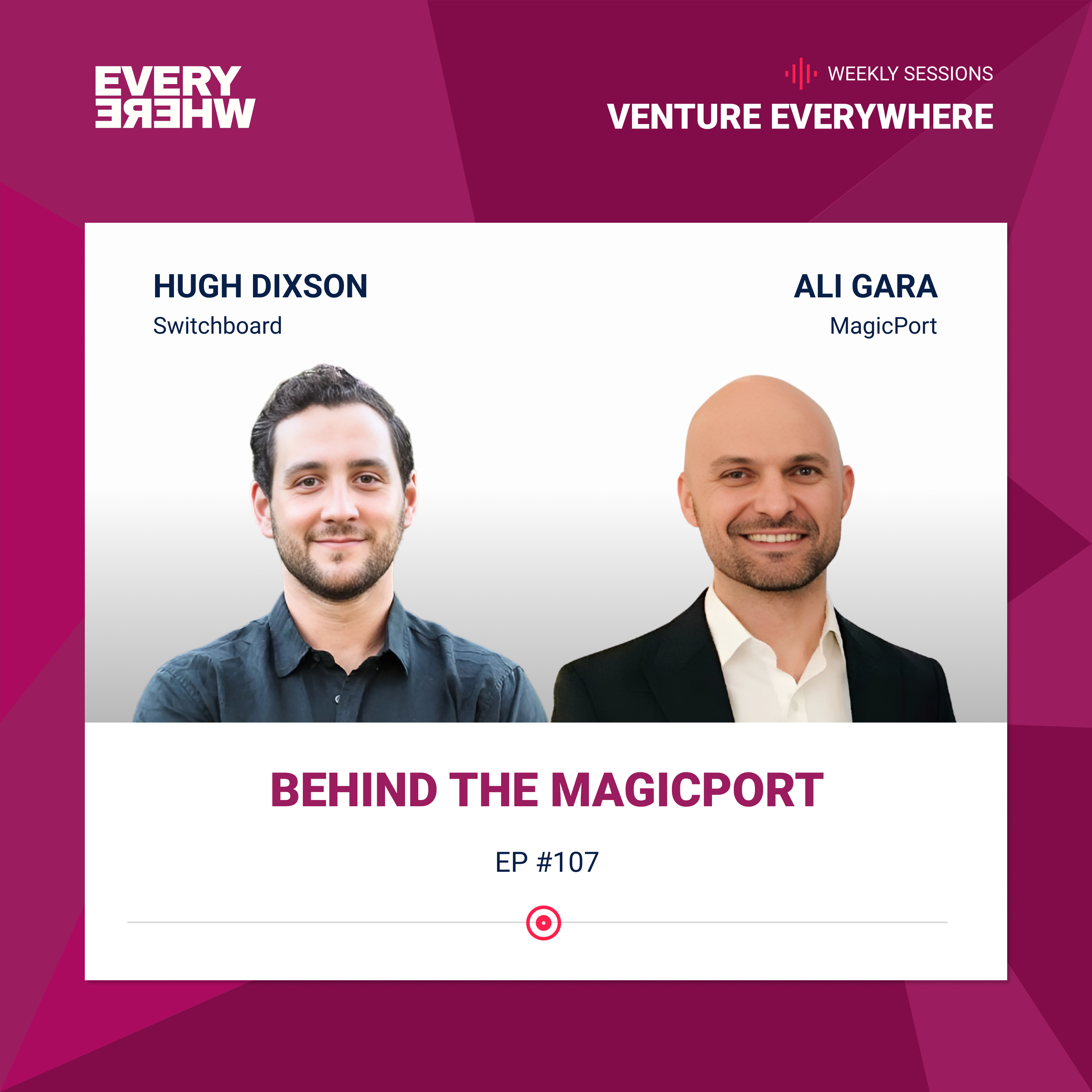
The host of episode 107 of Venture Everywhere is Hugh Dixson, CEO and founder of Switchboard, a platform that integrates enterprise IT systems in supply chains and automates manual processes. He talks with Ali Gara, founder and CEO of MagicPort, a software platform bringing intelligence and automation to shipping operations. Ali shares his journey from private equity in Asia to founding MagicPort in Singapore, where he saw an opportunity to modernize the inefficient, manual processes around port calls. He discusses how MagicPort provides maritime intelligence and an operating system for port call management, helping shipping companies leverage data for business development, optimize operations, and streamline collaboration across the fragmented industry.
In this episode, you will hear:
Replacing Excel and email with an integrated operating system for port calls.
Leveraging AI and automation to deliver immediate customer value.
Aggregating data from sources for real-time vessel and port intelligence.
Driving adoption in a change-resistant, fragmented shipping industry.
Building trusted networks on smart platforms for efficient global trade.
If you liked this episode, please give us a rating wherever you found us. To learn more about our work, visit Everywhere.vc and subscribe to our Founders Everywhere Substack. You can also follow us on YouTube, LinkedIn and Twitter for regular updates and news.
TRANSCRIPT
00:00:04 VO: Everywhere Podcast Network.
00:00:14 Jenny Fielding: Hi, and welcome to the Everywhere podcast. We’re a global community of founders and operators who’ve come together to support the next generation of builders. So the premise of the podcast is just that, founders interviewing other founders about the trials and tribulations of building a company. Hope you enjoy the episode.
00:00:33 Hugh: Welcome to the Venture Everywhere podcast. I’m Hugh Dixson, I’m the founder and CEO of Switchboard. We integrate the various enterprise IT systems in supply chains and order manual handling of supply chain processes.
00:00:46 Hugh: I’m here today with Ali Gara, the founder and CEO of MagicPort. Ali, great to have you on. Do you want to introduce yourself?
00:00:53 Ali: Hi, Hugh. Thanks for the opportunity. Yes, I founded MagicPort. Our focus is on shipping. What we do actually is quite similar to what you are doing in the broader supply chain.
00:01:06 Ali: We are trying to bring more intelligence and automation to shipping operations, specifically port calls. Shipping is a critical infrastructure for global trade, for the global economy.
00:01:17 Ali: There are a lot of manual works, inefficiencies because people don’t have the data or information they need. Most companies, they use different systems or they don’t use any system at all. I thought that this is such a big industry and if we fix some of these problems, it can be so much better, more efficient. This is what we are trying to do.
00:01:37 Hugh: Why don’t we go back to the beginning. Tell me about a bit about your background and how you ended up in shipping specifically and how you found yourself starting MagicPort.
00:01:47 Ali: So actually I have a generalist background. Before shipping, I was in finance, I was in private equity investing. So I started in the United States, but came to Asia because my work was Asia focused. I was in an emerging Asia fund. We were investing in Asian companies.
00:02:04 Ali: After about seven years there, I thought that I could take the risk. I can start something. This was something also shaped by my own experience. Before this, I worked in big companies. I also worked in public service.
00:02:20 Ali: But through that experience, I came to the conclusion that if I really wanted to have the maximum impact, the private sector is the place. This is why I decided to go to business school.
00:02:31 Ali: After the business school, I only had a big amount of debt. I didn’t have any great ideas. So I went to work in finance. It was great because we worked with a lot of inspiring entrepreneurs. That experience actually is quite useful now that I have to work with funding sources, investors.
00:02:50 Ali: But there came a time when I was thinking that, okay, I can now take the risk. I have some savings. I have, I think, good experience. That happened to be when I was in Asia. So I was in Singapore.
00:03:01 Ali: Because of this generalist background, I thought actually trade is an interesting place to go. It’s the foundation of prosperity. You have division of labor, you go do different things, they trade. That’s how we got to where we are today.
00:03:15 Ali: This idea that global trade, it can be better, more efficient, was interesting for me. Singapore is a shipping hub. The whole history of the city is about shipping.
00:03:24 Ali: Somehow I ended up in the very guts of this whole system, which is, we are focusing today mostly on ship operations, like what happens when the ship comes to the port. But that’s a place where we start. There is a lot to do there. But as we build and grow, it’s a big journey. We will be touching more aspects of trade in the future.
00:03:46 Hugh: Interesting. You’re right. Singapore is such a big shipping town. I remember every time I’ve been, whenever you’re staying in one of the hotels or whatever, you can look out the window and all you see is ships on the horizon. So I can fully appreciate how you catch the bug, living in Singapore.
00:04:02 Hugh: Tell us a little more now about the tool itself, so MagicPort. What is the product that you’re producing for your customers? How does it solve the pain points you’re addressing in the shipping industry?
00:04:14 Ali: As you know, shipping is a huge industry. It’s a trillion dollar industry. It’s truly global. There are many aspects of it. You have commercial operations and technical operations.
00:04:25 Ali: I thought there is a lot of waste of time and resources and money when the ship comes to the port, when typically a lot of companies have to work with each other because obviously things happen only when the ship is at the port.
00:04:40 Ali: Actually, they often say that there are maybe 20 plus bilateral transactions between different companies when there is a cargo operation, when the ship is docking and doing something at the port.
00:04:50 Ali: What are these problems? One, you have the element of trust, having a network of companies that you can work with. Then the second one is there are jobs to be done and you need a system to do them. Or if you don’t have a system, you do it on email or Excel.
00:05:03 Ali: But then beyond how you do it yourself, you have to work with your customers, your vendors. There is a lot of collaboration, coordination, transactions between entities. Given that everyone uses different systems, this is not ideal.
00:05:18 Ali: And then the data, everyone can use data in customer support, business development, operations, but it’s very limited what can be done and what’s being done today. There is also opportunity for even financial transactions at some point because these are all global payments and transactions. There’s very limited working capital.
00:05:38 Ali: This is the big problem set, what you can touch in this space. We wanted to start from some fundamental parts of it, which was, can we provide data to people so that they can use it in their business?
00:05:50 Ali: So one pillar we have is we provide maritime intelligence. Companies need information on vessels, ports, different companies. They use this either in business development or operations or customer support. So that’s one of our key products.
00:06:05 Ali: We also provide an operating system for port call management. It means it’s a job management solution that you can create jobs and add your services, manage your communication with your vendors and customers, and also create your invoices and things like that.
00:06:21 Ali: When you have a system like this, you can have access to analytics, KPIs, reports, etc. These are the two core products that we are providing for our customers to make port calls more efficient.
00:06:34 Hugh: It sounds really interesting. Having experience in some similar fields, I’m sure there’s an enormous amount of complexity that sits underneath that process with all those different parties and the different types of transactions that are going on, on your platform.
00:06:51 Hugh: Could you give us a bit of a flavor, a couple of examples maybe of the types of interactions that you’re managing on your platform?
00:06:59 Ali: For sure. I give example actually for each product. Our maritime intelligence solution, we have data about vessels, shipping companies, ports, how all these data relate to each other. For example, someone may want to keep an eye on a particular port, someone wants to keep an eye on a particular fleet, or someone just wants to keep an eye on their own fleet.
00:07:22 Ali: That is a general purpose product, which if you are in shipping, you need industry data. This is a product that you can use. We have customers from all segments of shipping. Where customers use this is either business development, operations or customer support.
00:07:37 Ali: If I were to give an example, if you are keeping an eye on a port, let’s say you provide services in this port, and you want to know all the port calls happening in this port, which are the shipping companies that come here, their contact information, where else are they going. Because if you want to engage with them, it’s easier when you have an understanding of your potential customer.
00:08:00 Ali: A lot of companies use this data and product for business development. It can integrate with your CRM. For example, some of our customers, they just connect their CRM data, which accounts they have, and what vessels these accounts have. They want to keep an eye on these things globally. This is just another example of business development/customer support.
00:08:22 Ali: Or let’s say in some of the large companies, they may be dealing with an account, but they are missing some of the opportunities because they don’t keep an eye on what other vessels that belong to this company actually comes to our port.
00:08:34 Ali: Operations-wise, optimization can mean you are going to service a vessel and you want to know when it’s arriving, is there a delay, you want to get a smart notification. These are the many, many use cases you can get from the first product.
00:08:48 Ali: The second product, which is synergistic with the first one is… let’s say you usually are serving a ship coming to your port. When this ship comes, you will have 20, 30 different line items, different services, which will have orders going to your sub vendors.
00:09:03 Ali: Before you do this, you first send a pro-forma invoice to your customer. Once they approve it, then you create all these services, you assign them to sub vendors. Then once all these things are done, and while they are being done, you have to keep an eye on everything. You need to have that visibility. You need to collect all the documents and create a final invoice and keep tabs on how much they paid, how much they settled and what’s the balance.
00:09:27 Ali: Our software does all these things for our customers. They create a job, they create invoices, they deal with their vendors, their customers, generate their reports. So it’s a complete operating system for job management, for port calls.
00:09:42 Hugh: Thanks for going through that Ali, it sounds really interesting. Sitting here and listening to you describe it, I can think of a couple of conversations that I’ve been in over the last months, year or so, where people have asked me about both those parts, about intelligence on ports and vessels, but also streamlining shipping operations. So I can fully appreciate the pain that you’re solving and the importance and complexity for your clients. So that’s really exciting.
00:10:09 Ali: I have a question for you. I know that what we do, there are some similarities and one of the important services we discovered that we need to have is integrations as well.
00:10:19 Ali: Many companies don’t have solutions, but many others do. When they have it and they want to get your solution, they want a complete end product that will solve their problems. It means you have to integrate many things.
00:10:31 Ali: You are also on this journey. I think in your portfolio, you have automation of workflows, you have integrations. How was your journey? Did you start with integrations and come to workflows or did you start with workflows and then come to integrations? How do you think it will evolve?
00:10:47 Hugh: Integrations are our core product, and that is what we’ve always done. We built a software product that allows us to build and deploy these integrations, which are exactly as you discovered, they can be pretty nuanced and they can be pretty big software tasks to connect these big systems and that have lots of data fields and lots of complexity in them.
00:11:10 Hugh: We started out by focusing on that and building out more generic standard integrations. As we developed as a business, our capabilities grew as we worked with more systems and we started doing more complex and compounded integrations and workflows.
00:11:26 Hugh: Now we offer a full suite of integration service and automation services so we can connect up those systems, exactly like you’re describing, to provide the plumbing or the pipes between those systems that we came to maintain.
00:11:39 Hugh: We can manage any type of data and send it to any system. Also, whether that data comes through a system integration, we can also ingest it through PDFs and emails and various other things too. That’s how we came into it and that’s the space that we play in. So similar, I suppose, but we’re a part of your broader journey.
00:11:58 Hugh: Ali, prior to doing Switchboard in the integrations business, I ran a road, freight and transport company in Australia. And so I know a little bit about this industry and it’s a tough one to drive change in. What have you found about the maritime shipping industry as you’ve been launching and running your product over the time? What are some of the challenges you’ve faced in the industry?
00:12:19 Ali: Definitely it’s not an easy industry from the point of view, “I’m going to build and sell software or data.” It is very fragmented industry. The bigger companies, they have their solutions. Smaller companies, your competition is most likely Excel and email. But it’s very hard to change people or convince them that they need something.
00:12:38 Ali: It is going to change. We are in the middle of this big revolution, what’s happening with AI and automation and intelligence, what can be done. There are more opportunities for doing things faster, delivering value. Things are going to change, but it’s going to be a long journey. I don’t expect that it’s going to be very fast.
00:12:57 Ali: The key, I think is, can we give people value fast so that they feel the potential and they want to use the software. I have definitely felt the difficulty, especially operating system, giving people operating system and convincing them to change things. I think it’s very difficult.
00:13:18 Ali: How we are thinking to solve this, within our own team is, how can we add more intelligence and automation into our products? How can we speed up our development so that we can provide customers more immediate value? That can be our hook. If they see something that makes a big difference for them in their life, that can be the starting point.
00:13:41 Hugh: I think it makes a lot of sense. So tell me about this vision. You talk about the future and the industry is very manual and very email and Excel heavy at the moment, which I 100% agree with. That’s definitely true across the broader supply chain industry, across all modes.
00:13:56 Hugh: And so tell me, what does it look like for you? When you connect the carriers, the ship owners, the terminals, service providers, what does this smart and efficient shipping actually look like in practice?
00:14:08 Ali: I have a vision which makes sense to me and I think it is how things should be. But we have to figure out how we can get there. A big long journey, how can we get to this place? We have to be open-minded and learn on the way.
00:14:22 Ali: How I envision the industry being more efficient is that first of all, there is more trust, which means you have a network of trusted, reliable companies. They are working on, ideally, a smart platform or smart software that in itself has a lot of intelligence and automation, but since people use the same thing, it works as one platform.
00:14:45 Ali: So you don’t have to send a lot of emails and things like that. People have access to the data so that they can use it in their operations to improve their business. Potentially in all businesses like this, you usually have the key financial services that people need for their business on the platform.
00:15:03 Ali: So this is how I envision how MagicPort can become a very big business. But you start from zero and towards that destination, you have to solve many problems and figure out what’s the right sequence of things.
00:15:17 Ali: I don’t think there’s any fast route. We are just trying things that make sense. Some of them, they work. Some of them, they don’t. It’s an experiment. It’s okay. We move to the next one, these small steps toward that vision.
00:15:31 Ali: But you also have to be very mindful that as a startup, you have a very limited bandwidth and capacity. You have to be super focused. So we take it very serious and we cannot jump on different things randomly. That’s why I say you have to be at peace that it’s a long journey. Today, people typically don’t have patience.
00:15:51 Hugh: Very true. But it certainly is a long journey and full of ups and downs. That’s for sure. I want to talk for a few minutes about their intelligence because I find it really interesting. Start at the beginning. For the listeners, the intelligence, how is it used by customers?
00:16:07 Ali: Just like I was describing, I see three use cases among our customers: business development, optimizing your operations or customer service. Customers are using this data on vessels, ports, shipping companies to reach up to new potential customers, new accounts. When they do the reach outs, they want to make it smarter so that they can show to their customer that they understand what they are doing.
00:16:30 Ali: For optimization, there are a lot of use cases. So like your vessel is coming to the port. To start with, you want to know the ETA, to get updates if there’s a delay, to be able to plan your operations, whatever you need to know from this perspective.
00:16:44 Ali: You can go into even more advanced cases where if I’m running a few tugboats, how do I position them? How do I optimize them? So that’s the optimization and operations area.
00:16:54 Ali: And then the last one, customer support. If you connect your CRM data with your asset data, which is like I have these accounts and I know what vessels these accounts are on and where they go, when they are coming to my port, and how do I make sure that I never miss them. I get certain reports from the system. These are a few use cases of how intelligence can be used for business development, improving operations or customer support.
00:17:20 Hugh: Well, how do you maintain this information? How does it stay current? That’s a lot of data. Where does it come from? And how does the background of it work?
00:17:29 Ali: We have invested a lot into this capability. So we have a team that’s in charge of MagicPort’s maritime intelligence product. Today, we get data from 100 plus different sources. It comes from public databases. It comes from private data sources that we buy and have a process to establish a source of truth at any given time, like what are the vessels in the world at this moment?
00:17:57 Ali: It’s not easy. There are a lot of hairy issues here and there. I would say we are constantly improving. Right now we are in the middle of a major internal initiative where we are trying to improve this whole process so that the data quality increases. It’s a long iterative journey. You have to just work on it, keep investing and build that capability internally.
00:18:19 Hugh: Wow. It’s even more complex than I had imagined. That sounds very significant. Must have taken a long time to build that capability even to where it is today.
00:18:29 Ali: We have been working on this more than three years now. It’s definitely three plus years of work. The experience, we accumulate because you keep learning.
00:18:39 Hugh: Thinking about your founder journey and what you’ve experienced over the years, how have you seen yourself change and grow over the time you’ve been running MagicPort? What have been some of your own personal lessons?
00:18:55 Ali: Building something from zero, it’s just so difficult and hard. It’s exciting. But when I look back, it was so hard. It never crossed my mind that, oh, I want to give up or I would give up or that it’s not going to work.
00:19:10 Ali: Maybe that’s why you’re also a founder. Maybe that’s something that we have. I don’t know if it’s a good thing or a bad thing, but its those type of people that take such risks.
00:19:20 Ali: When I look back, it’s like drinking from a firehose. So many things you have to do and we don’t have a lot of resources so everything you have to figure out. You have to figure out how to put together a team that can develop a digital product, which people ignore it.
00:19:35 Ali: In a startup, they don’t talk about product development cycle or how exactly this thing is going to work, because it’s technical, not interesting details. But you have to get it right. You have to have the right people, the right process. And then you have to figure out how to sell. You have to figure out how we are going to hire the right people, deal with investors or find resources.
00:19:55 Ali: It’s interesting that we have to learn all these things. But you make mistakes and it’s painful because you waste time, you waste money. It’s people’s trust that they gave us to build something.
00:20:05 Ali: It is very painful. I am hoping that through all this experience, now I have a little bit better judgment. I can make better decisions, but it’s a constant work. I try to work on it every day. Like how can I build it better today? It is a lot of painful work, but it’s fun.
00:20:23 Hugh: It is hard. I completely agree. I know exactly what you mean. I’m sure startups in all industries are difficult, but I can definitely say that the ones in supply chain have a lot of challenges to overcome. That’s for sure. So I’m very sympathetic.
00:20:40 Hugh: Ali, it’s been really nice talking to you today. I think this is such an interesting solution and I can really personally clearly see the need for it and the benefit for both the products. I’m really impressed by the depth you had to go to, to build that intelligence product. That’s amazing.
00:20:56 Hugh: We have a speed round, so I’m going to whip through four questions very quickly. What’s a book and newsletter or podcast that you recommend?
00:21:05 Ali: I walk every morning and listen to podcasts. I think they’re a great resource. If I were to pick one, I think Lenny’s Podcast is great. It’s about product management and product development. I really like it.
00:21:17 Ali: On books, there are so many great books, but the two recent ones that I’ve read, I recommend. One is A Little History of the World by Gombrich. And then the second one, Silk Roads by Frankopan. It’s just the whole world history. They just try to summarize it in one book.
00:21:35 Ali: But what stands out in both books is how all the humans and human history, societies are all connected. It was really eye-opening for me, just to remember that, how ideas and civilization itself has formed through interactions between all of us.
00:21:53 Hugh: Okay, what is your favorite productivity hack?
00:21:56 Ali: Now, I think especially important at this stage in our company to be really productive. I am trying to focus on my habits, and it comes down to simple things. What time do you need to sleep? When do you wake up? When do you sit down to start working? Taking breaks and trying to meditate a little bit. Just healthy things. Or don’t always check your emails. Just check it only regular times.
00:22:20 Ali: I know we all know these things, but I guess what I’m trying to do differently is just focus on the habit angle that, okay, I just need to try to make these habits, and around that structure, I can be more productive. So this is one big goal I have set for myself this year. Let’s see how it goes.
00:22:40 Hugh: I like it a lot. I’m definitely guilty of being in my inbox too often, so definitely something for me to learn there as well. Where can listeners find you, Ali?
00:22:51 Ali: I’m posting on LinkedIn. In terms of social media, that’s the only place where I regularly post. If you search Ali Gara, MagicPort, I’m sure you will find me.
00:23:03 Hugh: I’m Hugh Dixson, also on LinkedIn. Hugh Dixson, Switchboard. You can find me. Perfect. Thank you very much, Ali. It’s been really nice talking with you today.
00:23:13 Ali: Yeah, Hugh. Thanks so much.
00:23:16 Scott Hartley: Thanks for joining us and hope you enjoyed today’s episode. For those of you listening, you might also be interested to learn more about Everywhere. We’re a first-check pre-seed fund that does exactly that, invests everywhere. We’re a community of 500 founders and operators, and we’ve invested in over 250 companies around the globe. Find us at our website everywhere.vc, on LinkedIn, and through our regular founder spotlights on Substack. Be sure to subscribe and we’ll catch you on the next episode.
Read more from Ali Gara in Founders Everywhere.
Read more from Hugh Dixson in Founders Everywhere.