The holidays are officially upon us and leftovers aren’t the only thing we will be overindulging in this weekend. That’s right, it’s Black Friday, which rolls into Cyber Monday, which is part of Cyber Week, which, at this point, might as well be Cyber Season, or Cyber Eternity. It’s not just surviving the food coma, it’s surviving the annual promo onslaught in our inboxes. And while the thrill of deals is hard to resist, there’s one thing we should be thinking about while we click “Buy Now”: staying safe in the digital chaos.
Cybersecurity has become the backbone of our digital lives. Yet, for too long, security has been treated as a series of patches and walls, static defenses in a world of dynamic, ever-evolving threats. As new technologies emerge every day, new risks arise, demanding proactive strategies that connect the pieces rather than remedy them one by one. The reality is that security isn’t a single layer or a one-time fix, it’s a moving target. At Everywhere Ventures, we are backing founders who are building a new, more integrated future for security.
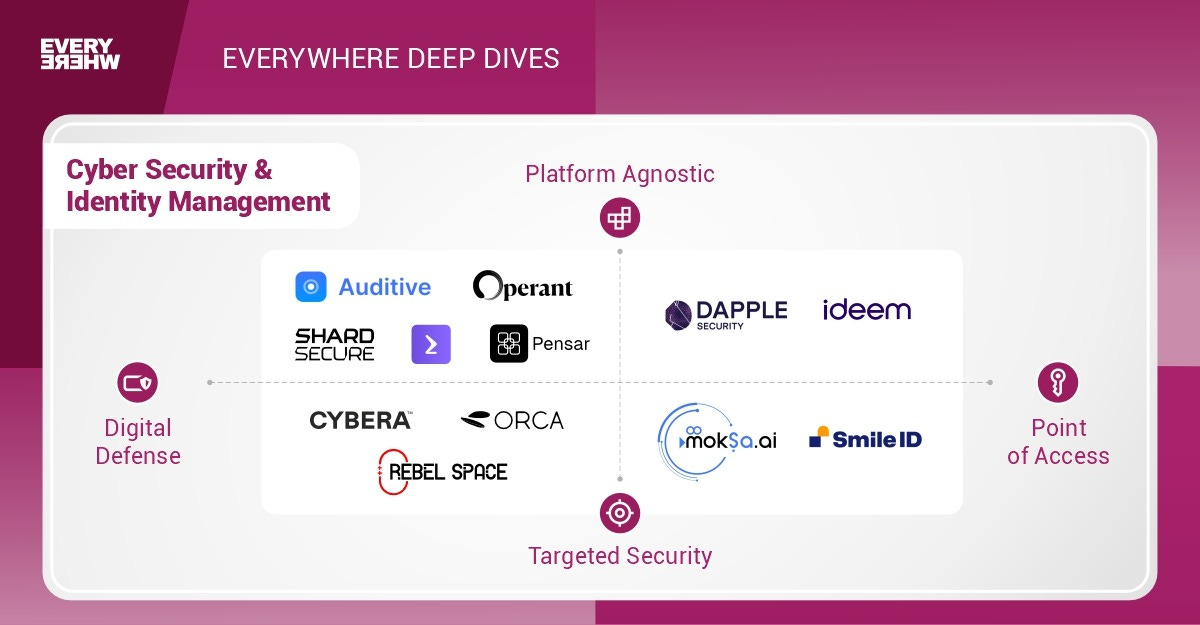
We believe the future of cybersecurity will be shaped by the seamless integration of its many parts. We are backing founders architecting the platforms and defenses to repair fractures in the system and strengthen digital trust:
Platform Agnostic <> Point of Access: Pairing universal foundations with secure, seamless authentication at the entry point.
Point of Access <> Targeted Security: Combining entry-point protections with tailored defenses for high-risk industries and geographies.
Targeted Security <> Digital Defense: Fusing industry-specific safeguards with adaptive, software-driven tools that detect and neutralize evolving threats.
Digital Defense <> Platform Agnostic: Harnessing intelligent software to fortify broad, cross-industry platforms that serve as the foundation of cybersecurity.
1. Platform Agnostic <> Point of Access: Universal Foundations, Stronger Entry Points
The front door, where users and systems prove their identity, remains the most exploited part of the digital world. We back companies that are making this universal entry point both fundamentally secure and seamless to use, because the strongest security is the one that actually gets used.
Privacy-First Access: Dapple Security is rethinking authentication with a platform built on advanced biometrics that puts privacy at the center, ensuring access protects both identity and individual rights.
Zero-Trust Authentication: Ideem’s Zero-Trust Security Module delivers seamless two-factor authentication by binding passkeys directly to a user’s device. It works across browsers and devices, giving quantum-safe protection without the hassle of one-time codes.
By strengthening access at its foundation, these companies are making identity verification more secure across the digital ecosystem.
2. Point of Access <> Targeted Security: Protecting the Point of Access in High-Risk Environments
Access isn’t just an entry point, it’s the frontline. For high-risk industries and geographies, strong authentication isn’t enough; defenses need to be precise, adaptive, and built for context. We’re investing in companies that make access both seamless and secure, while tailoring protection to the markets and environments where defenses are still emerging.
Intelligent Surveillance: Physical spaces can be just as vulnerable as digital ones. Moksa.AI brings AI-powered video analytics to existing cameras, spotting suspicious behavior in real time and delivering actionable insights from loss prevention to employee safety.
Securing Identity: High rates of identity fraud don’t just drain resources, they erode trust. Smile ID closes this gap with real-time verification and KYC compliance, giving businesses across Africa a secure way to confirm identities and protect the people they serve.
These companies are redefining access for industries and regions exposed to risk and are setting a new standard for trust at the front door.
3. Targeted Security <> Digital Defense: Scaling Protection for Tailored Threats
Some threats are universal, but others cut deep into specific industries. From fraud in financial networks to vulnerabilities in space operations, these gaps demand defenses that are both tailored and adaptive. We are backing platforms that combine contextual expertise with software-driven intelligence to protect at scale.
Adaptive Fraud Defense: Fraud in emerging markets often outpaces regulation and overwhelms traditional tools. Orca Fraud provides Africa’s first fraud orchestration platform, giving businesses no-code, AI-powered tools to prevent and mitigate fraud. Cybera provides a scam reporting and recovery platform that weaves in advanced AML intelligence, helping organizations not just spot fraud but respond effectively by tracing transactions and recovering stolen assets across both crypto and fiat.
Mission-Critical Cybersecurity: Rebel Space Technologies provides an AI-powered platform for comprehensive space system security, built to safeguard mission operations through continuous monitoring and rapid, adaptive response.
These companies exhibit how software-driven defenses can be tailored to the unique demands of targeted industries and locations.
4. Digital Defense <> Platform Agnostic: Smarter Tools, Stronger Foundations
Platforms are only as strong as the software intelligence that powers them. By weaving adaptive safeguards into the core layers of infrastructure and data, these companies are fortifying cybersecurity without adding complexity.
Cloud-Native Defense at Scale: As applications move faster into the cloud, protection has to move with them. Operant AI embeds protection directly into infrastructure, APIs, and Kubernetes environments, while Pensar AI secures codebases by automatically detecting and patching vulnerabilities, especially those introduced by AI-generated code.
Resilient Data & Vendor Trust: Shard Secure’s Microshard technology breaks data into fragments and distributes them so no single piece is usable on its own, ensuring privacy and resilience across hybrid and multi-cloud systems. Auditive complements this by automating third-party security reviews so organizations can trust vendors without slowing down business.
Securing the AI Layer: Ciphero is an AI Verification Layer that allows enterprises to control and verify all AI interactions within the workspace. By monitoring and managing both internal and third-party models, it ensures compliance with company policies, prevents loss of proprietary or confidential data, and keeps sensitive information securely within the organization.
By strengthening both the systems at the core and the networks surrounding them, these companies are shaping how universal security is built into different industries.
The last decade has made clear that static defenses can’t keep pace with adversaries who move faster and strike smarter. Security today is not a single checkpoint but a living framework, stretching across access, industries, data, and platforms, and reshaping itself as the threat landscape shifts. By backing companies at these critical intersections, we aim to support the foundations of a more resilient and trustworthy digital ecosystem.
We’ll be sharing more insights soon. In the meantime, if you’re a founder working in this space, we’d love to hear from you. You can find our complete cyber security portfolio here.