Welcome to Founders Everywhere, where we highlight the incredible people behind the companies we’ve backed at Everywhere Ventures, a global pre-seed fund supported by a community of 500 founders and operators.
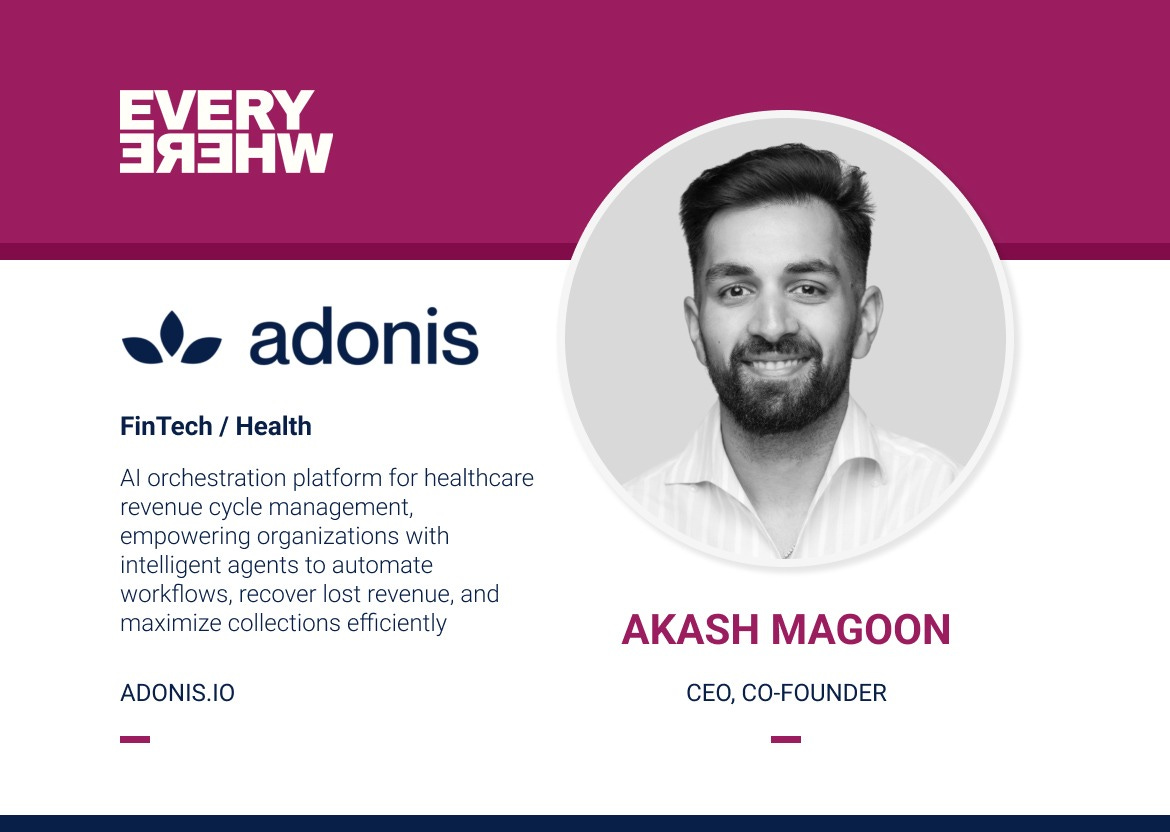
People assume hospitals bring in big money because healthcare is expensive, but the reality is very different. The average health system in the U.S operates on margins as low as 0.5% to 2%, and many are even in the red. Instead of generating steady profits, many providers are effectively living on 30-day cash cycles, relying on timely reimbursements just to stay afloat. The biggest lever they have is how efficiently they collect revenue from insurance companies. Recognizing this, Adonis set out to modernize one of healthcare’s most overlooked systems. They are building an AI-powered platform that automates the full revenue cycle, from claim submission to denials and appeals, helping providers increase collections, reduce administrative overhead, and get paid faster. Adonis recently raised a $40 million Series C to expand further into large health systems, invest in product development, and to hire and grow its New York–based team.
Co-founder and CEO Akash Magoon started Adonis with his brother, Aman Magoon, CPO, building on a partnership that began with their first company, an employee benefits software that acted as a turbo-tax like experience for choosing benefits during open enrollment. While working closely with insurers at that company, the two gained an inside look at how claims are evaluated (and often denied), giving them a rare understanding of the system from the payer side. After exiting the company, they saw an opportunity to flip that insight on its head and build for providers instead. With a background in computer science and experience as a software and machine learning engineer, Akash brings a technical and product-driven approach to a deeply operational problem. The brothers are now focused on transforming one of healthcare’s most complex financial systems into something far more automated, predictable, and efficient.
What inspired you to build Adonis?
My brother and I grew up in an entrepreneurial Indian‑American household where being a doctor was always the highest calling. We realized that practicing healthcare itself wasn’t what excited us, but building for healthcare did. We realized we could still make a significant impact on the lives of so many patients by building at the intersection of healthcare and software. That’s the part we fell in love with and motivates us to build everyday.
What’s Adonis’ North Star?
Our goal is to minimize friction around revenue so hospitals can reinvest those proceeds back into improving patient care. Five to seven years from now, we want the revenue cycle for a provider group to be as automated as it is for a local coffee shop, where you swipe a credit card and get paid consistently. The practical version of that is moving from a world where every claim is touched by a human to an exceptions‑driven revenue cycle, where maybe 1 out of 100 claims (the gnarliest and hairiest ones) gets human attention.
Tell us about a recent milestone that Adonis crushed.
We recently closed our $40 million Series C, with a strong mix of existing investors, like General Catalyst, Bling Capital, and Max Ventures, plus new investors like Quadrille Capital, who led our round with the largest check. It’s a great combination of long‑term believers and new growth‑stage partners as we hit this next inflection point. 2025 was a breakout year, with strong product‑market fit, several major health‑system wins, and more than 4x revenue growth, which set the stage for this round.
What I’m personally proud of is that we’ve done this while building a New York–based, in‑person culture. We opened our office in 3 World Trade Center in month one and have been very intentional about making Adonis one of the most challenging but rewarding places our team will work. We recently put together a video to show what it’s like to work at Adonis, check it out here! We have 80+ employees today and are hiring; you can see open roles on our careers page.
What makes Adonis a “must‑have” vs a “nice-to-have”?
I like to answer that by asking: what happens if a customer wakes up tomorrow without Adonis? If that happened, they’d probably collect 10–15% less cash that month and have to staff up their revenue cycle team by 30–35%. That combination would likely create a pretty hard cash crunch within the quarter. That’s the must‑have story for us, if you pull us out of the system, the financial and operational hit is immediate and painful.
How does Adonis inspire “customer love”?
We’ve built an AI platform that studies all the claims, learns how insurance companies are denying claims for specific reasons, and then uses AI agents to automate the entire loop: submission, denials, and appeals. At a high level, we focus on improving three core KPIs for our customers: net collection rates, headcount costs, and speed to payment.
Net collection rates – most hospitals collect about 90% of what they’re owed; we’re trying to get them into the upper 90s.
Headcount costs – revenue cycle teams are a big chunk of the workforce and there’s a lot of administrative bloat; we focus on reducing that overhead.
Speed to payment – today it often takes 60–65 days for a provider to get paid after a visit; we’re working to cut that in half.
Fun fact:
I stay closely connected to my alma mater, the University of Maryland, by actively giving back. I founded a scholarship, serve on multiple university boards, and mentor students, helping the next generation of Terps break into tech and startups.
Listen to Elliot Katz with Scott Hartley, on the Venture Everywhere podcast: In the mixus. Now on Apple & Spotify. Check out to all our past episodes here!